$500 vs $50 Cashmere Wool Jumper: The Brutally Honest Truth
This Cashmere Wool Jumper Men’s $500. This one costs fifty. That’s a ten times price difference. For centuries, cashmere has earned its reputation as a pinnacle of luxury knitwear, famous for its incredible softness, warmth, and timeless style. Luxury brands will tell you their quality is an investment, something that gets better with age and can last a lifetime, making a $500 price tag feel like a wise move. But at the same time, budget brands have flooded the market, promising a “100% Mongolian Cashmere” experience for a tiny fraction of the price.
So what are you actually paying for with a cashmere wool jumper men’s style at this price gap? Is it a genuinely better sweater, or is it just a brand name, a fancy label, and a whole lot of marketing? It’s one of the biggest questions in fashion: is it worth it?
Both jumpers went through a series of side-by-side tests for durability, style, and feel to get to the brutally honest truth of what your money really buys. By the end of this, you’ll know exactly where your hard-earned cash should go.
Meet the Contenders
In the luxury corner, there’s the “Heritage Crew” from a fictional brand, let’s call it “Aethelred of Milan.” It costs a cool $495. The marketing is what you’d expect: it’s crafted in Italy from “100% Grade-A, 2-ply Mongolian Cashmere,” promising unmatched softness and a shape that will hold for a decade. The whole brand story is about heritage, craftsmanship, and the idea that this isn’t just a sweater; it’s an heirloom.
In the budget corner, there’s the “Everyday Crew” from a fictional brand, “Foreland Basics.” This one is just $50. The claims are surprisingly bold and sound very similar: “100% Pure Cashmere” at a revolutionary price, supposedly by cutting out the middleman. Brands like this have totally shaken up the market, but the big question is whether they cut costs or cut corners.
Before the tests, let’s decode a few luxury cashmere terms. Grade A cashmere uses exceptionally fine fibers—typically 14 to 15.5 microns—making the fabric softer, stronger, and more resistant to pilling. Two-ply simply means two strands of yarn are twisted together, creating a denser, more durable knit that holds its shape better over time. This makes the knit denser and more durable, so it holds its shape better and is less likely to develop holes. Cheaper sweaters often use single-ply yarn, which can be less resilient. As Britannica notes in its overview of cashmere, the fiber comes specifically from the downy undercoat of the Kashmir goat, and its price has always been shaped by how labor-intensive it is to harvest and separate that fine undercoat from the coarser guard hair. And these details are going to matter a lot in just a minute.
Round 1: The Fit and Feel Test
Now for round one: the immediate, out-of-the-box first impression. This is where the luxury “experience” is supposed to kick in.
Pulling on the $500 Aethelred Cashmere Wool Jumper Men’s style, the feeling is undeniable. It’s substantial. It has a reassuring weight and density. The softness is complex—not just fluffy, but smooth and buttery against the skin, with zero itchiness. Looking at the fit, it’s precise. The shoulders sit perfectly, the drape is elegant, and it hangs without clinging. The ribbed cuffs and hem are tight and springy. The seams are incredibly neat. You can see the craftsmanship. It feels expensive. Period.
Now for the $50 Foreland Basics jumper. The very first thing that stands out is the weight, since it’s significantly lighter, almost airy. The softness is there, but it’s different. It feels more superficial, a bit too fluffy, which can sometimes be a trick used to create a soft first impression with shorter, weaker fibers. The fit is fine. It’s a standard crew neck shape, but it doesn’t have that same tailored drape. It’s a bit boxier, and the cuffs and hem feel looser, less secure. Looking closely at the knit, it’s clearly less dense. Held up to the light, it’s almost see-through in spots.
A quick resilience test tells the same story. Taking a section of the $500 jumper and gently stretching it, it snaps right back into shape. Instant recovery. Doing the same with the $50 jumper, it’s slower. It doesn’t quite bounce back with the same urgency, and it feels like it wouldn’t take much to stretch this out of shape for good.
So after round one, the luxury jumper definitely feels more premium. The fit is superior, and the fabric has a density and resilience the budget one just can’t match. But is that initial feeling worth an extra $450? The real test, the one that separates an investment from a disposable piece of fashion, is durability.
Round 2: The Durability Gauntlet
This is where the marketing gets separated from the reality. A great cashmere sweater should feel good on day one, but it has to feel good after many wears and washes. This is the most important test, so both jumpers got washed and checked for the enemy of all sweaters: pilling.
First, the wash test, following the care labels to the letter. The $500 Aethelred says “Hand Wash Cold, Lay Flat to Dry.” That’s exactly what happened, using a gentle cashmere shampoo. It’s a delicate process. After a soak, it got rolled in a towel and laid flat to dry, carefully reshaped along the way.
The $50 Foreland Basics jumper, surprisingly, says “Machine Washable, Delicate Cycle.” This is a common selling point for budget cashmere. It went in inside out, in a mesh bag, on the coldest, most gentle wool cycle. Then it also got laid flat to dry.
Now for the moment of truth. The $500 jumper looks exactly the same. The shape is identical, the color is just as rich, and if anything, the fibers have “bloomed” a bit, making it feel even softer. It held its structure perfectly. This is what you pay for.
The $50 jumper, however, shows immediate signs of stress. It hasn’t shrunk dramatically, but it has lost some structure. The body seems a little tighter, while the arms feel a bit longer, a sign of uneven tension in the knit. It looks a little sad. The fabric also feels a bit rougher, as if the wash stripped away that initial superficial softness.
But the biggest difference is the pilling. Pilling happens when short fabric fibers twist into little balls, usually in high-friction areas. All cashmere can pill, but lower-quality cashmere made from shorter fibers pills much more aggressively.
After just one wash and a day of simulated wear, the difference is shocking. On the $500 jumper, you have to hunt to find any pills at all. There are a few tiny ones under the arm, but that’s it.
On the $50 jumper, it’s a totally different story. The entire underside of the arms and the sides are covered in noticeable pills. It’s not just a few; it’s a fuzzy mess that instantly makes the jumper look old and worn. To show the maintenance required, a cashmere comb reveals the difference clearly. On the luxury jumper, a few gentle strokes and the pills are gone. On the budget jumper, combing takes a while, and a lot of fiber comes off with it. This tells you that with every wear, you’ll be removing material, and the sweater will literally get thinner over time.
The Final Verdict and Recommendation
So, what’s the final verdict?
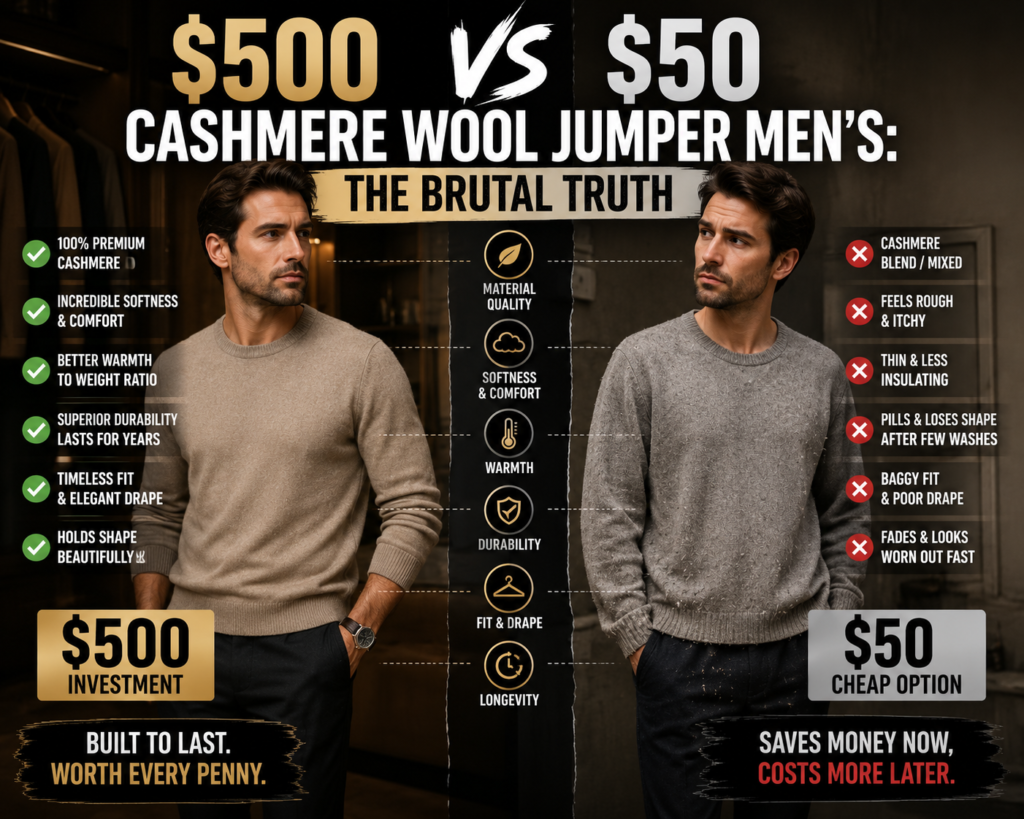
When comparing a Cashmere Wool Jumper Men’s style at different price points, the premium option clearly stood out. The $500 jumper offered a better fit, a denser knit, and barely pilled after washing, while the $50 version quickly lost its shape and developed heavy pilling.
Is the $500 jumper better? Absolutely. Is it worth ten times the price? Not for everyone. The $50 jumper delivers much of the same look and initial softness, but the premium cashmere justifies its price with superior fit, durability, and long-lasting quality.
Now for the most important metric: cost-per-wear. It’s simple math, since the price of the item gets divided by how many times you wear it. A quality cashmere sweater, if cared for properly, can last for over a decade. Say you wear the $500 jumper 20 times a year for 10 years. That’s 200 wears. The cost-per-wear is just $2.50.
Now, the $50 jumper, based on how it pilled after a single wash, will likely look worn out after just one season. If you wear it 20 times before it looks too shabby, its cost-per-wear is also $2.50. The difference is, in year two, you might have to buy another one. And another the year after that. In the long run, the “cheaper” option could end up costing you more.
So this brings us to the final recommendation: who is each jumper for?
The $500 jumper is for someone building a long-term wardrobe. If you believe in “buy less, buy better” and want a core piece that will perform flawlessly for a decade or more, this is a worthy investment. Your cost-per-wear will eventually be incredibly low, and you get the satisfaction of owning something truly well-made. This kind of foundational, quality-first thinking is the same logic that applies across a well-built men’s wardrobe, whether it’s a cashmere sweater under a tailored blazer or any other core piece meant to last for years.
The $50 jumper is for someone who’s cashmere-curious but not ready for a major financial commitment. Maybe you want to try the style, or you just want that cozy cashmere feel for a season without the guilt. For that, it’s an excellent choice. It gives you a touch of luxury, but you have to accept that it has a limited lifespan.
Longevity or Accessibility
Ultimately, the choice comes down to your priorities: longevity or accessibility. There’s no single right answer, but now you know exactly what you get, and what you give up, at each price point.
FAQ Section
1. Is an expensive cashmere wool jumper men’s style actually worth the price?
Yes, if you plan to wear it for years. A quality $500 jumper holds its shape, resists pilling, and can last a decade or more, which brings the cost-per-wear down dramatically over time compared to a budget option that wears out after one season.
2. What does “Grade A” mean on a cashmere sweater label?
Grade A refers to fiber thickness. True Grade A cashmere fibers measure between 14 and 15.5 microns in diameter, which is much finer than average wool. These fine, long fibers create a softer yarn that resists pilling better than lower grades.
3. What’s the difference between single-ply and two-ply cashmere?
Two-ply cashmere twists two threads of yarn together, creating a denser, more durable knit that holds its shape and resists holes. Single-ply yarn, common in cheaper sweaters, is thinner and less resilient over time.
4. Why does cheap cashmere pill more than expensive cashmere?
Pilling happens when short fibers twist into little balls, usually in high-friction areas like underarms. Budget cashmere often uses shorter, weaker fibers that pill aggressively, while higher-quality long fibers resist this much better.
5. How should I wash a cashmere wool jumper men’s style to make it last?
Hand wash in cold water with a gentle cashmere shampoo, then lay flat to dry while reshaping it. Machine washing, even on a delicate cycle, tends to stress the knit more and can cause uneven stretching over time.
6. Is a budget cashmere sweater a bad purchase?
Not necessarily. A budget cashmere jumper can be a good choice if you want to try the style without a big commitment, but expect a shorter lifespan, more pilling, and less structure than a higher-quality piece.