Veil Lengths: The Complete Guide to Matching Your Dress Without the Mistakes
Veil lengths can make all the difference in completing your bridal look. You’ve done it. After months of dreaming, scrolling, and shopping, you finally found the dress. The one that makes you feel incredible. But what if one small accessory could unintentionally sabotage that whole perfect look?
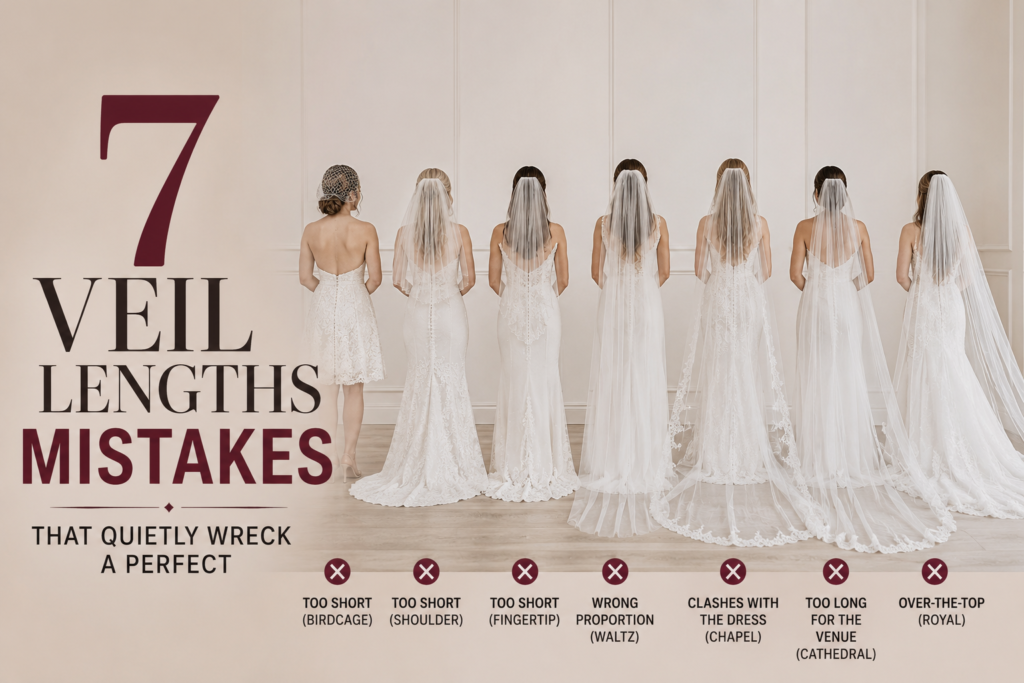
As a bridal stylist, I’ve seen it happen time and time again: a stunning dress gets completely overshadowed by the wrong veil. It clashes, it overwhelms, or it just doesn’t make sense. You’ve spent a small fortune and a ton of energy on your gown, and you deserve a veil that makes it even better, not worse. Below, we’re breaking down the seven biggest veil mistakes brides make — starting with the one people underestimate the most: getting your veil lengths wrong.
Mistake #1: Mismatching Your Whites
Let’s start with the sneakiest, yet most critical, mistake: getting the color wrong. You might think “white is white,” but in the bridal world, there’s a huge spectrum of shades, and a mismatch can be surprisingly jarring. Pairing a bright, stark white veil with a creamy ivory gown is one of the biggest no-nos. The contrast can make your beautiful dress look dull or even yellow in photos.
The truth is, very few wedding dresses are pure, stark white anymore. Designers love shades like ivory, diamond white, or champagne because they’re softer and flatter more skin tones. So, how do you get it right?
First, figure out your dress’s true color. A great trick is to hold a plain piece of white printer paper next to your gown in natural daylight. The paper’s starkness will instantly show you if your dress has cool, blue undertones (a true white) or warm, creamy ones (ivory). If your dress is pure white, you need a pure white veil. If it’s ivory, you need an ivory veil. “Diamond white” or “off-white” are often safe bets that sit in the middle.
The absolute best way to guarantee a match is to get a fabric swatch from your dress boutique. When you’re veil shopping, hold the swatch right up to it. You’re not looking for a perfect carbon copy — different fabrics reflect light differently — but a harmonious blend. When in doubt, it’s better for the veil to be a tiny bit lighter than the dress, but never darker.
Mistake #2: Fighting with Your Embellishments
You fell in love with your dress for a reason — the intricate lace, the delicate beading, the sparkle. The last thing you want is a veil that tries to steal the spotlight. A huge mistake is pairing a super-detailed dress with an equally embellished veil. It just creates visual noise, and instead of two beautiful pieces, you get one cluttered look.
The golden rule here is balance. If your dress is the star, your veil should be the supporting act. If your gown is covered in detail, go for a simple, clean veil. A raw-edge tulle veil will give you that classic bridal feel without competing with your dress’s gorgeous design.
On the flip side, if you chose a minimalist gown — like a sleek crepe dress or a simple satin A-line — this is your chance to let the veil bring the drama. A veil with a lace edge, scattered pearls, or a sparkling crystal trim can add texture and romance that perfectly elevates a simple dress. It’s all about creating one cohesive look.
Mistake #3: Getting Your Veil Lengths Wrong for the Silhouette
Now we’re talking about the architecture of your bridal look. Understanding veil lengths matters more than most brides expect, because your veil’s length has a huge impact on your overall silhouette. Choosing one that fights the shape of your dress is a common pitfall. The most important rule: your veil and train have to work together. A veil that ends at an awkward spot can visually chop you in half.
The biggest offender is a veil that’s just a little bit shorter than your dress’s train. It just looks unbalanced and stunted. As a rule of thumb, your veil should either be noticeably shorter than your gown (like a fingertip length) or extend at least a foot or two beyond your train.
Here are some pairings that always work:
A long, flowing cathedral-length veil creates a beautiful, elongated line when paired with sheath or fitted dresses. If you’re wearing a big ball gown or an A-line dress, most veil lengths work well, but chapel and waltz styles are especially pretty because they highlight the silhouette without adding extra bulk. Dresses with no train or a short, tea-length hem pair best with shorter veils, such as birdcage, shoulder, or fingertip styles. If your dress has a chapel train, a longer cathedral veil will look breathtaking. The goal is a graceful, intentional flow from head to toe.
Mistake #4: Disregarding Your Body Proportions
Just like you picked a dress shape that flatters your figure, your veil should do the same. The wrong length can completely overwhelm your frame or throw your proportions off balance.
If you’re a petite bride, you don’t want to get lost in a sea of tulle. A very long, heavy cathedral veil can sometimes overwhelm a smaller frame and make you look shorter. Shorter styles, from a birdcage to a fingertip veil, are often fantastic choices. But that doesn’t mean you can’t go long. If you have your heart set on drama, just pick a very sheer, lightweight, and narrow cathedral veil so your silhouette can still shine through.
If you’re a tall bride, you can carry off those dramatic lengths with total ease. Chapel, cathedral, and even royal-length veils will look grand and proportionate. Shorter veils look great too, but you have the unique ability to rock those show-stopping long styles without a second thought.
The goal is to create a line that elongates and flatters. Before you buy, try on different lengths and see how they make you feel in a three-way mirror. It’s worth applying the same proportion-first thinking you’d use for structured tailoring elsewhere in your wardrobe — balance is the whole game.
Mistake #5: Hiding the Best Parts of Your Dress
You said “yes” to your dress because you loved a specific feature — maybe it was the stunning illusion back, the row of tiny buttons, or an embellished waistband. The fifth major mistake is picking a veil that covers that exact detail.
Think about where your veil falls. If your dress has an incredible open-back design, a thick, two-tier veil that ends at your elbows is going to hide it completely. It’s a heartbreaking mistake because you’re covering up the very thing you fell in love with.
So, what’s the fix? It’s all about placement and sheerness. If the back of your gown is the main event, you have two great options. First, choose a shorter veil that ends well above the detailing. Your second, more dramatic option, is to pick a long, single-tier veil made from super sheer, simple tulle. This gives you that dreamy bridal halo while still letting every gorgeous detail of your gown’s back show through.
Historically, the veil wasn’t even meant to be decorative — it was worn to hide a bride’s identity from evil spirits and to conceal her face from the groom before the ceremony. It’s a nice reminder that today, the choice is entirely about what flatters you. Theweddingveilshop
Mistake #6: Forgetting Your Venue & Practicality
A veil isn’t just an accessory; it’s something you have to manage all day long. Mistake number six is choosing a veil that’s totally impractical for your wedding.
That majestic, floor-sweeping cathedral veil is stunning for a grand church ceremony. But take that same veil to a beach or garden wedding? It’s a nightmare. It will drag in the sand, collect leaves and twigs, and turn into a tangled mess in the wind. For outdoor venues, shorter, fuss-free lengths like fingertip or waltz styles are way more practical and will keep you looking elegant, not stressed.
Also, think about your reception. Planning to dance all night? A cathedral-length veil is a trip hazard for you and everyone on the dance floor. Many brides solve this by simply taking the veil off after the ceremony and photos. Others opt for a two-tier veil where the long layer can be removed, leaving a shorter, party-ready layer for the reception — not unlike how a good pair of block heel sandals can carry you from ceremony to dance floor without missing a beat.
Mistake #7: Not Testing for Comfort
This last mistake is one brides often don’t think about until it’s too late. The weight and security of your veil matter. A lot. Veils with heavy beading or lots of tulle can be surprisingly heavy. Trust me, the “veil headache” is real, and it can start in under an hour if your veil isn’t secured right, pulling on your hairstyle all day.
When you’re trying on veils, try to keep your favorite on for at least 20 minutes in the store. Feel the weight of it. Does the comb feel secure? Most importantly, talk to your hairstylist about your veil during your hair trial. They are pros at securing them and can create a hidden anchor of bobby pins so that comb has something sturdy to grip.
Comfort is everything. You want to be focused on your partner and the celebration, not on an aching head or a slipping veil. A truly beautiful veil is one you can forget you’re even wearing.
Choosing the right veil is the final step that transforms your look and truly says “bride.” Getting your veil lengths right isn’t just a technicality — it’s the difference between a veil that completes your dress and one that fights it.
Remember, the perfect veil doesn’t overpower your dress; it completes it. It shouldn’t cause you stress; it should bring you joy. By avoiding these seven mistakes, you’re making sure that when you walk down that aisle, your whole look is balanced, beautiful, and completely you.
FAQ Section
What veil length works best for a fingertip-length dress?
A fingertip veil (around 36–40 inches) is the safest match, since it ends at roughly the same point as the dress hem without creating an odd visual break.
How do I know if my veil is too long for my dress?
If the veil extends noticeably past your train with no intentional design reason, or if it ends at an awkward point that visually cuts your silhouette, it’s likely mismatched. Aim for the veil to either sit clearly shorter than the gown or extend at least a foot beyond the train.
Can I wear a cathedral veil at an outdoor wedding?
You can, but it’s high-maintenance — expect it to drag on grass, sand, or gravel. A fingertip or waltz length is far more practical for outdoor ceremonies.
Do petite brides have to avoid long veils?
Not necessarily. A very sheer, narrow cathedral veil can still work on a petite frame — the key is choosing a lightweight fabric so the veil doesn’t overwhelm your proportions.
What’s the difference between chapel and cathedral veil lengths?
Chapel veils typically extend a few feet beyond the dress hem, while cathedral veils are longer still, often trailing several feet behind for a more dramatic effect.