Apres Boots and the Hidden Science of the Perfect Winter Boot
Most winter boots fail right when you need them most. Your feet go cold inside a boot that looks like a tank. You shuffle across a parking lot like a penguin, hoping you don’t fall. You get home and your feet feel completely wrecked. The best apres boots don’t have these problems — because they’re built as engineered systems, not just footwear. Every great winter boot has to win three simultaneous battles: the physics of keeping warmth in, the material science of keeping you upright on ice, and the biomechanics of keeping your feet functional all day. Get any one of these wrong, and the boot fails. Get all three right, and you have something genuinely special.
The Physics of Warmth: Why More Insulation Isn’t Always the Answer
Keeping your feet warm sounds simple. It isn’t. Your foot runs at around 98°F. The frozen ground pulls that heat away constantly. A boot’s entire thermal job is to stop that transfer.
Insulation doesn’t generate heat — it just traps the heat your body already produces. The real mechanism is air. The best insulation creates millions of microscopic air pockets that prevent warm air from escaping. Think of a double-pane window: it’s not the glass doing the insulating, it’s the trapped layer of air between the two panes.
How to Read Insulation Ratings
Boot insulation measures in grams. As a practical guide: 200g suits cool days with active movement; 400g works well as an all-around cold-weather choice; anything over 600g targets deep-freeze conditions, especially for people standing still for long periods.
The two dominant names are Thinsulate and PrimaLoft. Thinsulate uses extremely fine microfibers to deliver warmth in a thin, non-bulky profile. PrimaLoft, originally developed for the U.S. military, mirrors the insulating behavior of down but holds onto its warmth even when wet — a significant advantage in slushy snow conditions.
However, more insulation creates a problem. If a boot can’t breathe, your foot sweats. That trapped moisture becomes the real enemy. Water pulls heat away from the body roughly 25 times faster than air does. Your own perspiration can freeze your feet solid inside an otherwise well-insulated boot. A great boot manages both warmth and moisture — it functions as a breathable fortress, not just a sealed one.
The Material Science of Grip: Why Ice Is Actually a Film of Water
Staying warm is half the battle. The other half involves not falling down. Ice traction is more complicated than it looks, and most boots handle it poorly.
The common assumption is that ice gets slippery because of pressure-melting. Research has shown this isn’t the primary cause. The real explanation: a super-thin, liquid-like layer of water molecules sits on the surface of ice even well below freezing. You’re not slipping on solid ice — you’re essentially hydroplaning on a microscopic film of water.
Vibram Arctic Grip vs. Michelin Ice Control
Two companies dominate serious outsole technology, and both borrowed their expertise directly from the tire industry.
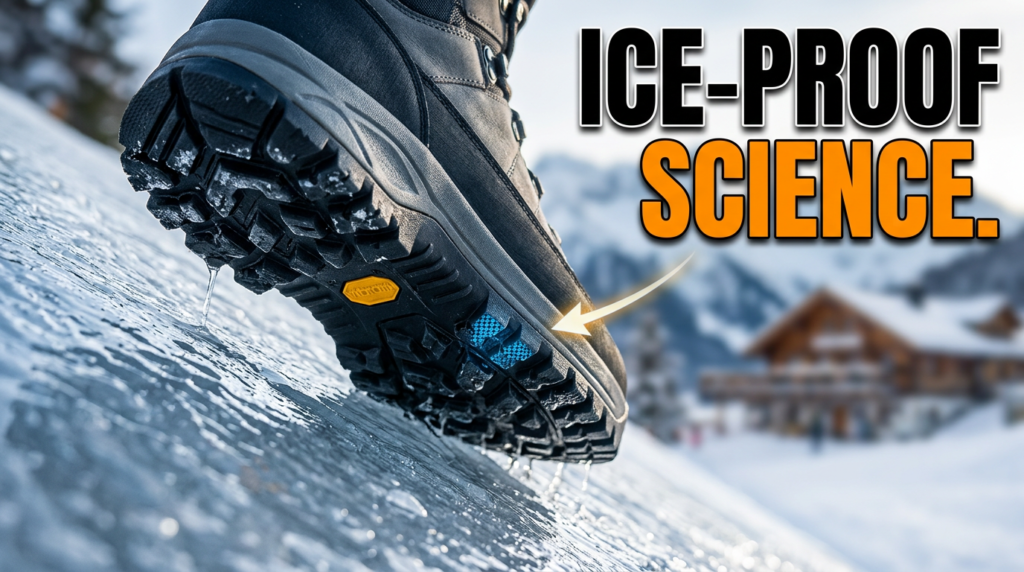
Vibram, recognizable by its iconic yellow octagon logo, developed a technology called Arctic Grip. The outsole lugs contain a specialized polymer blend that stays soft and pliable in cold temperatures. This flexibility allows the sole to conform to tiny surface irregularities in ice, creating friction where a hard, frozen rubber sole would slide straight over. Some models include a lug that changes color near freezing, signaling when the compound reaches peak grip performance.
Michelin brings over a century of tire engineering to boot outsoles. Their Ice Control technology uses rubber compounds and tread patterns directly inspired by winter car tires. Sharp, angled lugs dig into snow and packed ice. Thin grooves called sipes — identical in function to those on a car tire — bite into ice surfaces as the foot flexes through a stride.
These aren’t marketing claims. Independent testing by the WinterLab at Canada’s KITE Research Institute puts boots on real people and tilts a giant ice sheet upward, degree by degree, until they slip. A single snowflake rating requires holding firm at a 7-degree slope — the angle of a standard wheelchair ramp. Their findings show that the vast majority of winter boots on the market fail even this basic threshold. Without specialized outsole science, tread patterns are largely decorative.
As Vogue’s winter boot buyer’s guide highlights, outsole technology has become one of the most important factors separating genuinely functional cold-weather boots from aesthetically similar ones that don’t perform.
The Biomechanics of Comfort: Why Your Feet Feel Destroyed After a Day Out
So your feet are warm. You’re not on the ground. But after an hour of walking, every step feels like lifting concrete. This is the third engineering challenge: biomechanics — how the boot works with your body rather than against it.
Many winter boots fail here because they’re heavy and stiff. The hiking world applies a useful rule of thumb: every extra pound on your feet feels like carrying five extra pounds in a pack. That wasted energy compounds quickly into fatigue. Well-designed boots use lightweight materials like EVA foam in the midsole to absorb shock without adding meaningful weight.
The Hidden Shank: Your Boot’s Internal Skeleton
Inside most high-quality boots sits a shank — a semi-rigid piece of material, usually nylon or steel, embedded beneath the arch. It performs two critical functions. First, it provides torsional stability, preventing the boot from twisting on uneven ground. Second, it guides the boot to flex precisely where your foot naturally wants to flex: at the ball of the foot.
Without a shank and a proper flex point, the boot fights every step you take. Your muscles work harder to compensate, your natural stride distorts, and your arches bear strain they shouldn’t. A cheap, flimsy boot and a heavy, rigid one both cause fatigue — one through zero support, the other through zero flex. Both leave you exhausted.
Fit amplifies or destroys everything else. Too tight compresses the insulating air pockets, leading to cold feet. Too loose lets the foot slide inside the boot, causing blisters and instability. The right fit provides just enough room for thicker winter socks while locking the heel firmly in place.
Harper’s Bazaar’s guide to choosing winter boots that actually fit addresses this directly, noting that fit and internal structure matter far more to all-day comfort than the outsole or insulation alone.
How Apres Boots Solve All Three Problems at Once
Few boot categories face all three engineering challenges simultaneously as intensely as apres boots. That’s exactly what makes them the best example of winter boot design done right.
After a day in tight ski boots, circulation is sluggish and feet need serious warmth immediately. Paths from lodge to car cross ice, slush, packed snow, and wet pavement all within a few hundred feet. And after hours of physical exertion, feet are exhausted and demand comfort and support above everything else.
Why Apres Boots Are Built Differently
Great apres boots address all three demands in one package. Slip-on designs eliminate the need to bend over with tired legs. Plush linings deliver instant warmth and that immediate sense of recovery. Aggressive outsoles with advanced rubber compounds handle the icy, mixed surfaces outside a mountain lodge without hesitation — a fall after a long day on the slopes is simply not acceptable.
Many apres boots also feature a rockered or curved sole — the same gentle arc found in high-end walking shoes. A rockered sole encourages a more natural rolling gait that uses less muscular energy per step, which matters significantly when legs are already spent. The combination makes apres boots a serious piece of engineering that deliberately doesn’t feel like one. That’s the point.
What to Look For When Buying Winter Boots
The next time you shop for winter boots, think like a technician evaluating a piece of gear — not like someone choosing an accessory.
Start with the insulation. Look for a specific rated material — Thinsulate or PrimaLoft — matched to the actual temperatures you’ll encounter, not just the coldest theoretical day. Check the outsole. Generic hard rubber fails on ice. Look for Vibram Arctic Grip, Michelin Ice Control, or a comparable compound with visible sipes and purpose-built lugs.
Then hold the boot and flex it. First, check whether it bends where your foot bends—at the ball—or whether it behaves like a rigid slab. Then consider its weight; it shouldn’t feel absurdly heavy. Finally, make sure it supports the arch without locking the foot in place. These structural details determine whether a boot carries you through winter comfortably or fights you every step of the way.
The perfect winter boot isn’t just something you wear. It’s a piece of hidden engineering you live in.
FAQ — Apres Boots
Q1: What makes apres boots different from regular winter boots?
A: Apres boots solve warmth, traction, and comfort simultaneously — which regular winter boots often don’t. They pair plush insulation and slip-on convenience with aggressive outsoles built for icy mountain terrain. The category prioritizes recovery and comfort alongside genuine cold-weather performance, rather than focusing on just one of those qualities.
Q2: Are apres boots good for walking on ice?
A: The best apres boots use outsole technology specifically engineered for ice traction, including compounds like Vibram Arctic Grip that stay pliable in cold temperatures. However, not all apres-style boots include serious outsole tech. Check the sole specification before buying — a decorative lug pattern on hard rubber provides little real traction on ice.
Q3: What insulation is best for winter boots in extreme cold?
A: PrimaLoft and Thinsulate are the two leading options, and both outperform generic synthetic fill significantly. For deep cold or standing-still conditions, look for 600g or more. For active use in moderate cold, 200–400g typically provides sufficient warmth without excessive bulk or moisture buildup.
Q4: Why do my feet get cold even in insulated winter boots?
A: The most common cause is fit. A boot worn too tight compresses the air pockets inside the insulation, eliminating its thermal value. Moisture also plays a major role — if the boot doesn’t breathe, sweat accumulates and water pulls heat from the body roughly 25 times faster than air does. Try roomier fit with moisture-wicking wool socks.
Q5: What does a rockered sole do on a winter boot?
A: A rockered sole curves gently from heel to toe, encouraging a natural rolling stride rather than a flat foot-fall. This reduces the energy cost of each step and lessens fatigue over a full day of walking. Many apres boots incorporate a rockered sole for exactly this reason — they’re built for people whose legs are already tired.
Q6: What is Vibram Arctic Grip and how does it work?
A: Vibram Arctic Grip is an outsole compound that stays soft and flexible at sub-zero temperatures. Unlike standard rubber, which hardens in the cold and loses traction, Arctic Grip conforms to micro-irregularities on ice surfaces to generate friction. Some versions include lugs that change color near the freezing point, indicating when grip performance is at its peak.
Q7: Is a shank necessary in a winter boot?
A: Yes — for any boot you’ll wear for extended walking. A shank is a semi-rigid internal component embedded beneath the arch. It prevents the boot from twisting on uneven ground and guides the boot to flex at the ball of the foot rather than the arch. Without one, your muscles compensate with every step, causing fatigue far sooner than the boot should.
Q8: How much should I spend on a quality pair of winter boots?
A: Boots with proven outsole technology, rated insulation, and quality construction typically start around $150–$200 and scale upward from there. Below that price point, corners usually get cut on outsole compound, internal structure, or breathability. The cost of a boot that fails — a fall on ice, chronic cold feet, or daily foot pain — outweighs the savings quickly.