
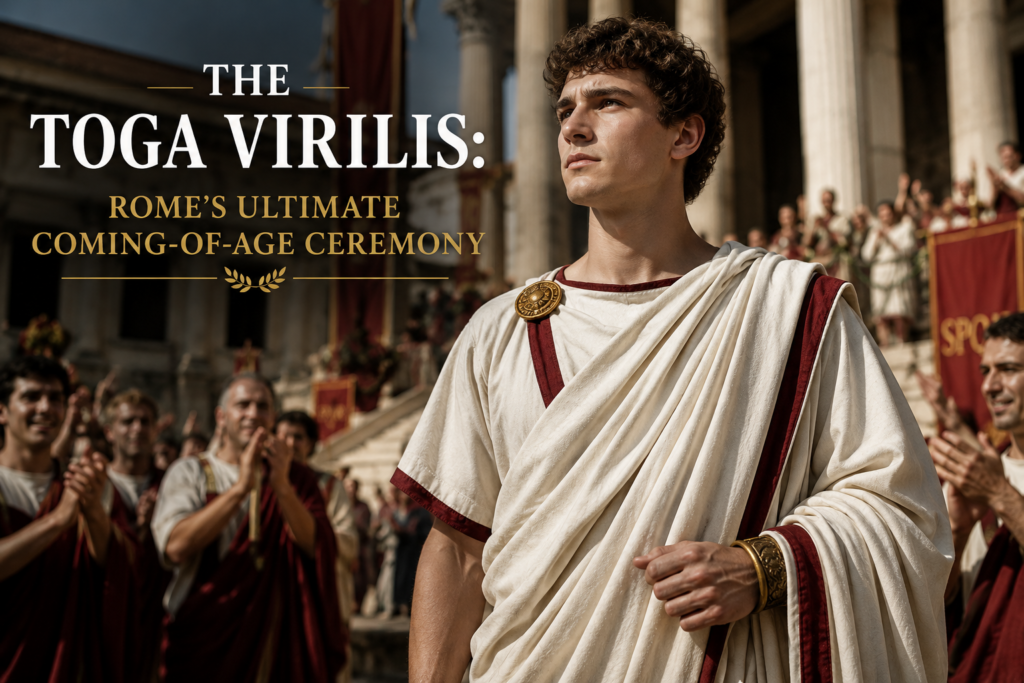
The Toga Virilis: Rome’s Ultimate Coming-of-Age Ceremony
For most of us, becoming an adult means a party, maybe a cake, and the right to vote. But what if it meant something more? What if it signified your entry into the rights and duties of a citizen, with the future of an entire republic resting on your generation’s shoulders? In ancient Rome, one simple garment marked that massive transition. This is the story of the toga virilis, Rome’s ultimate coming-of-age ceremony, where a boy became a man in a single, transformative day.
This wasn’t just a change of clothes. It was the moment a Roman boy was formally recognized as a member of civic society, with all the new rights and responsibilities that entailed. This transition was one of the most important in a Roman man’s life, a public declaration of adulthood that shaped his future and the future of Rome itself. To get the full weight of this day, we first have to understand the world the Roman boy was leaving behind.
The World of a Roman Boy
Life for a freeborn boy in ancient Rome was one of structured protection. If his family was wealthy, his world from the age of seven was often shaped by a paedagogus, a slave or freedman responsible for his education and behavior. While many were Greek, this attendant could come from any background, and he followed the boy everywhere, making sure he learned to read, write, and carry himself with the decorum of a future citizen.
The boy’s very clothing symbolized his protected, not-yet-adult status. On formal occasions, he wore the toga praetexta, a white toga with a distinctive purple border. In Roman culture, purple was a color of power and sanctity. That purple stripe acted as a visual warning: the wearer was a freeborn child, and harming him was a grave offense. The toga marked him as sacrosanct, a child living under the absolute authority of his father.
This authority was called patria potestas, the “power of the father,” and it was legally absolute. A Roman father held legal control over his children for his entire life, no matter their age. He could arrange their marriages and, technically, any property they acquired was legally his. While the early republican “power of life and death” is debated by scholars and was likely more theoretical than common practice, the father’s power was immense. A grown man in the Senate could still be legally subordinate to his father.
Around the boy’s neck hung the final symbol of his youth: the bulla. This was a locket, made of gold for the rich or leather for the poor, given to him on the dies lustricus, the naming ceremony held about nine days after his birth. It was an amulet, intended to ward off evil spirits and protect him from harm. The toga praetexta and the bulla were the twin symbols of his suspended reality — a life of education and privilege, but one without true legal autonomy. But one day a year, that all changed.
The Toga Virilis Ceremony: A Day of Transformation
For many Roman boys, manhood arrived on March 17th, during the festival of Liberalia. This festival honored Liber Pater, the god of fertility, wine, and freedom — a fitting patron for a day of personal and political liberation. While it was a popular and traditional date, families could and did choose other days for the ceremony.
The day began not with a public spectacle, but at home. The boy, standing before the lararium — the household shrine to the ancestral spirits — would perform his final act of childhood. He’d take off the bulla, the protective amulet he had worn his whole life, and dedicate it to the Lares. Sometimes, he might add a lock of his hair or the trimmings from his first shave. This offering was a powerful statement: he was no longer a child in need of magical protection.
Next, he shed the purple-bordered toga praetexta for the last time. His father might then present him with a new tunic, the tunica recta, before helping him drape the garment that defined the day: the toga virilis.
Translated as the “toga of manhood,” it was a massive, semi-circular cloth of plain, undyed white wool, which could be up to 18 feet long. It was bulky and hard to wear, but its most powerful feature was its simplicity. This was the toga pura — the “pure toga” — made of natural, unadorned wool. Its plainness symbolized his new status not as a protected child, but as an adult Roman citizen.
With the transformation complete, the ceremony moved into public. The father would lead a procession of family, friends, and clients from the house to the heart of Roman life: the Forum. There, the young man’s name was formally entered into the citizen rolls. He was now officially registered with his tribe and had the right to vote. The day often wrapped up with a sacrifice on the Capitoline Hill and a feast back home, celebrating the arrival of a new man in Rome.
Rights and Responsibilities After the Ceremony
Putting on the toga virilis was the key that unlocked Roman civil life. The privileges were significant. As a full citizen, he now had the right to vote in assemblies and, with parental consent, to marry. His children would be recognized as legitimate Roman citizens.He also gained important legal protections as a Roman citizen. This ceremony let ambitious young men begin Rome’s political career.
But every new right came with a heavy responsibility. With citizenship came the duty to serve the state. He now owed military service and had to fight for Rome. The pure white toga marked his entry into public life, where people scrutinized his actions. He was now socially and legally accountable for his own conduct.
It’s crucial to remember, though, that the toga didn’t magically erase his father’s power. A son remained under his father’s authority until his death. However, this ceremony marked the practical start of his independence. Society now recognized him as a future head of a Roman family.
Legacy and Modern Echoes
The toga virilis ceremony might have vanished with the Roman Empire, but the toga itself never fully disappeared. Today it survives mostly as a punchline — the classic college toga party, thrown together from a bed sheet and a decorative pin, a lighthearted callback to Roman formalwear that would look almost unrecognizable to a Roman citizen. But the deeper idea behind the toga virilis — using a symbolic garment to mark a life transition — is still very much with us. Graduation robes mark the transition from one stage of life to the next. A new officer’s uniform symbolizes a new identity and greater responsibility.
These ceremonies, just like the assuming of the toga virilis, are about more than just the person. They are public rituals that reinforce a society’s values. The Roman ceremony hammered home the importance of citizenship, duty, and the passing of responsibility from one generation to the next. The stark visual shift from the purple-bordered toga praetexta to the plain white toga virilis was a powerful metaphor for the journey from protected youth to accountable adulthood — a lesson taught not with words, but with wool and ritual.
Ultimately, the toga virilis was more than a piece of clothing, and the ceremony was way more than just a party. A Roman boy stood at the threshold between childhood and adulthood. He left childhood and stepped into Roman public life.In one day, one garment gave him the privileges and responsibilities of Roman citizenship, marking his official entry into adulthood.
It’s worth asking which modern rituals carry that same kind of weight today — a graduation, a first vote, a first deployment. This unforgettable transformation defined manhood and revealed what becoming an adult truly meant in ancient Roman society.
FAQ Section
What is a toga virilis?
A Roman boy wore the toga virilis, a plain white wool toga, to mark his transition into adulthood.
How old were Roman boys when they received the toga virilis?
There wasn’t one fixed age. The ceremony typically took place once a boy reached puberty, and families could choose the exact day, though the Liberalia festival on March 17 was a popular choice.
What’s the difference between the toga praetexta and the toga virilis?
The toga praetexta was a white toga with a purple border, worn by freeborn boys to mark their protected, not-yet-adult status. The toga virilis was completely plain, undyed wool, worn by men who had become full citizens.
Can you buy or recreate a toga virilis today?
You can’t buy an authentic toga virilis because it was a unique 18-foot wool garment from ancient Rome. What you’ll find instead are simplified toga costumes for parties and reenactments, usually made from a folded sheet rather than true wool.
Why was the purple border on the toga praetexta significant?
In Roman culture, purple signaled power and sanctity. The purple stripe worked as a visual warning that the wearer was a freeborn child under legal protection, and harming him was a serious offense.
Did the toga virilis ceremony give a young man full independence?
Not fully. He gained the right to vote and other citizen protections, but he still remained under his father’s legal authority, called patria potestas, until his father’s death.