Sweater Cashmere Mens Shoppers Buy Wrong: 3 Tests That Save You Money
That “100% Cashmere” label on your sweater might not mean what you think it does, and that’s exactly why understanding sweater cashmere mens buying rules matters before you spend a cent. Many people tell you to look for softness, but that advice can lead you straight into one of the industry’s biggest tricks. Brands often use an incredibly soft, almost slippery feel to make low-quality sweaters seem luxurious in the store. In reality, over-processed, low-quality fibers create that sensation, and they quickly lose their appeal after a few wears. The industry relies on this carefully crafted illusion to convince you to spend money on a sweater that won’t last.
You know the feeling. You spend what feels like a small fortune on a beautiful cashmere sweater. It’s your new favorite piece. You wear it twice, maybe three times, and then you see them: those ugly little balls of fuzz, the pilling, under the arms and down the sides. Suddenly, your investment piece looks cheap, worn-out, and a shadow of the sweater you fell in love with. It sags, it loses its shape, and you feel ripped off.
This isn’t an accident; it’s often by design. The market is flooded with sweaters made from cheap, short fibers that are destined to fail. This guide covers the industry secrets and the simple, physical tests you can perform before you buy, so you never get ripped off again. Consider it your path to becoming a cashmere connoisseur.
The Cashmere Code: What Every Sweater Cashmere Mens Buyer Needs to Know
Before getting to the hands-on tests, it helps to understand what you’re actually paying for. The quality of a cashmere sweater comes down to four critical factors: fiber length, fiber thickness, ply, and craftsmanship.
First, consider the fibers themselves. Cashmere is sorted by quality, and while it’s not a legally enforced standard, the industry generally uses a grading system: Grades A, B, and C.
Grade A is the absolute pinnacle. The fibers are the longest, often 34mm or more, and the thinnest, typically under 16 microns in diameter. For context, a human hair is about 70 microns thick. This combination of long, thin fibers creates a garment that is both incredibly soft and remarkably durable, resisting pilling because the long fibers stay securely anchored in the knit. The finest Kashmir goats of China and Mongolia yield fiber with diameters ranging from roughly 14.5 to 16.5 micrometers, which lines up closely with what separates true Grade A fiber from everything else on the shelf. Cashmere & Cotton
Grade B is the middle ground, with slightly thicker fibers, around 16 to 19 microns, and shorter lengths. Many commercial, mid-range brands use this grade. It’s still soft, but it’s more prone to pilling over time than Grade A. Then there’s Grade C, the lowest quality. These are thick, short fibers, often over 19 microns in diameter. According to the U.S. government, to even be called cashmere, the average fiber diameter can’t exceed 19 microns. Sweaters made from Grade C fibers can feel less soft, and they’re almost guaranteed to pill immediately. They’re the reason for the disappointment you’ve felt.
Now, what about “ply”? You might see a label that says “Two-Ply Cashmere.” A ply is a single strand of cashmere yarn. To create a stronger, more durable sweater, manufacturers twist two of these strands together, creating “two-ply.” This produces a denser, warmer, and much more resilient knit that holds its shape and resists holes. Because of this, two-ply is often considered the standard for quality sweaters.
Some brands might sell you on “single-ply” as being lighter, but this is often a trade-off for durability. When shopping for a Sweater Cashmere Mens style, it’s important to look beyond marketing claims and focus on the quality of the fibers. Here’s the crucial industry secret: a two-ply sweater made from Grade A cashmere is far superior to a four-ply sweater made from Grade C cashmere. Fiber quality always matters more than the number of threads.
The In-Store Inspection: Three Tests to Spot a Rip-Off
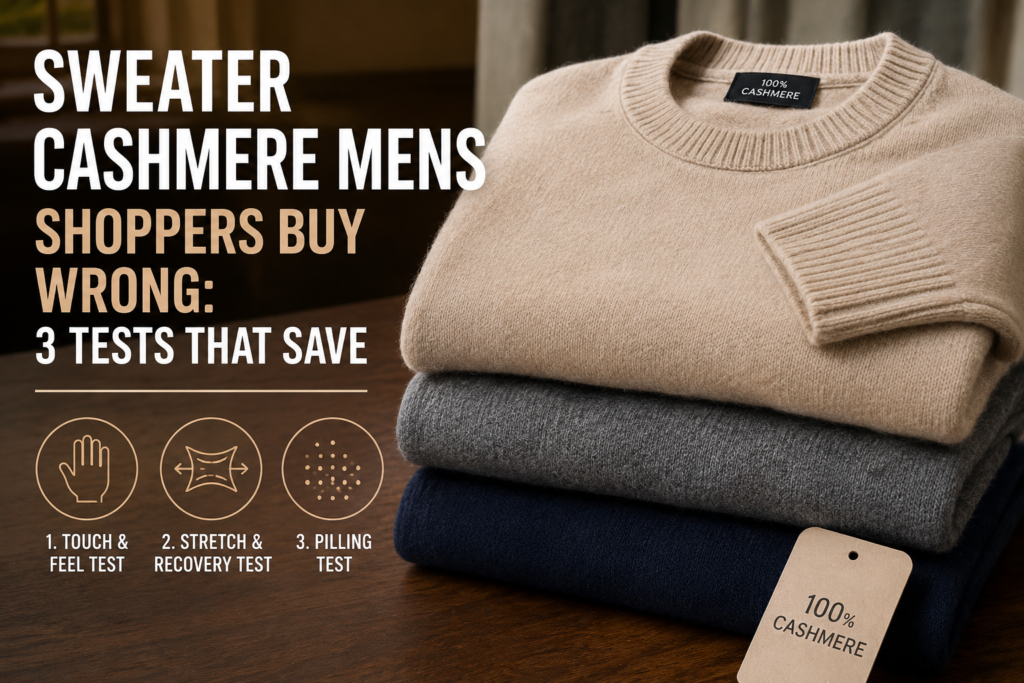
Now that you know the theory, it’s time to put it into practice. You don’t need a microscope to spot quality; you just need your hands and your eyes. Here are three simple tests worth performing in the store.
The Touch and Feel Test
Don’t just run your hand over the sweater. Pick it up and rub it on a sensitive part of your skin, like your neck. High-quality, Grade A cashmere should feel smooth and buttery: soft, but not slippery or greasy. A slick feeling can be a red flag that chemical softeners were used to mask lower-grade fibers. If the fabric feels even slightly rough or scratchy, you’re likely holding a sweater made with lower-grade fibers or a blend.
The Stretch and Recovery Test
This is one of the best ways to check the resilience of the knit. Gently take a small section of the sweater, the cuff or the hem is a good spot, and stretch it out. Now, let it go. A high-quality sweater, made with well-constructed yarn from long fibers, should spring back to its original shape almost immediately, and you should see the knit tighten right back up. If it sags, stays stretched out, or slowly returns to shape, you’re looking at a sweater made with short, weak, low-quality fibers. This sweater will lose its shape and look baggy after just a few wears, so it’s best to put it back.
The Surface and Pilling Test
Look closely at the surface of the sweater. It should look smooth and carry a soft, natural luster. Now, take your thumb and rub a small, less visible area of the surface back and forth five or six times. If little balls of fiber immediately start to form and twist together, put the sweater down. This is a tell-tale sign of short fibers already breaking free from the knit. All cashmere may pill slightly over a lifetime of friction, but a high-quality garment should never show significant pilling in the store.
Decoding the Label and the Price Myth
You’ve done the physical tests, and now it’s time to look at the label, but you have to know how to read it. If you’re shopping for a Sweater Cashmere Mens style, the first thing to look for is the phrase “100% Cashmere.” If it says “Cashmere Blend,” “Cashmere Feel,” or anything similar, it’s not what you’re looking for. Those are marketing terms designed to mislead you into buying something that is mostly wool or synthetic material.
But even “100% Cashmere” can be deceptive, which is why the physical tests matter so much. A brand can legally label a sweater made from the worst Grade C fibers as “100% Cashmere,” as long as it meets the 19-micron thickness rule. Origin is another factor worth considering. The finest raw cashmere often comes from Inner Mongolia, where the harsh climate forces the goats to grow an incredibly fine and long undercoat to survive. Craftsmanship matters too; Scotland and Italy have long-standing reputations for producing some of the best-knit garments in the world.
Now, about price. How much should a good cashmere sweater actually cost? It’s a spectrum, and it often relates to the quality grades discussed above.
Budget Tier: $50–$150
Brands like Quince and Naadam offer remarkable value here. They often use 100% Mongolian cashmere that could be considered Grade A or B, but to hit that price point, the fibers might sit on the shorter side of the spectrum. You might experience more pilling than a premium sweater, but for the price, the value can be exceptional. This is a great entry point.
Mid-Range Tier: $150–$300
This is the sweet spot for many people. Brands like Naadam, Ralph Lauren, and Everlane often live here. These sweaters typically offer a fantastic balance of luxury and longevity, and likely use Grade B or even Grade A fibers. This is where you often get the best cost-per-wear.
Premium and Luxury Tier: $300–$1,000+
Here you’re in the world of brands like Todd Snyder, Luca Faloni, and at the very top, Loro Piana. These garments are often made from the absolute finest Grade A fibers, sourced from specific regions and handcrafted in Italy or Scotland. The softness and resilience can be unmatched, and you’re paying for impeccable craftsmanship along with the absolute pinnacle of material quality. Each goat yields only a few grams to about half a kilogram of cashmere annually, and a single sweater requires the fleece of four to six goats, which explains why that level of craftsmanship never comes cheap. Street To Fashion
Remember the concept of cost-per-wear. A $100 sweater you can only wear ten times before it looks terrible costs $10 per wear. A $300 sweater you can wear a hundred times costs just $3 per wear. Investing in quality tends to pay for itself.
Lasting a Lifetime: Care and Maintenance
Buying a quality sweater is the first step. Making it last a lifetime is the second, so don’t ruin the investment by treating it like a normal piece of clothing.
Washing
Wash it as infrequently as possible. Cashmere is naturally odor-repellent, so unless something spills on it, you can often wear it five to ten times before washing. When you do wash it, hand washing is the safest method. Use cold water and a dedicated cashmere soap or even a gentle baby shampoo. Let it soak, gently squeeze out the water, never wring it, and then roll it in a clean towel to absorb excess moisture. Some brands say machine washing is fine on a delicate or wool cycle, but it’s riskier and can shorten the sweater’s life.
Drying
Never, ever hang a wet cashmere sweater. The weight of the water will stretch the fibers and can ruin the shape permanently. Instead, lay it flat on a drying rack, away from direct sunlight or heat, and reshape it as it dries.
Storage
Fold your sweaters instead of hanging them, since hanging can cause stretching in the shoulders over time. Store them in a drawer or on a shelf with cedar blocks or lavender sachets to repel moths, which are notoriously attracted to natural fibers. If minor pilling appears after many wears, don’t pull the pills off with your fingers. Use a cashmere comb or a fabric shaver to gently remove them instead.
The Three Tests, One More Time
So there you have it: the insider knowledge that most shoppers lack. You’re now equipped to walk into any store, bypass the marketing gimmicks, and identify true quality.
Remember the three key tests: the touch and feel test, the stretch and recovery test, and the surface pilling test. Use them every time you shop for a Sweater Cashmere Mens style. Invest in the best quality you can afford, focusing on that mid-range sweet spot for the ultimate value. Care for it properly, and you won’t be buying a new sweater every year. Instead, you’ll be investing in a piece that gets softer with age and lasts a lifetime.
FAQ Section
What should sweater cashmere mens shoppers check before buying?
Check the fiber grade if it’s listed, then run the touch, stretch-and-recovery, and surface-pilling tests in-store. Together they reveal more about real quality than the price tag alone.
What does “100% Cashmere” on a label actually guarantee?
Only that the fiber diameter meets the legal threshold, not that it’s high quality. A brand can legally label Grade C fiber as “100% Cashmere” as long as it stays under 19 microns.
What’s the difference between Grade A, B, and C cashmere?
Grade A uses the longest, thinnest fibers (often under 16 microns) for maximum softness and durability. Grade B offers a good balance between quality and price. Meanwhile, Grade C uses thicker, shorter fibers that pill the fastest.
Is two-ply cashmere always better than one-ply?
Not automatically. Ply affects warmth and durability, but fiber grade matters more. A two-ply Grade A sweater will always outperform a four-ply Grade C one.
Why does my cashmere sweater pill so quickly?
Rapid, heavy pilling usually points to short, low-grade fibers that break free from the knit easily. All cashmere pills a little over time, but it shouldn’t happen the first time you wear it.
How much should a good cashmere sweater cost?
Budget options run $50–$150, the mid-range sweet spot sits at $150–$300, and premium, luxury-grade pieces start around $300 and climb well past $1,000.
Can I machine wash a cashmere sweater?
Hand washing in cold water is safest. Some brands allow a delicate or wool machine cycle, but it carries more risk of shrinking or stretching the fibers.
How often should I wash a cashmere sweater?
Cashmere naturally resists odor, so most sweaters can handle five to ten wears between washes unless something spills on them directly.