The Black Fringe Jacket: The Survival Story Hidden Behind the Most Iconic Piece in Fashion
You see a rockstar. A fashion icon. A rebel. You see a statement piece designed to catch the light and draw every eye in the room. You see legends of the stage and screen, all defined by the swagger and sway of one single garment. The black fringe jacket has always carried that kind of energy — electric, untamed, impossible to ignore.
But what if the fringe was never really about fashion? What if it was originally designed not to turn heads, but to save a life?
This jacket was not created to make a statement. It was part of a system built for survival. And once you know the full story, you will never look at a fringe jacket — black or otherwise — the same way again.
The Black Fringe Jacket Started as Practical Survival Gear
So what was the original point of all that fringe? One of the most widely accepted theories is as simple as it is genius: water.
For the Native American tribes who created fringed buckskin garments — and later for the cowboys and frontiersmen who adopted the design — staying dry could genuinely be a matter of life and death. In harsh, unpredictable weather, a waterlogged leather jacket gets heavy, cold, and pretty useless fast.
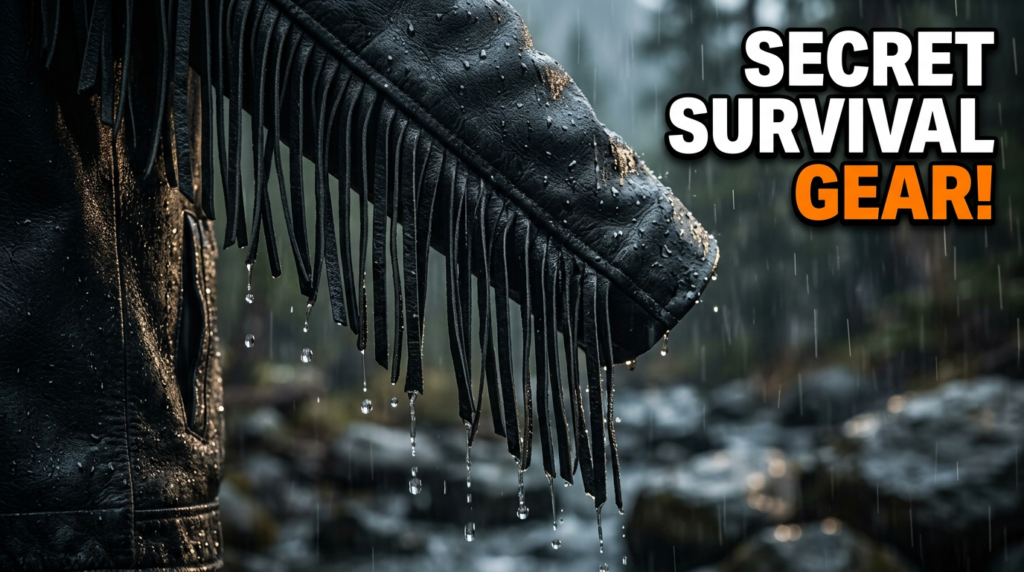
This is precisely where fringe offered a clever solution. It acts like a series of small channels. Rainwater runs down each individual strip and drips off the end, away from the wearer’s body. This helps prevent the main body of the jacket from becoming completely saturated, allowing it to dry far faster and keep the person inside noticeably warmer. It is a simple, low-tech way to shed water — protecting the seams from rot and the wearer from the cold.
And the practical genius may not stop there. Some theories suggest the fringe also acted as a wearable toolkit. On the frontier, if a strap on your gear snapped, a strip of fringe could be cut off for a quick emergency repair — a reserve of all-purpose cordage always within reach. Other hypotheses even suggest that the constant movement of fringe could help break up a person’s silhouette, offering a slight camouflage advantage while hunting.
While these ideas are fascinating, the water-wicking function remains the most historically grounded explanation. The fringe was not an afterthought. It was a key feature that made the garment actually work.
From the Frontier to the Stage: How Fringe Became a Symbol
How did this piece of practical survival technology become a symbol of cool? The journey from the plains to the stage is a genuinely fascinating story of cultural exchange and reinterpretation.
It started with the cowboys of the American West. As settlers moved westward, they encountered and adopted many practical designs from Native American cultures. They saw how effective the fringed jacket was and integrated it into their own gear, appreciating both its durability and its rugged, frontier look. The fringed jacket quickly became associated with tough, independent living on the open land.
In the modern era, things really took off in the 1920s. The Roaring Twenties were all about liberation, and the flapper dress — with its layers of swinging fringe — perfectly captured the wild energy of the Jazz Age. The fringe moved with the dancer, accentuating the free, expressive movements that defined the entire era. It was no longer about shedding rain. It was about expressing a new kind of social freedom.
After the twenties, fringe fell in and out of style until the 1950s and 60s, when it was picked up by a new kind of rebel entirely. The rise of rock and roll gave the fringe jacket a fresh, defiant edge — and this set the stage for its explosion in the counter-culture movement. The fringe jacket became the unofficial uniform of hippies, musicians, and anyone actively rejecting the mainstream. When you saw someone in a fringe jacket at Woodstock or in a film like Easy Rider, it was not just a style choice. It was a statement. It said you were part of a tribe that valued individuality and a rejection of the status quo.
As Vogue’s history of the fringe jacket traces, the garment’s journey from functional frontier wear to cultural icon is one of the most complete transformations in the history of fashion.
Why Rockstars Made the Black Fringe Jacket Legendary
So what was it about the fringe jacket that made it so perfect for rock and roll? The answer is simple: movement.
A stage is a dynamic space. An audience connects with energy, with motion. And nothing moves quite like fringe. It amplifies every single gesture, turning a simple arm movement into a dramatic, sweeping visual. The fringe visually echoes the music — creating a spectacle of sound and motion working together.
Rockstars like Jimi Hendrix, Janis Joplin, and Jim Morrison understood this power completely. The fringe on their jackets was not just decoration — it was part of their instrument, an extension of their performance. It added a layer of wild, untamed energy that became genuinely inseparable from their music. Even Elvis Presley, particularly during his legendary ’68 Comeback Special, used fringe to amplify his electrifying stage presence.
This visual power is also why the fringe jacket became a symbol of a very specific kind of confidence. To wear fringe is to invite attention. You simply cannot disappear into the background when your clothes are literally dancing with every step. Wearing a black fringe jacket is a non-verbal declaration that you are not afraid to be seen.
This rebellious spirit was immortalised on film. In Easy Rider, Dennis Hopper’s heavily fringed jacket became a visual shorthand for the entire counter-culture movement — representing freedom from the nine-to-five and from a life lived in straight lines. The jacket was the uniform of the open road.
That legacy continues today. The fringe jacket remains a staple for musicians and artists who want to project an image of authentic, rebellious creativity. When a modern artist puts on a fringe jacket, they are — consciously or not — tapping into the spirit of Hendrix, Joplin, and the entire history of rock and roll.
How to Style a Black Fringe Jacket Today
So why, after all these years, does the black fringe jacket keep coming back? In a world of fast fashion, how has this piece of gear managed to stay so consistently relevant?
One major reason is its incredible versatility. A black fringe jacket can be styled to fit almost any look. Pair it with jeans and boots, and it is classic Western. Wear it with all-black underneath, and it becomes edgy rock and roll. Combine it with a flowing dress, and it reads as pure bohemian chic. This adaptability means it is never really out of style — it just gets reinterpreted by each new generation.
There is also a more modern reason for its endurance: the camera. In the age of social media, clothing that has movement and texture simply looks better on screen. Fringe looks alive on video. It catches the light, creates dynamic motion, and makes even a simple photo instantly more interesting. It is almost as if the jacket was designed for the era of short-form content and fashion reels.
On top of that, there is a growing movement toward buying fewer, more meaningful pieces. A well-made black fringe jacket is not a disposable item. It is a statement piece that can be worn for years. Its rich history gives it a sense of substance that most modern clothing simply lacks. It feels less like a product and more like an artefact — carrying an entire story in its seams.
According to Harper’s Bazaar’s guide to investment fashion pieces, statement outerwear with genuine cultural history — like a quality fringe jacket — consistently ranks among the most worthwhile long-term wardrobe investments precisely because of that combination of versatility and meaning.
The Fringe Jacket Is a Story of Survival, Not Just Style
From a practical tool on the American frontier to a symbol of rebellion on the world’s biggest stages, the black fringe jacket has had a truly remarkable journey. It started with pure function — a clever, low-tech way to deal with rain and stay alive on the frontier. It was then adopted and transformed by cultures and subcultures across centuries, each one adding a new layer of meaning. The flappers made it dance. The cowboys made it rugged. The rockstars made it rebellious.
What began as a smart design became a statement of identity. It is a rare example of a garment that taps into something fundamental — a desire for freedom, movement, and individuality.
So the next time you reach for a black fringe jacket, look a little closer. Do not just see the fashion. Admire the ingenuity. Uncover the history. From a hunter staying dry on the frontier to a cowboy riding West and a rockstar commanding a stage of thousands, the story comes alive.. You are not just putting on a jacket. You are putting on a story of survival.
FAQ Section
Q1: What makes a black fringe jacket different from other fringe jackets?
A: A black fringe jacket specifically combines the movement and drama of fringe with the versatility of black as a base colour. Black makes the jacket wearable across a far wider range of outfits and occasions — from casual Western looks to edgy all-black ensembles and boho festival styles — without the fringe feeling costumey or overly statement-heavy.
Q2: What outfits go well with a black fringe jacket?
A: A black fringe jacket pairs naturally with skinny or straight-leg jeans and ankle boots for a classic rock-and-roll look. It also works beautifully over a flowy midi dress for a bohemian vibe, or layered over an all-black outfit for a sleek, edgy finish. For a more casual look, try it over a white tee and cut-off shorts.
Q3: Is a black fringe jacket still in style in 2026?
A: Absolutely. The black fringe jacket has moved well beyond seasonal trend status. Its connection to rock and roll history, Western fashion, and counter-culture means it carries genuine cultural weight — and that never goes fully out of style. It currently appears in festival outfits, street style, and even elevated fashion editorials.
Q4: Where does the fringe on a jacket originally come from?
A: Fringe on jackets originated with Native American fringed buckskin garments, where it served a primarily functional purpose — channelling rainwater away from the body to keep the wearer dry and warm. Initially embraced by cowboys and frontiersmen, the design later gained broader cultural significance. Ultimately, rock and roll culture helped cement its status as a symbol of freedom and rebellion.
Q5: How do I care for a black fringe jacket?
A: Care depends on the material. Regularly condition a genuine leather fringe jacket and store it on a wide hanger to help it maintain its shape.Avoid folding, as this can crease the fringe. Use a suede brush to clean suede versions gently, and keep them away from moisture to preserve their appearance. Always check the care label first.