Shoes Snake Skin: The Billion-Dollar Lie Nobody Talks About (Real vs Fake Explained)
You have seen this shoe a hundred times. On social media, in store windows, maybe you even own a pair. It promises a little luxury, a little danger, a touch of the exotic. Shoes snake skin designs keep showing up season after season — on fierce heels, casual sneakers, and everything in between. According to the runways, the snakeskin pattern ranks among the hottest looks out there.
But here is a secret most people never hear: this shoe is a lie.
And it is a lie that has built a billion-dollar industry. The global market for synthetic or faux leather reached an estimated 39 to 41 billion dollars in 2023 and 2024, with projections pushing it beyond 70 billion by 2032. A significant portion of that growth comes directly from footwear. What most people see on shelves — and what most people buy — is very often not real snakeskin at all. It is a sophisticated imitation, a carefully constructed copy designed to deliver the look without the reality.
The gap between genuine craftsmanship and mass-market fakes runs far deeper than most shoppers realise. Moreover, what sits underneath that gap proves far more interesting, and considerably more costly, than you might ever imagine.
Myth #1 — “It’s All the Same”
The biggest myth surrounding shoes snake skin designs is that whether it is real or fake, the pattern is the point and nothing else matters. The moment you place a genuine snakeskin shoe next to its common imitations, however, that myth starts to unravel fast. Three main players dominate this space: genuine snakeskin, embossed leather, and synthetic prints. They are worlds apart.
Starting with the imposters — since they account for most of what you will find on the high street — the most common approach involves embossing. Manufacturers take cowhide or another less expensive leather and use high-pressure machines to stamp a snake-scale pattern directly onto the surface. The result is a print with texture. Beyond that, the next level of imitation goes fully synthetic, typically using a polyurethane (PU) or PVC plastic base where a snakeskin pattern simply prints on top, much like a picture on a sheet of paper.
What Genuine Snakeskin Actually Looks and Feels Like
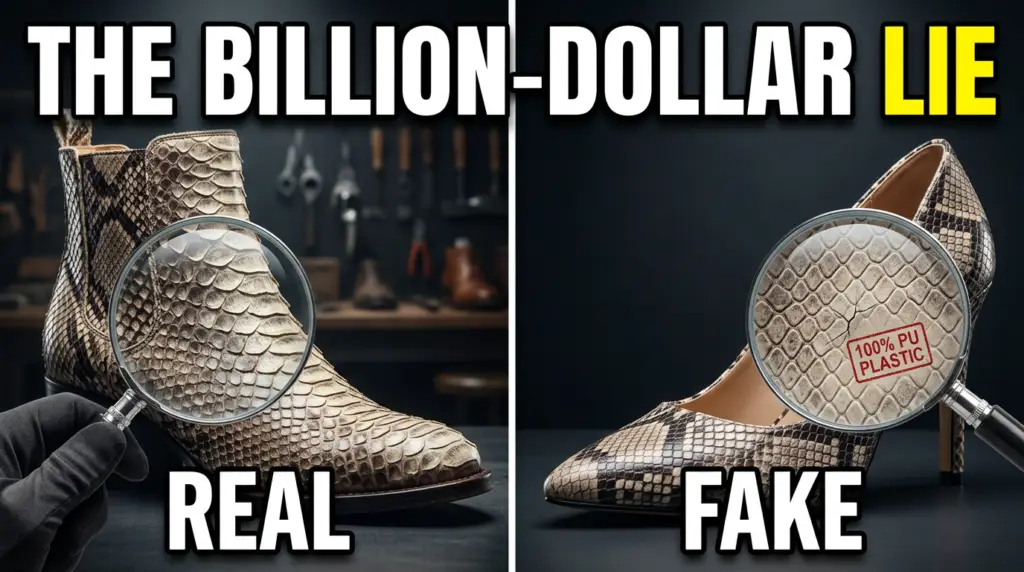
Genuine snakeskin — most commonly from pythons — carries an entirely different character. The pattern on a fake tends to look too perfect, too uniform, like a digital file copied and pasted across the surface repeatedly. A real snake, by contrast, carries natural, beautiful irregularities. Scales shift in size and shape from the belly to the back. Subtle variations in colour and texture appear throughout, and no machine can perfectly replicate them.
The most telling difference, though, is the feel. Running a hand over a synthetic or embossed shoe returns a flat or uniformly bumpy texture. Genuine python skin responds differently. Moving fingers against the grain produces a slight, distinctive roughness — each individual scale edge sitting slightly lifted. It feels organic. Alive.
An imitation feels like a picture of a snake. Genuine snakeskin feels like a snake. One emerges from nature, refined by human hands. The other comes from a machine, designed for mass appeal and maximum profit. They are not the same. Not even close.
Myth #2 — “The Price Is the Only Difference”
Perhaps the most dangerous myth of all: that the only real gap between a £100 pair of “snakeskin” shoes and a £1,000 pair is the price tag and a designer name. This belief sits at the core of the billion-dollar lie. The price is not just a number. Rather, it reflects two entirely different worlds of production, each carrying vastly different costs that go far beyond the materials themselves.
The Hidden Cost of the Cheap Fake
The lower-priced shoe most likely uses polyurethane (PU) or polyvinyl chloride (PVC) — plastics derived from petroleum. Producing these materials consumes non-renewable resources and can release volatile organic compounds (VOCs) alongside other harmful chemicals that contribute to air pollution. Furthermore, these shoes rarely last. Many lower-end synthetic styles crack and peel within a few years of regular use. Eventually, they end up in landfill, where they will not break down into soil. Instead, they slowly decompose into microplastics that can contaminate soil and water for centuries. That low price tag hides a significant environmental debt that everyone ends up paying.
The True Value Behind the Genuine Article
As Vogue has highlighted in its coverage of sustainable luxury, the journey of a real snakeskin shoe involves skill, time, and deeply specialised knowledge. The skins themselves are delicate. Tanning them into the soft, durable material found in luxury products is an art form — one that requires careful handling to preserve the texture of every individual scale. Rushing or automating this process simply does not work. After tanning, a master shoemaker takes over, cutting the skin to best showcase its natural pattern before hand-crafting the shoe itself. A single pair can represent dozens of hours of skilled work.
That high price tag therefore pays for the artisan’s time, their years of accumulated skill, the quality of the tanning process, and ultimately a product that — with proper care — can last decades rather than just a couple of seasons. The expensive shoe tells a story of human skill. The cheap shoe, more often than not, tells a story of environmental compromise and throwaway culture. The price difference is not the lie. It is actually the first clue pointing toward the truth.
Myth #3 — Shoes Snake Skin Are Just a Decadent Luxury
The final myth frames genuine snakeskin as an unnecessary, purely decadent indulgence. On the surface, that argument makes sense. Nobody needs snakeskin shoes. Dismissing them as mere excess, however, misses a far deeper story — one about culture, skill, and the ethics embedded in every purchase.
Reducing snakeskin to a pattern printed on plastic devalues both the material and the remarkable craftsmanship it represents. Hand-making shoes from exotic leathers has long been a tradition passed down through generations of artisans. In a world of automated factories producing disposable footwear at volume, that tradition becomes an increasingly rare art form.
The Ethics Are More Complex Than You Think
The ethical dimension here runs considerably more complicated than most marketing would suggest. The trade in many snake species is regulated by CITES, the international agreement designed to prevent over-harvesting. Reputable brands using genuine snakeskin must provide documentation proving their materials are legally sourced. Some argue that this regulated trade can provide meaningful income to local communities and even support conservation efforts.
The system, however, is far from perfect. Documented issues around enforcement do exist, and illegally harvested skins can occasionally enter the legal supply chain. Moreover, studies on the python skin trade suggest that the majority of profits flow to middlemen and European fashion houses rather than to local hunters.
The “Vegan Leather” Problem
As Harper’s Bazaar has explored in its sustainability reporting, the conversation around vegan leather often presents it as the straightforward ethical alternative. However, as the breakdown above makes clear, most vegan leather is simply plastic — carrying its own significant environmental toll. Newer, more genuinely sustainable alternatives made from mushrooms, cactus, or pineapples do exist, but they currently represent a tiny fraction of the overall market.
This creates a genuinely difficult choice. Opting for a petroleum-based plastic means contributing to centuries of pollution. Engaging with genuine materials means navigating a complex and sometimes murky supply chain. Neither option offers clean hands. Pretending that a plastic shoe automatically claims the moral high ground is itself part of the billion-dollar lie — it simplifies a deeply complex issue into a marketing tagline.
The real luxury, then, is not the snakeskin itself. It is having the knowledge to navigate these questions and make a choice that genuinely aligns with your values.
The Truth Behind Every Pair
Returning to that shoe — the one promising luxury and danger — we now know that in most cases, the promise is a fabrication. The “snakeskin” on most shelves is very often a printed pattern on cow leather or plastic. A ghost of the real thing.
The billion-dollar lie is not simply that the shoe is fake. The lie is the entire system the fake shoe represents. A system that has convinced shoppers that appearance is everything and substance is nothing. That a printed pattern substitutes for genuine craftsmanship. That disposable is desirable. That a lower price comes with no hidden costs.
The costs are very real. The environment pays them through plastic waste accumulating from fast fashion habits. Artisans pay them as their skills lose economic value. And consumers pay them too, sold a disposable dream rather than lasting quality.
None of this is about shaming anyone for buying faux snakeskin shoes. It is about empowerment. Next time you shop, the tools to make a smarter choice are right there. Look closely at the pattern — is it too perfect? Feel the texture — does it feel like plastic? Ask yourself what story this product actually tells.
The real question was never whether snakeskin is in style. It is what it says about what we value.
FAQ Section
Q: What are shoes snake skin made from?
A: Most shoes marketed as snakeskin use one of three materials: genuine snakeskin (often python), embossed leather (cowhide stamped with a scale pattern), or synthetic materials like PU or PVC plastic with a printed snake pattern on top. Genuine snakeskin accounts for a very small share of the market.
Q: How can you tell if shoes snake skin are real or fake?
A: Check the pattern first — genuine snakeskin features natural irregularities in scale size, colour, and texture. Faux versions tend to display a too-perfect, repeating pattern. Next, feel the texture. Real python skin has a slight roughness when you run your fingers against the grain, with slightly lifted scale edges. Synthetic or embossed versions feel flat or uniformly bumpy by comparison.
Q: Are shoes snake skin ethical to buy?
A: The ethics depend on the material. Genuine snakeskin involves CITES-regulated trade, meaning reputable brands must document legal sourcing — though enforcement issues do exist. Most faux snakeskin uses petroleum-based plastics, which carry serious environmental concerns of their own. Newer plant-based alternatives (mushroom, cactus, pineapple leather) offer a more sustainable option but remain a small part of the market.
Q: Why are real shoes snake skin so expensive?
A: Genuine snakeskin shoes involve highly specialised tanning, careful handling to preserve scale texture, and skilled hand-crafting by experienced artisans. A single pair can take dozens of hours to produce. That price tag covers materials, craftsmanship, and a product built to last decades with proper care — not just a brand name.
Q: Do shoes snake skin last long?
A: Genuine snakeskin shoes, when properly maintained, can last for many years or even decades. Lower-end synthetic snakeskin shoes, by contrast, are prone to cracking and peeling, sometimes within just a few years of use, and tend to end up in landfill relatively quickly.
Q: Are faux shoes snake skin bad for the environment?
A: Most faux snakeskin footwear uses PU or PVC plastics derived from petroleum. These materials consume non-renewable resources during production and can release harmful chemicals. At the end of their short lifespan, they do not biodegrade — instead breaking down into microplastics that can contaminate soil and water for centuries.
Q: What is the best alternative to real shoes snake skin?
A: If genuine snakeskin is outside your budget or ethical comfort zone, look for high-quality embossed leather (which biodegrades) over fully synthetic options. Emerging plant-based leathers made from mushrooms (mycelium), cactus, or pineapple waste offer the most environmentally responsible alternatives currently available, though they remain limited in wider retail availability.