Petite Leather Trousers: Why They Weren’t Working and How to Fix That
If you’re petite, you’ve probably heard it before — stay away from leather trousers. People say they’ll swallow your small frame. They say the fabric is just “too much” for you.
Well, that’s simply not true.
The reason petite leather trousers might not have worked for you has nothing to do with the fabric. It’s all about a few simple details in the cut and how you style them. Once you know what to look for, you can finally wear this trend with total confidence.
Leather trousers are a huge closet staple now. They’re not just for that edgy, rock-and-roll vibe anymore. You can wear them to the office, to brunch, or on a night out. They make any outfit feel more polished, more intentional, and honestly, way more expensive.
But for petites, that excitement usually comes with frustration.
You find a pair you love, but the legs are too long. Or they fit in the waist, but the thighs are baggy. The knees hit somewhere down by your shins. It’s a classic problem — and we’re told the trend just isn’t for us.
Here’s the truth: the problem isn’t the leather. The problem is proportion.
The fashion world loves to tell us what we can’t wear. However, it rarely explains why. The real secret isn’t about avoiding certain clothes. It’s about understanding how to build an outfit that flatters you.
So here are the three core reasons why leather trousers might have let you down — and exactly how to fix that.
The Cut: Your Foundation for Flattering Petite Leather Trousers
First, look at the cut. This is the foundation of your entire look.
Leather grabs your attention naturally. It has structure and a slight shine, so the eye is drawn straight to it. Because of that, the shape it creates really matters. If that shape is off, it can easily overwhelm a smaller frame.
Many petites first try leather trousers in a super-skinny, spray-on style. That can work sometimes. However, it can also make your top half look wider by comparison.
On the other hand, a wide-leg or baggy leather trouser creates too much volume. It can make you feel lost in a sea of fabric.
So where’s the sweet spot? A straight-leg or gently tapered cut.
This is the most flattering style for petites, hands down. A high-rise straight leg creates a clean vertical line from your hip all the way down. Your eye travels smoothly without stopping — and that’s the oldest trick for creating the illusion of height.
It’s not about looking taller. It’s about working with your proportions to create a streamlined, balanced look.
A straight-leg cut skims your body without clinging. It gives you the sleekness of a skinny fit but with more breathing room. As a result, the fabric looks effortlessly chic instead of strained.
As Vogue has noted in its petite style guides, brands that get petite cuts right understand one thing — you can’t just shrink a standard pattern. You have to re-engineer it completely.
The Inseam: The Detail That Makes or Breaks the Look
Next up is length. And this is the one that trips up most petites.
The inseam is everything.
You could have the most perfectly cut leather trousers in the world. But if they’re too long, the whole look falls apart.
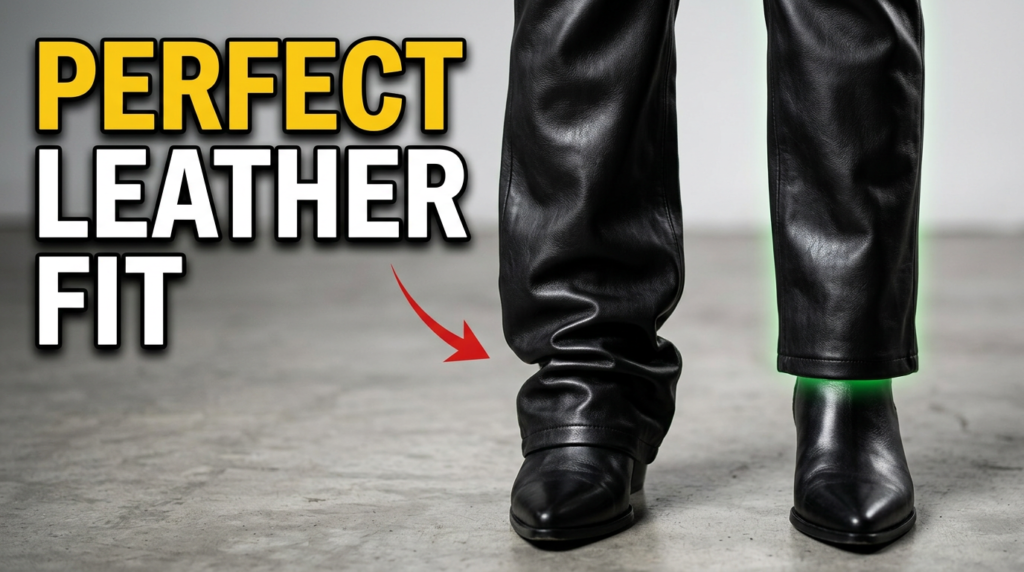
The biggest mistake is wearing leather trousers that bunch and pool around your ankles. That bunched-up fabric creates a horizontal line at the bottom of your leg. As a result, your legs look shorter and the outfit looks messy.
Because leather is so structured, this effect is even stronger than with softer fabrics like cotton.
So what length should you aim for?
The hem should either just graze the top of your shoe or show a small sliver of ankle. This creates a clean finish and keeps that long vertical line going.
For a full-length look, most petite women need an inseam between 27 and 29 inches. For a cropped or ankle-length style, aim for 25 to 27 inches.
This is also why “cropped” pants from standard lines can be a petite girl’s secret weapon. What’s cropped on a taller person is often the perfect full length on someone 5’3″ and under.
More brands are now offering true petite sizing too. A real petite cut moves the knee placement up, so the leg tapers in the right spot. No more baggy-knee problem.
When you get the length right, everything changes. Your shoes look great. Your legs look longer. The whole outfit looks tailored and intentional.
Proportion and Styling: Tying It All Together
So you’ve found straight-leg leather trousers with the perfect inseam. You’re almost there.
The final step is styling with the right proportions. Because leather has a heavy visual weight, what you pair it with really matters.
The most common mistake is choosing a top that’s too long or bulky. For example, throwing an untucked oversized sweater over your trousers — one that hits at mid-thigh — cuts your body in half. It creates a blocky, shapeless look.
The fix is simple: define your waist.
For petites, this is non-negotiable. Fortunately, there are easy ways to do it.
The French tuck works every time. Just tuck in the front of a t-shirt or knit sweater. It immediately brings back your waistline. A high-waisted trouser with a tucked-in top also creates the illusion of longer legs and a shorter torso.
A cropped top is another solid option. And no, that doesn’t mean showing your stomach. A sweater or jacket that ends at your natural waist works just as well. It keeps your proportions in check and stops the outfit from swallowing you up.
It’s all about balance.
If your trousers are sleek and fitted, you can try a little more volume on top — like a slightly oversized blazer with some structure. However, if you’re wearing wide-leg leather trousers, a fitted or tucked-in top is essential to maintain your shape.
Harper’s Bazaar has long highlighted this contrast approach — leather against a soft cozy knit, or sharp trousers paired with a relaxed silk blouse. It’s a combination that always works.
Finally, think about your shoes. A pointed-toe shoe — whether a boot, flat, or heel — extends your leg line beautifully. Moreover, wearing a shoe that matches your trouser color, like a black boot with black leather pants, creates one seamless line and gives you maximum length.
The Myth Is Officially Busted
The idea that petites can’t wear leather trousers is one of the oldest fashion myths around.
It was never about your height. It was always about the details.
It was about finding a straight or tapered cut for a clean line. It was about getting the right inseam for a sharp, tailored finish. And it was about defining your waist — not hiding it.
Leather trousers are powerful, chic, and far more versatile than most people think. When you find the right pair, they don’t overwhelm you. Instead, they work for you.
So go try them on. This time, you know exactly what to look for. Pay attention to the cut, be picky about the length, and always define your waist. You can absolutely wear this trend — and look incredible doing it.
FAQ
Q: Can petite women wear leather trousers? A: Yes, absolutely. Petite leather trousers look great when you choose the right cut, correct inseam length, and define your waist. The fabric is not the issue — proportion is.
Q: What cut of leather trousers is best for petites? A: A straight-leg or gently tapered high-rise cut works best. It creates a clean vertical line from hip to hem, which lengthens the leg without adding bulk.
Q: What inseam length should petite women look for? A: For full-length trousers, aim for 27 to 29 inches. For a cropped style, look for 25 to 27 inches. The hem should graze the top of your shoe or show a small sliver of ankle.
Q: What tops go best with petite leather trousers? A: Tucked-in tops, French tucks, and cropped styles that end at the natural waist are most flattering. They define your waist and keep the outfit from looking shapeless.
Q: Should petites wear wide-leg leather trousers? A: Yes, they can work well. However, pair them with a fitted or tucked-in top for balance. Also, choose a shoe with some height — like a block heel or platform — to carry the volume of the fabric.