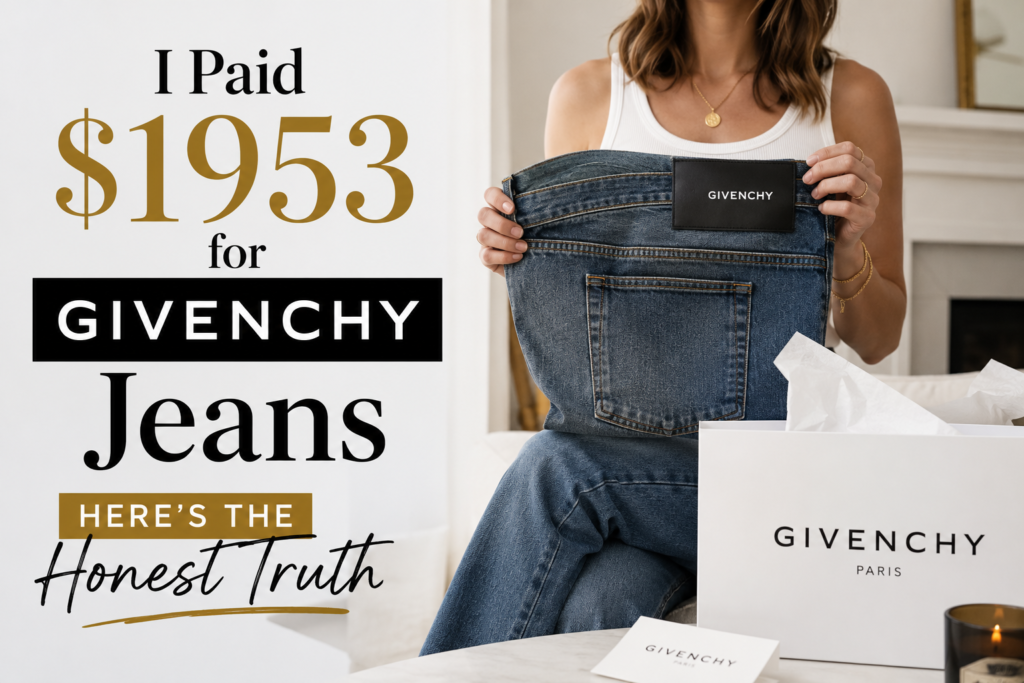
I Paid $1953 for Givenchy Jeans — Here’s the Honest Truth About Them
Nineteen hundred and fifty-three dollars. Not rent for the month — that’s what a single pair of givenchy jeans costs. Spending the money and doing the homework so nobody else has to felt like the only way to actually answer the real question: are you paying for unbelievable quality, or just a very, very expensive logo?
For most of us, denim is the foundation of a wardrobe. It’s supposed to be tough, dependable, and something anyone can wear. But in the world of luxury fashion, a pair of jeans can cost as much as a used car, which raises an obvious question: what could a brand possibly do to a simple pair of cotton pants to justify a price tag that is, honestly, completely insane?
This isn’t just any pricey denim — this is a top-tier pair from a legendary French fashion house. Givenchy, founded in 1952, is a name that means Parisian chic and high fashion. But does that legacy of elegance really translate into a pair of jeans that’s genuinely two thousand dollars better than anything else? The goal here is a totally honest look at the fit, the fabric, the feel, and the facts, all in service of one simple question: are these jeans even remotely worth it?
The Unboxing and First Impressions
When you’re paying this much, the whole experience better start the second it arrives. These came from a certified luxury retailer, and the packaging is a lot. There’s the heavy-duty shipping box, and inside that, the actual branded Givenchy box — sleek, black, and expensive-feeling.
Inside, the jeans sit wrapped in thick, branded tissue paper, sealed with a Givenchy sticker. Pretty standard for luxury goods, but it’s part of what you’re paying for: the presentation, the feeling of opening something special.
And there they are.
The first reaction is the weight. These things are heavy and dense — nothing like average jeans from the mall. The denim itself has a rigid, substantial feel. This reads as raw denim, meaning it hasn’t been pre-washed or treated, which usually signals higher quality and a much longer break-in period. The color runs a deep, inky blue. Running a hand over them, the texture feels smooth but with a definite grain, and the tag confirms 100% cotton. Zero stretch in these, which for denim purists counts as a very good sign.
Visually, they’re incredibly clean and simple. From a distance, they could be any pair of high-quality raw denim. Get closer, though, and the little details start showing up — and for almost two grand, those details better be amazing. They smell clean, like new cotton and dye. They certainly feel expensive. But “feeling expensive” and “being worth $1953” are two completely different things, so it’s worth taking a much closer look at whether the craftsmanship actually justifies that price.
The Expert Breakdown
After spending a lot of time looking at denim, from what’s on sale at Target to high-end selvedge, a few key things always separate real quality from just marketing.
Start with the fabric. This material feels incredible — dense, tightly woven denim that recalls the high-quality fabrics that come out of Japan, or possibly a top-tier mill in Italy or elsewhere in Europe. Either way, the feel is unmistakable top-shelf stuff. Running fingers along the inside, the weave reads as incredibly uniform, with no bumps or inconsistencies, which points to a controlled, high-end milling process. Being 100% cotton means these are built to last and meant to mold to the body over time rather than just stretch out and lose shape. This is the kind of denim that promises a personal journey, fading and creasing in a way unique to the wearer — a true hallmark of premium denim.
Next, the construction. The seams — inseam, outseam — tell a lot. The stitching runs a classic orange color, but the execution is what matters. The stitches are tiny, tight, and perfectly straight, with no loose threads or wavy lines anywhere. It’s almost robotic in its precision. Some designer jeans use details like twisted seams to create a certain shape, but these stick to a traditional straight seam, executed flawlessly. Turned inside out, everything looks perfectly finished and clean, with none of the messy stitching you’d find on cheaper pairs. This is built to last.
Then there’s the hardware, always a huge tell. The main button at the waist is a heavy, custom-engraved metal button stamped with the GIVENCHY name, solid and set securely. The zipper is a high-quality metal zip, and the pull carries subtle Givenchy branding. The rivets — those little metal studs on the pocket corners — are custom and perfectly placed too. These aren’t generic parts; they were made specifically for the brand, which adds to the cost but also makes the whole thing feel like a cohesive, well-designed product.
Finally, the details that make them Givenchy. On the back, a thick, black leather patch carries the brand name stamped in crisp lettering. Some Givenchy jeans go for a wild 4G monogram pattern, but these stay much more subtle — the only other branding is a small embroidered logo on a back pocket. This is luxury that whispers instead of shouts. The brand bets on quality and cut to make the statement, not a giant logo.
From a technical perspective, these jeans are impeccably made. The materials read as top-tier, and the craftsmanship is laser-precise. But the question still sits on the table: does this level of quality make them worth the price? Figuring that out means seeing how they actually fit.
The Fit, Comfort, and Styling
This is the moment of truth. All the fancy stitching in the world doesn’t matter if the fit is a disaster. European designer brands tend toward a very specific, tailored silhouette, and they often run slimmer than mainstream brands.
A standard size 32 seemed like the right test of just how slim the fit really runs. Pulling them on confirms it — raw denim is no joke. Getting into them is a genuine struggle, which, believe it or not, counts as normal for high-quality, non-stretch raw denim. The first wear should always feel a little tight.
Buttoned and on, the waist sits snug but not painful, right where it’s supposed to. In the mirror, the area around the hips and seat runs very fitted, but without pulling or straining.
The legs tell their own story. These run as a straight-leg cut, clean and sharp from the thigh down. Not a skinny jean, but a very lean silhouette, with length built long enough to cuff or hem. Turning a full 360, the denim’s structure creates a really flattering, almost architectural shape. It doesn’t just hang — it drapes exactly how the designer intended, and that’s where the high-fashion background really shows. The cut feels intentional.
Comfort is a different story, at least right now. These are not comfortable. At all. They feel like they’re made of starched cardboard. Walking feels stiff. Sitting down brings a very real awareness of wearing a serious pair of pants. But that’s not a flaw — it’s a feature of this kind of denim. Raw denim needs a break-in period, weeks or even months of steady wear. Over time, the fabric softens, and the jeans shape to the body, eventually becoming more comfortable than any pre-washed, stretchy pair could ever manage. It’s a commitment.
So how do you actually style jeans that cost almost two thousand dollars?
Look one keeps it simple: a good quality white t-shirt and clean leather sneakers. The jeans are the star here. The deep blue color and sharp cut elevate this basic outfit, making it look polished and effortlessly cool — a look for someone who values quality and fit over flash.
Look two dresses them up: black leather boots, a fitted black turtleneck, and a tailored wool coat. Instantly, the jeans transform. They hold their own in a more formal outfit with ease. The clean lines and dark wash make them look almost like tailored trousers — this works for a nice dinner or a creative work meeting, no problem.
The styling proves these can go beyond weekend wear and function as a foundation for a luxury wardrobe. The fit runs precise, if a bit demanding. And the comfort? That’s a long-term investment.
The Verdict
After the unboxing, the deep dive, and the try-on, the big question remains: are the $1953 Givenchy jeans worth it?
Break it down honestly, and if the goal is finding the absolute highest quality denim for the money, the answer is no. You are not getting two thousand dollars’ worth of fabric and stitching. Phenomenal jeans exist from cult-favourite denim brands like Iron Heart, Fullcount, or Momotaro — all famous for their incredible Japanese selvedge denim and obsessive construction — for a fraction of this price, often starting in the $300 to $500 range. Those brands cater to denim heads, and in that world, pure quality is king.
But buying into the world of Givenchy is a different game. You’re not just buying pants — you’re buying the brand, the design, and the status that comes with it. The price isn’t just about the quality, which is genuinely excellent, but about the brand’s place in the luxury world. You’re paying for the legacy of Hubert de Givenchy, the modern creative direction, and the simple fact that not everyone has these.
So who are these jeans actually for?
Givenchy jeans suit buyers who value brand prestige as much as material quality. They’re also a strong choice for fashion enthusiasts seeking a specific designer piece and who understand luxury pricing. For shoppers with significant disposable income building a designer wardrobe, these jeans can serve as a versatile staple that ties everything together.
These jeans don’t fit the person just looking to upgrade their denim and get the best bang for their buck. The law of diminishing returns is in full effect here. A $400 pair of top-tier selvedge jeans gets you 95% of the way there in terms of pure material quality and construction. That last 5% — the designer name, the specific cut, the custom hardware, the unboxing experience — is what costs an extra $1,600.
Givenchy jeans are expertly crafted with premium materials and a refined fit. However, much of their high price reflects the brand name rather than the denim itself. If you value luxury prestige, they may be worth it—but for most buyers, the cost outweighs the value.
It’s a fascinating peek into the world of high fashion, where quality and brand mythology get woven together into a single, very expensive pair of pants.
FAQ Section
Are Givenchy jeans worth the price?
It depends on what you’re optimizing for. For pure material quality and construction, no — comparable quality exists from selvedge denim specialists for a fraction of the cost. For brand prestige, design, and luxury status, the price reflects what you’re actually buying.
Why are Givenchy jeans so expensive?
The cost covers premium raw denim, custom-engraved hardware, precise construction, and the brand name itself. Much of the price comes from designer status and craftsmanship rather than raw material cost alone.
Do Givenchy jeans run true to size?
They tend to run in line with a slim, tailored European fit rather than a relaxed American cut. Sizing true to your usual measurement works, but expect a snugger fit through the hip and seat, especially since the denim isn’t pre-washed or stretched.
Is raw denim from Givenchy jeans uncomfortable at first?
Yes, initially. Raw, unwashed denim like this feels stiff and rigid out of the box and needs a break-in period of weeks or months before it softens and molds to the body.
What’s a cheaper alternative to Givenchy jeans with similar quality?
Brands like Iron Heart, Full count, and Momotaro offer comparable Japanese selvedge denim quality and construction, typically starting in the $300 to $500 range.