How to Find a White T Shirt Not See Through — The Fabric Science Nobody Tells You
This looks like a simple t-shirt. Classic. Essential. But it might be lying to you. The fashion industry has sold us this idea of the “perfect white tee,” but what they don’t tell you is that many of them are basically set up to fail. That white t shirt not see through promise? It’s not a given. The sheerness you hate isn’t really a bug — it’s a side effect of cheap manufacturing. Here’s the textile science that separates a great t-shirt from a sheer disappointment.
A white tee is supposed to be the ultimate blank canvas, the cornerstone of effortless style. But the second you step outside into bright sunlight, that illusion can completely shatter. Suddenly, you’re not wearing a wardrobe staple — you’re wearing a fabric stress test. We’ve all been there: standing in front of a mirror, twisting and turning, asking yourself, “Is this too see-through?” It’s a frustrating ritual that makes you question the shirt, the lighting, and maybe your whole outfit.
That sinking feeling is the deception. You thought you bought a simple, confident basic, but instead you got a garment that makes you feel self-conscious. The see-through problem isn’t just about color — it’s about science. The answer isn’t simply to “buy a better shirt.” It’s about understanding the fabric, the weave, the weight, and the fit.
The Science Behind a White T Shirt Not See Through
The first thing to understand is that transparency is fundamentally a fabric problem, not a color problem.
Think about it this way: white fabric reflects more light than dark fabric. When a fabric is thin or loosely woven, there are tiny gaps between the threads. Light passes through those gaps, hits your skin, and because white fabric is so reflective, it bounces back an image of whatever is underneath. A dark shirt absorbs more of that light, which helps hide what’s going on underneath. White doesn’t have that luxury.
It All Starts at the Fiber Level
A huge key to opacity is density. A dense, tightly knit fabric has smaller gaps, which means less light passes through. Instead, light scatters across the surface of the threads and creates a solid, opaque look. This is why two white t-shirts can look identical on the hanger but perform completely differently once you put them on. One is a solid wall. The other is a chain-link fence.
Long-Staple Cotton: The Material That Actually Matters
How do you find that solid wall? It starts with the material.
You’ll hear a lot about cotton, but not all cotton is the same. The magic words to look for are long-staple cotton — specifically Pima or Supima. “Staple” refers to the length of the individual cotton fibers. Long-staple fibers are smoother and stronger, so when they’re spun into yarn, they create a more uniform thread with fewer fuzzy ends sticking out.
Short-staple cotton, the kind used in most cheap tees, creates a weaker, fuzzier yarn that’s more prone to thinning and pilling over time. That’s why a high-quality, long-staple cotton tee feels smoother and lasts much longer. As Vogue’s guide to the best white t-shirts points out, fabric quality is the single biggest factor separating a tee you’ll wear for years from one you’ll throw out after three washes.
GSM: The Number That Predicts Everything
For opacity, there’s one critical number you need to know: GSM, or Grams per Square Meter. This is a direct measurement of the fabric’s density and weight.
A flimsy, almost-sheer t-shirt usually has a GSM of around 120–150. For good opacity, look for a t-shirt in the 160 to 220 GSM range, often described as mid-to-heavyweight. A higher GSM means more cotton packed into every square meter, which physically blocks more light. It’s one of the most reliable indicators of whether a shirt will actually pass the see-through test.
The White T-Shirt Showdown: Budget vs Mid-Range vs Designer
Let’s put this science to the test with three white t-shirts that represent what most of us have in our closets.
The Budget Multipack Tee (~$10)
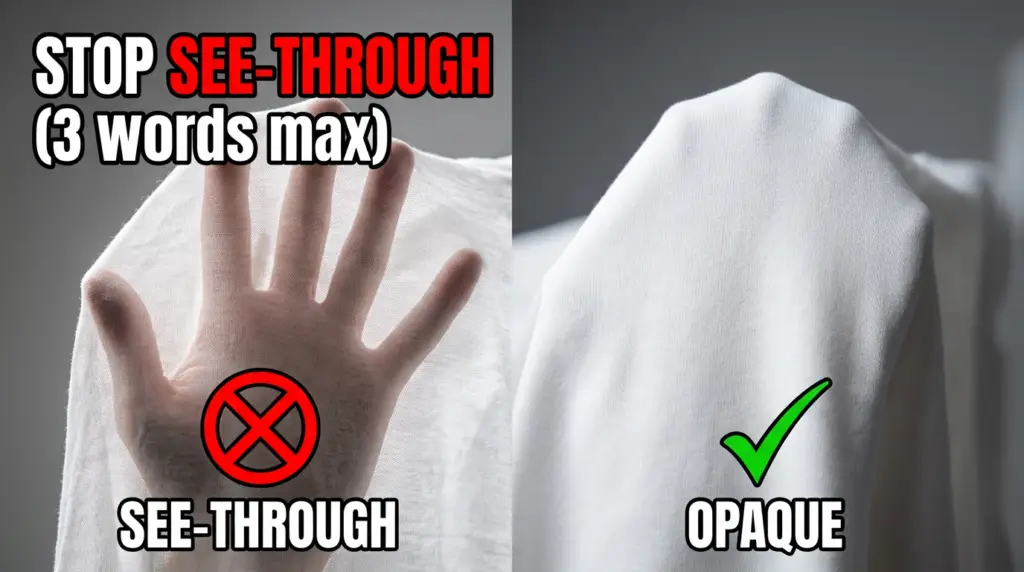
Holding it up, the problem is immediately obvious. The fabric feels incredibly thin. Place your hand behind it and you can clearly see the outline of your fingers. This is a classic sign of low GSM — probably around 140 — and standard short-staple cotton. The weave is loose, and when you give it a gentle stretch, the see-through problem gets even worse.
This shirt feels like it was designed as an undershirt. The frustration comes from the fact that it’s often sold as a standalone tee. Hard pass, unless you’re strictly layering it under something else.
The Mid-Range “Internet Favorite” (~$40)
The tag says 100% Pima cotton — a great start. The fabric immediately feels more substantial, likely in the 180 GSM range. The hand test shows way lower visibility. You can see a faint shadow, but no distinct shapes. The knit is much tighter, holds its structure well when stretched, and the collar is thick and reinforced — a sign of better construction overall.
This is a really solid contender.
The Expensive Designer Tee (~$100+)
The fabric is incredibly soft, and the tag boasts about an “exclusive” Supima cotton blend. It feels heavyweight — likely over 200 GSM. It passes the hand test with flying colors: basically zero transparency. The drape feels structured and luxurious.
But is it five times better than the mid-range option? The opacity is slightly better, sure. The main difference is really the feel and fit. For pure see-through performance, the mid-range tee gets you 95% of the way there for a fraction of the price.
The Verdict
The budget tee is a definite skip unless you’re wearing it strictly as an undershirt. The expensive designer tee is a luxury. But the clear winner for value and performance is the mid-range, Pima cotton tee. It hits the sweet spot of high-enough GSM and long-staple fibers to give you great opacity and real durability.
Surprising Things That Can Still Sabotage Your White Tee
Even if you buy a high-GSM, long-staple cotton masterpiece, there are still a few things that can undermine your look.
The Undergarment Mistake Almost Everyone Makes
The biggest mistake? What you wear underneath.
Logic might tell you to wear a white bra or white undershirt beneath a white t-shirt. That’s actually the wrong move. White undergarments create a stark contrast against your skin, making their outline even more visible through the shirt. The real solution is to wear undergarments that match your skin tone. A nude-colored bra or camisole blends in, neutralizes that contrast, and becomes practically invisible. It’s a counterintuitive trick that genuinely changes everything.
Optical White Isn’t Always Your Friend
The absolute whitest white isn’t always your best option. That brilliant, optical white on many cheaper tees creates a harsh contrast with your skin tone, which can make any sheerness more noticeable. A slightly off-white, cream, or ecru-colored shirt often appears more opaque because the softer color is more forgiving against skin. As Refinery29’s white tee style guide notes, the most flattering “white” for everyday wear is often the one that isn’t the brightest shade on the rack.
So, the most practical choice might not be the brightest one in the store.
Fit Matters More Than You Think
Don’t underestimate the impact of fit. A t-shirt that’s too tight stretches the fabric, pulling the knit apart and letting more light pass through — that’s just physics. Even a high-quality tee can look sheer if it’s straining across your chest or shoulders.
Opting for a fit that skims your body without clinging not only looks more modern but also helps the fabric do its job. You don’t need a baggy shirt — just one that isn’t under constant tension.
Your Practical Checklist for a White T Shirt Not See Through
A great white t-shirt should feel invisible in the best way possible. It should look clean, fit well, and let you stop thinking about it the second you put it on.
Here’s your quick checklist when shopping:
1. Check the tag. Look for long-staple cottons like Pima or Supima for a smoother, more durable fabric.
2. Feel the weight. Look for shirts described as mid-weight or heavyweight — that typically means a GSM of 160 or higher.
3. Do the hand test. Hold the fabric up. If you can clearly see the details of your hand through it, it’s going to be see-through in daylight too.
4. Perfect your foundation. Wear skin-toned undergarments for a seamless look — not white ones.
5. Nail the fit. Choose a size that drapes cleanly without pulling or stretching the fabric across your body.
Once you understand the formula, the mystery disappears. It’s not magic — it’s just fabric density, fiber length, and light. You’ll know exactly what to look for, and you’ll stop wasting money on white tees that let you down.
FAQ Section
Q: Why is my white t shirt see through?
A: Most white t-shirts look see-through because they have a low GSM (fabric weight) and use short-staple cotton, which creates a looser, thinner weave. White fabric also reflects light rather than absorbing it, which makes any gaps in the knit more visible than they would be in a dark shirt.
Q: What makes a white t shirt not see through?
A: The two biggest factors are GSM and fiber quality. Look for a t-shirt with a GSM of 160 or higher (mid-to-heavyweight), made from long-staple cotton like Pima or Supima. A tighter knit, proper fit, and skin-tone undergarments also make a significant difference.
Q: What GSM should a white t-shirt be to avoid being see-through?
A: For reliable opacity, aim for 160–220 GSM. Anything below 150 GSM is likely to be sheer, especially in direct sunlight. Mid-weight and heavyweight tees in this range are your safest bet.
Q: Does wearing a white bra under a white shirt help?
A: No — a white bra actually makes the problem worse. White undergarments contrast with your skin tone, making their shape more visible through the shirt. Wear nude or skin-tone matching undergarments instead. They blend in and become virtually invisible.
Q: Is Pima cotton better for white t-shirts?
A: Yes. Pima (and Supima) cotton uses long-staple fibers, which spin into a smoother, denser yarn. The result is a tighter knit with fewer gaps — which means better opacity, a softer feel, and better durability over time compared to standard short-staple cotton.