The Best Facial Cleansers for Laser Treatment Skincare Recovery
You just made a big investment in your skin with a laser treatment. That is genuinely great. But honestly, the most critical part of the entire journey is happening right now — at your bathroom sink. Using the wrong cleanser can seriously irritate your healing skin and slow down your recovery. The right one, however, will speed up that healing and protect the investment you just made.
The best facial cleansers laser treatment skincare routines depend on are not always the most expensive or the fanciest. More often than not, they are the simplest. Here is everything you need to know.
Your Skin Is Playing by a Whole New Set of Rules
First, you have to understand that for the next few weeks, your skin is operating under a completely different set of rules. Laser treatments — especially for resurfacing or pigmentation — work by using controlled energy to create change in the skin. By design, this process temporarily disrupts your skin’s natural protective barrier.
All of a sudden, your face can feel hot, tight, dry, and incredibly sensitive. That face wash you have loved for years might suddenly sting or make you noticeably redder. That is a sign. It is your skin telling you its defences are down.
During this healing window, your skin is far more absorbent and vulnerable than usual. Ingredients that were completely fine before can suddenly become serious problems.
This is where a big mindset shift becomes necessary. Your normal skincare routine — the one full of “actives” like Vitamin C, retinoids, or exfoliating acids — is on pause. The goal is no longer to “treat” or “optimise” your skin. The new goal is much simpler and far more important: protect the healing process. Think of it less like a skincare routine and more like a recovery protocol. And in that protocol, doing less is almost always doing more.
Best Facial Cleansers Laser Treatment Skincare Actually Needs
So what actually makes a cleanser safe and effective after a laser treatment? The answer is not a fancy brand name or a high price tag. It is a specific type of formula. The keywords to look for are “gentle,” “hydrating,” “mild,” and “for sensitive skin.”
The job of your cleanser right now is simply to remove sweat, dirt, and excess oil — without stripping your skin of its essential moisture. This means actively avoiding anything that leaves you with that “squeaky clean” feeling. That sensation is usually a sign you have stripped away your skin’s natural fats, which is the last thing a compromised barrier needs.
Texture Matters More Than You Think
Reach for a creamy, milky, or non-foaming cleanser. Heavy foaming agents — like sulfates — are designed to break down oil aggressively, which is far too harsh and drying at this stage. A gentle, low-foaming or non-foaming cream cleanser will do the job without disturbing your skin at all.
Keep the Ingredient List Short
Now is not the time for a science experiment on your face. Look for cleansers that are completely free of common irritants. The most important things to avoid on a label are “fragrance” or “parfum” and essential oils. Even natural ingredients like lavender or citrus oils can be majorly irritating on sensitised skin. Make sure the formula is also free from any physical scrubs or exfoliating beads.
The Ingredients You Actually Want to See
Instead of harsh actives, look for these supportive, skin-friendly ingredients:
- Glycerin — a brilliant, reliable hydrator
- Ceramides — help restore and strengthen the skin’s barrier
- Niacinamide — genuinely soothing and calming for redness
- Panthenol (Pro-Vitamin B5) — excellent for supporting the skin’s healing process
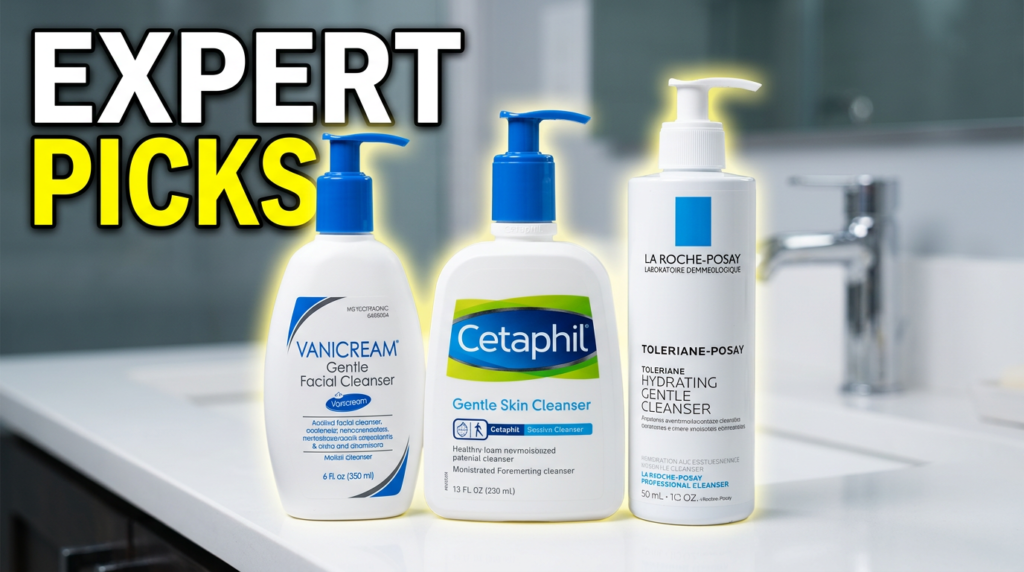
This is precisely why dermatologists consistently recommend affordable, easy-to-find options. Products like Vanicream Gentle Facial Cleanser, Cetaphil Gentle Skin Cleanser, and La Roche-Posay Toleriane Hydrating Gentle Cleanser are popular for a very good reason. They are formulated to be non-irritating, fragrance-free, and effective without any drama. They are the living proof of the “boring is better” philosophy that is so key for post-procedure care.
As Byrdie’s guide to post-laser skincare confirms, the most consistently recommended cleansers after laser treatments are simple, fragrance-free formulas — not specialty post-procedure products with inflated price tags.
The “Don’ts”: What to Avoid in Your Post-Laser Cleanser
Knowing what not to do is just as important as knowing what to do. The wrong product or technique can genuinely set your healing back. So here is the complete “don’t” list — and it is worth taking seriously.
Ingredients to Avoid Entirely
These should be out of your cleanser — and your whole routine — until your provider gives you the green light. The timeline varies from a few days to a few weeks depending on the type and intensity of your laser, so their advice is always the final word. Generally, though, these are firmly on pause:
- Retinoids — all forms of Vitamin A, including retinol and tretinoin. They speed up cell turnover, which is far too aggressive for skin that is actively healing.
- Exfoliating acids — no AHAs like glycolic or lactic acid, and no BHAs like salicylic acid. These will sting and can cause serious inflammation.
- Vitamin C — this one surprises people, but most Vitamin C serums have a low pH that can be very irritating to a compromised barrier. It is best to wait.
- Alcohol — check labels carefully for denatured alcohol, especially in toners. It is incredibly stripping and will only leave skin drier and more irritated.
The Physical Don’ts Are Just as Important
How you wash your face matters just as much as what you wash it with.
- Do not use hot water. Hot water strips the skin and can increase inflammation. Always use lukewarm or cool water instead.
- Do not scrub your face. Put away the washcloths and cleansing brushes. Use only your clean fingertips with the gentlest possible pressure. For more intense ablative procedures like certain CO2 laser treatments, your doctor may provide a very specific cleansing protocol — follow it exactly.
- Do not rub your skin dry. After rinsing, gently pat your face dry with a clean, soft towel. Never reuse a towel that could carry bacteria.
Every single one of these don’ts exists to prevent one thing: irritation. And irritation, at this stage, is the enemy of good healing.
The Healing Trinity: Cleanse, Moisturise, Protect
Your cleanser is step one, but it is only one part of the post-laser recovery puzzle. To truly support your skin, think in a simple three-part system: Cleanse, Moisturise, and Protect.
After gently cleansing, moisturise immediately while your skin is still slightly damp. That timing helps lock in hydration effectively. And just like with cleansers, the best post-laser moisturisers are straightforward and supportive. Look for a bland, fragrance-free cream with ceramides, hyaluronic acid, and shea butter. For the first few days after a very aggressive laser, your doctor might recommend a thick, occlusive ointment like Aquaphor to keep skin constantly moist and protected. The mantra is simple: do not let your skin dry out.
The final step — and arguably the most important one — is protection. Sunscreen is completely non-negotiable after laser treatment. Your new skin is extremely vulnerable to UV damage. Sun exposure can not only be painful at this stage but can easily cause dark spots, known as post-inflammatory hyperpigmentation, which can ruin the very results you just paid for.
Most experts recommend a broad-spectrum mineral sunscreen with SPF 30 or higher — often SPF 50. Mineral formulas with zinc oxide and titanium dioxide tend to be far less irritating for sensitive, post-procedure skin than many chemical filters. Apply generously every single morning, reapply as directed, wear a wide-brimmed hat, and seek shade wherever possible. This is not just a suggestion. It is a critical instruction.
According to Vogue’s breakdown of the most important post-laser skincare steps, sun protection after laser treatment is consistently ranked as the single most important aftercare step by dermatologists — more important than any serum or treatment product.
The Psychology of Patience Nobody Talks About
There is a very human side to post-laser recovery that is worth addressing, because it is easy to get impatient. Some flaking may appear, tempting you to scrub it away. Dryness can make a fancy facial oil seem like the perfect solution. A bit of redness may also encourage you to reach for a “soothing” mask that is actually packed with irritating essential oils.
Resist that temptation — genuinely.
A significant number of preventable issues after laser treatments do not come from the procedure itself. They come from impatience during aftercare. That flaking skin is part of the process. Trying to rush it by exfoliating will only expose skin that is not ready yet, which leads to more irritation and a longer, harder recovery.
Think of it this way: your skin is a freshly repaired road. You would not immediately start doing burnouts on it. You would let the surface cure and strengthen first. Your skin needs exactly that same respect. The boredom of a simple, minimal routine is a feature, not a flaw. It means you are giving your skin what it actually needs — the time and space to heal itself properly.
The Complete Post-Laser Cleansing Game Plan
The formula for a perfect post-laser cleansing routine is straightforward: choose a gentle, fragrance-free, non-foaming cleanser. Use only your fingertips and lukewarm water. Pat your skin dry. Follow up immediately with a simple moisturiser, and never skip your mineral sunscreen during the day.
But the most important rule of all is to follow the specific instructions from your dermatologist or laser technician. They know exactly what your skin just went through and precisely what it needs. Their guidance always takes priority over any general advice — including this one.
The real secret to amazing laser results is not hiding in a magic serum. It is in disciplined, gentle, and patient aftercare. It is about respecting the healing process and trusting it to do its work.
FAQ Section
Q1: What are the best facial cleansers laser treatment skincare routines should include?
A: The best facial cleansers laser treatment skincare routines rely on are gentle, fragrance-free, and non-foaming. Top dermatologist-recommended options include Vanicream Gentle Facial Cleanser, Cetaphil Gentle Skin Cleanser, and La Roche-Posay Toleriane Hydrating Gentle Cleanser. These are affordable, widely available, and specifically formulated to be non-irritating.
Q2: How soon after laser treatment can I wash my face?
A: Most providers recommend waiting a specific number of hours before cleansing — usually between 6 to 24 hours depending on the intensity of the treatment. Always follow your dermatologist’s or laser technician’s specific post-procedure instructions as the primary guide.
Q3: Can I use micellar water after laser treatment?
A: Some gentle, fragrance-free micellar waters can be appropriate, but check the ingredients carefully. Avoid any that contain alcohol, fragrance, or strong surfactants. When in doubt, a simple cream or milky cleanser is the safer choice during early healing.
Q4: How long should I avoid actives after laser treatment?
A: Generally, retinoids, exfoliating acids, and Vitamin C serums should be avoided for at least one to two weeks after treatment, sometimes longer depending on the type of laser used. Your provider will give you a personalised timeline — always follow their advice first.
Q5: Why does my usual cleanser suddenly sting after laser treatment?
A: Because your skin’s protective barrier has been temporarily disrupted by the laser, it becomes far more sensitive and absorbent. Ingredients that were previously harmless — including mild foaming agents, fragrances, and even some natural extracts — can now cause stinging, redness, or irritation.