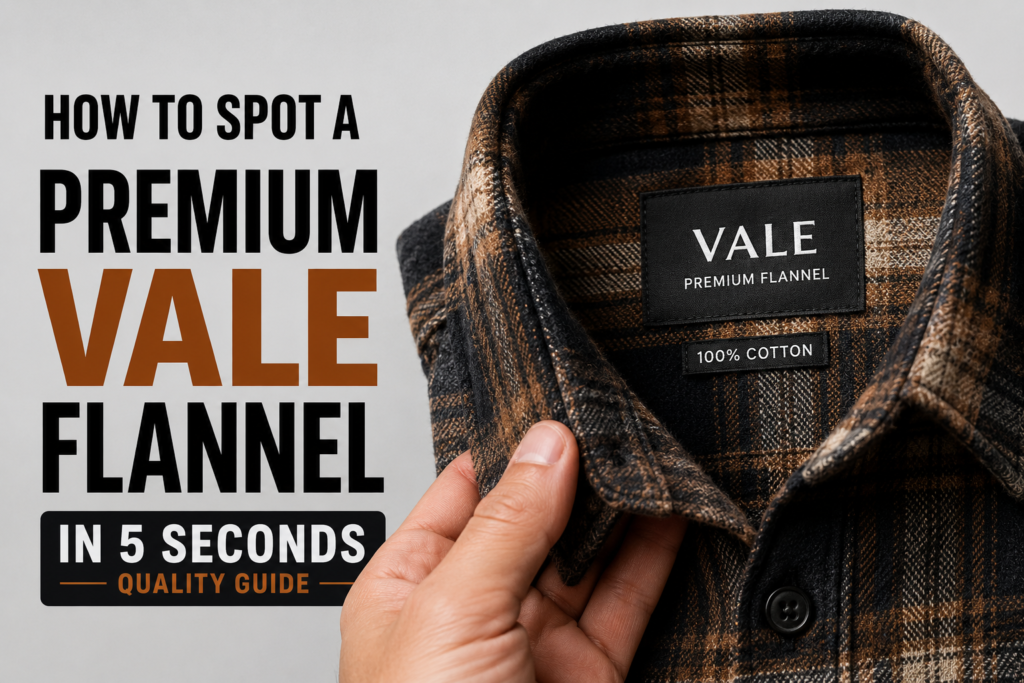
How to Spot a Premium Vale Flannel in 5 Seconds
A cheap flannel feels like paper. It’s thin, the colours look muddy almost immediately, and it’ll likely shrink into a doll’s shirt after one wash. Then there’s the quality flannel—it feels like a blanket. It’s heavy, incredibly soft, and feels like it’s been your favourite shirt for ten years right off the rack. The difference between a $20 fast-fashion flannel and a premium vale flannel at $200 isn’t just the price tag. It’s in the fabric, the construction, and the details that separate a shirt you’ll wear for one season from one that becomes a cornerstone of your wardrobe.
Most people can’t tell the difference when they’re shopping. But you can learn the insider tricks to spot a premium, ultra-soft vale flannel in five seconds, so you stop wasting money and start building a wardrobe that feels as good as it looks.
The 5-Second Test That Changes Everything
Forget the brand name for a moment. The first test of quality is all about the fabric’s density and softness, and you can feel it instantly.
I call it the “pinch and roll” test, and it’s the single most important thing you need to know.
Take a piece of the flannel between your thumb and forefinger. On a cheap shirt, when you pinch and roll the fabric, it feels thin, flat, almost papery. You can feel the individual threads, and there’s no real substance. It might even feel a little stiff from the chemicals used to make it look good on the shelf.
Now do the same on a premium vale flannel. It’s a completely different world. The fabric feels thick, substantial, and dense. When you roll it between your fingers, it has a plush, almost spongy quality. This is called “loft,” and it’s the result of high-quality brushing. You can’t feel the individual threads; instead, it feels like a single, soft, cohesive material.
That loft is what traps air and gives flannel its signature warmth. A cheap flannel often has superficial fuzz, but a great one is full of deep, dense loft. If it feels dense, plush, and substantial, you’re on the right track. If it feels thin, flat, and lifeless, walk away.
Understanding Flannel vs. Plaid: The Foundation
Before we go deeper, let’s clear something up. A lot of people use “plaid” and “flannel” interchangeably. They’re not the same thing. Plaid is a pattern—those intersecting lines of colour. Flannel is the fabric itself. You can have a plaid shirt that isn’t flannel, and you can have a flannel shirt that isn’t plaid.
Flannel is a woven fabric defined by its softness, which comes from a process called “napping” or “brushing.” After the fabric is woven, it’s literally brushed with fine metal brushes. This process lifts millions of tiny fiber ends from the surface, creating that fuzzy, soft-to-the-touch feel. It’s this fuzzy surface that traps air, providing insulation and making flannel warm and cozy.
High-end flannels are often double-brushed, meaning both sides of the fabric are napped for maximum softness and comfort. Cheaper flannels are often only brushed on one side, or undergo light brushing that creates superficial softness that disappears after the first wash. That’s why that cheap shirt feels stiff and flat so quickly—the illusion of softness is gone.
Material Quality Matters
The material itself is critical. For that classic, breathable, and soft feel, you’re usually looking for 100% cotton. Some of the most highly-regarded flannels come from Portugal, which is world-renowned for its textile heritage and meticulous brushing techniques. You’ll also see incredible ultra-heavy flannels from Japan, known for complex weaves and indestructible quality. For pure warmth and water resistance, premium options in wool or wool blends are perfect for true outdoor layering. Documents how flannel evolved as one of the most durable fabric traditions across cultures.
Low-quality flannels are often made from cheaper cotton or, increasingly, synthetic blends. If the tag says “100% polyester,” you’re looking at what the industry calls “micro-flannel.” While it’s soft and shrink-resistant, it doesn’t have the same breath ability and natural feel as traditional cotton flannel.
Weight and Weave: The Unseen Quality Indicators
Now that you’ve done the five-second test, the next thing to consider is the fabric’s weight. This is one of the biggest predictors of a flannel’s longevity and quality. Fabric weight is measured in ounces per square yard (oz/yd²) or grams per square meter (GSM).
Lightweight flannels, the kind you often find in fast-fashion stores, are typically in the 3 to 5-ounce range. They feel light, but this lightness often comes at the cost of durability, thinning out at the elbows and fraying at the cuffs over time.
A quality, mid-weight flannel—great for a versatile, three-season shirt—is usually in the 5 to 8-ounce range (around 170 GSM and up). It’s substantial enough to be durable and warm, but still light enough to layer comfortably.
Then you have the heavyweight and ultra-heavyweight flannels. These can range from 8 ounces all the way up to 15 ounces or more. When you hold a 12-ounce flannel, it feels more like a jacket than a shirt. These are often heritage-quality pieces designed to be worn for decades, not just a season.
How to Judge Weight While Shopping
Simply hold it. Let it drape from your hand. A quality vale flannel has heft. It feels substantial. If it feels light and airy, it’s likely not built to last. Another quick test is to hold the fabric up to a light. If you can easily see through the weave, it’s a sign that it’s too thin. A dense, high-quality flannel will block most of the light.
The weave itself is just as important. On a cheap flannel, if you gently pull the fabric, you might see the weave distort or separate. On a premium flannel, the weave is tight and consistent, which means it will hold its shape wash after wash.
Construction Details: Separating Good from Great
This is where we separate the good from the great. The small details in construction are a dead giveaway of a shirt’s quality and tell you how much care went into its making.
Pattern Matching
On a high-quality plaid flannel, the lines of the pattern will match up almost perfectly where different pieces of fabric meet. Look at the front placket, the shoulder seams, and especially the pockets. A cheap shirt won’t bother with this. The patterns will be misaligned, creating a jarring, chaotic look. Meticulous pattern matching takes more fabric and more time, so it’s one of the first corners cut to save money.
Stitching Quality
On a cheap shirt, you’ll see single-needle stitching with long, loose stitches that are prone to snapping. Now look at a premium flannel. You’ll often find double or even triple-needle stitching on high-stress areas like the shoulder seams and armholes. The stitches are small, tight, and dense. Also, look for flat-felled seams, especially along the sides. This durable seam folds the raw edges of the fabric in and sews them flat, creating a very clean and incredibly strong seam that you can spot by its two visible rows of stitching.
Hardware and Finishing
Buttons on a cheap flannel are usually thin, brittle plastic. A premium flannel will have thick, substantial buttons made of denser materials like urea or even horn. Give a button a little wiggle. On a quality shirt, it feels securely anchored.
And don’t forget to look at the “guts” of the shirt. Turn it inside out. A cheap shirt will be a mess of loose threads. A well-made shirt will be almost as clean on the inside as it is on the outside. This attention to detail, even in places no one sees, is a hallmark of quality craftsmanship.
The Intangibles: Fit, Heritage, and Long-Term Value
A great flannel isn’t just about the fabric; it’s about how it makes you feel. The fit of a premium flannel is intentional. It’s not a shapeless, baggy uniform. A modern, classic fit should have enough room to layer, but still follow the lines of your body. The shoulder seams should sit right on your shoulder bone, not drooping down your arm.
Then there’s the story. When you buy a vale flannel from a heritage brand or a Japanese textile maker, you’re not just buying a shirt. You’re often buying into a legacy—a garment made by fourth-generation artisans or fabric woven with centuries of history. This commitment to craft is woven into the shirt itself.
Is a Premium Flannel Worth the Investment?
Think of it this way: a shirt with thin fabric and flimsy construction might last you a season if you’re lucky. After a few washes, it can pill, shrink, and lose its softness. A high-quality vale flannel, on the other hand, is an investment. Many are pre-shrunk and built to last, and that’s a feature worth checking the label for. In fact, a great flannel gets better with age. The cotton softens even more with each wash, molding to your body and developing a unique character. Ten years from now, that shirt will still be the first thing you reach for when the weather turns cool.
FAQ Section
What makes a vale flannel different from a regular flannel?
Premium vale flannels use higher-quality materials (100% cotton), double-brushing for maximum softness, superior stitching (double or triple-needle), and intentional construction details like pattern matching and flat-felled seams.
How can I test flannel quality in the store?
Use the “pinch and roll” test: pinch the fabric between your thumb and forefinger. Premium flannel feels plush and substantial with deep loft, while cheap flannel feels thin and papery. Also hold it up to light—a quality flannel blocks most light.
What’s the ideal weight for a vale flannel?
Mid-weight flannels (5-8 ounces or 170+ GSM) are versatile for three-season wear. Heavyweight flannels (8-15+ ounces) are more durable and feel like jackets. Lightweight flannels (3-5 ounces) are less durable.
Is 100% cotton flannel better than synthetic blends?
Yes, 100% cotton flannel offers better breath ability and natural softness. Synthetic “micro-flannel” is shrink-resistant but lacks the same feel and breath ability as traditional cotton flannel.