Why a Leather Bag Woven by Hand Can Cost $5,000 — The Craft Secret Hidden in Plain Sight
From across the room, it looks almost plain. Simple. Understated. A clean silhouette with no logos, no flashy hardware. The kind of thing that’s instantly recognizable — but only if you already know what you’re looking at.
Get closer, though, and the illusion breaks. A leather bag woven using this technique isn’t a simple surface at all. It’s a complex system of tension and craft, designed to fool the eye. What you’re actually seeing is a grid of precise cuts and perfect alignment. It’s an architectural marvel that just happens to be an accessory. The reason this woven bag looks so expensive isn’t just the leather. It’s the shocking amount of work hiding in plain sight.
So, what makes a simple-looking bag worth five thousand dollars? This article pulls apart how the unique weave actually works, why it’s so difficult to get right, and how it became one of fashion’s most powerful — and expensive — secrets.
The Technique Behind Every Leather Bag Woven with Intrecciato
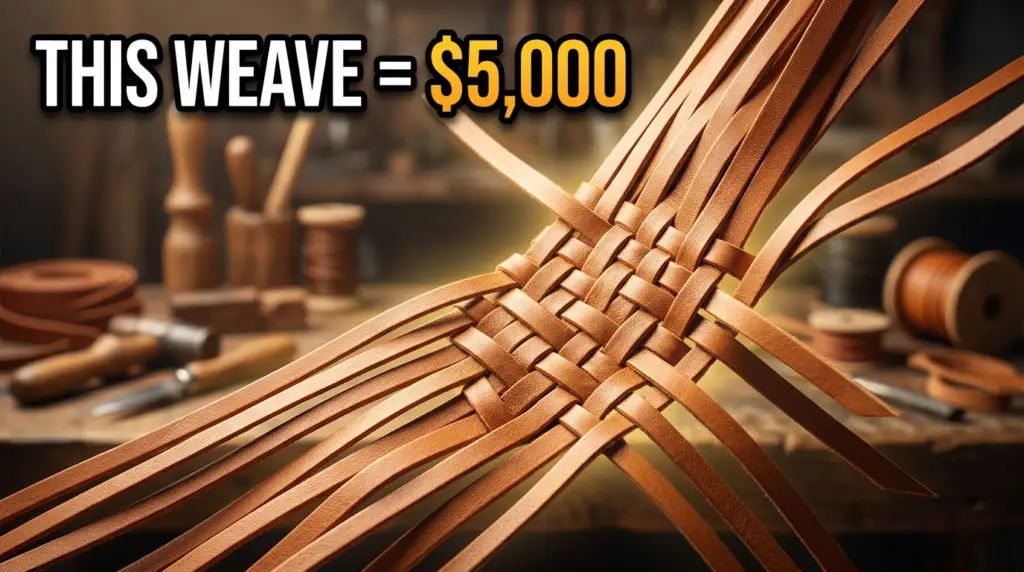
The technique is called Intrecciato, which is Italian for “interlaced” or “woven.” Thin strips of leather, called fettucce, are woven together to create a single, durable surface. But that description doesn’t do it justice. This isn’t like weaving a basket. It’s a painstaking process that can take days, and it all starts with the material.
The First Secret: The Leather Itself
Not just any leather works for this. The hide has to be incredibly soft and flexible — like lambskin — but also strong enough to be cut into thin strips and woven under tension without tearing. Artisans are incredibly selective about it. While they can cut around small imperfections in the hide, a significant weak spot could compromise the integrity of the entire weave. One bad strip and the whole surface suffers.
Once the right leather is chosen, it gets cut into dozens — sometimes hundreds — of uniform strips. This step demands extreme precision. If the strips are even a millimeter off, the whole pattern throws itself out of alignment.
The Second Secret: How It’s Actually Built
In some cases, artisans cut staggered, parallel slits into a solid panel of leather and then weave separate strips through. However, the most iconic and labor-intensive method — the one used for bags like Bottega Veneta’s famous Cabat — works differently. There is no pre-existing panel. Instead, the bag is woven from scratch, using double-faced strips of leather wrapped around a form. The artisan has to maintain perfect, consistent tension with every single row.
This is when it becomes clear that the weave isn’t just decorative — it is the structure. The story goes that this specific technique developed at Bottega Veneta in the late 1960s or early 1970s. Their sewing machines weren’t suited for thick leather. So by weaving together thin, supple strips, craftspeople created a material that was both strong and flexible.
The final product is often seamless, with no lining — the inside can look identical to the outside. It holds together purely through the integrity of the weave itself, with reinforcements only at key stress points. As Vogue’s deep dive into heritage craftsmanship explains, your eye registers all that discipline before your brain even knows what it’s looking at. The texture becomes a signal: somebody did this, very, very carefully.
The Price Tag: Quiet Luxury and the Psychology of the Weave
Understanding the technique explains the work. But it still doesn’t fully explain a five-thousand-dollar price tag. That’s where the conversation moves from technical into psychological.
The Third Secret: Quiet Luxury
In an era of loud logos and in-your-face branding, the Intrecciato weave sits at the opposite end of the spectrum. For its most classic pieces, the craftsmanship itself is the signature. It sits at the heart of Bottega Veneta’s founding philosophy: “When your own initials are enough.”
This creates a very different kind of status symbol. A bag covered in logos shouts its value to everyone in the room. A woven bag whispers. It’s an “if you know, you know” item — and that feeling of being in on a secret is a powerful driver of desire. In a world where obvious branding can sometimes feel a little desperate, quiet luxury signals genuine confidence. It suggests the owner isn’t looking for approval. Their own taste is enough.
The Visual Trick at Play
There’s also something happening optically. A flat piece of leather reflects light fairly uniformly. A woven surface, by contrast, carries hundreds of individual facets. Those facets catch and break the light from every angle, giving even a simple shape a sense of movement and depth that a flat bag simply can’t match.
This combination of visible labor and subtle signaling is what turns a well-made product into a luxury icon. The buyer isn’t just paying for the hours of work. They’re paying for the story the bag tells about its owner — a story of taste, restraint, and an appreciation for craft over advertising.
The Human Element: Craft, Character, and Durability
The impact of a leather bag woven this way reaches beyond fashion trends. For the artisans who make them, this technique is about preserving a craft. In a world obsessed with making things faster and cheaper, the Intrecciato weave makes human skill and patience physically visible. For a top-tier, entirely handmade bag, a single artisan can spend days on just one piece. That isn’t just a number — it’s a physical embodiment of time. It’s a quiet protest against the disposable.
And owners can feel that. The bag doesn’t feel like a sterile, machine-made object. The tiny, almost invisible variations that come from handwork aren’t flaws — they’re proof that it’s real. True luxury, after all, isn’t always about machine-like perfection. Sometimes it’s about character.
Durability That Comes from Structure
Then there’s the question of durability. A well-made woven bag is exceptionally strong because it distributes stress across the entire surface rather than concentrating it at seams. Scuffs and creases that might ruin the look of a sleek, flat leather bag often just blend into the woven texture, adding to its character over time rather than detracting from it.
Spotting the Real Thing
Of course, countless imitations exist — and that’s fine. They make the style accessible to a much wider audience. However, they also make it harder to know what you’re actually paying for. A truly handcrafted piece uses high-quality leather and solid construction throughout. A cheaper bag might mimic the look, but it will fall apart differently. The durability of the real thing lives not just in the weave itself, but in the backing, the adhesives, and the edge finishing — details you don’t always see at first glance. As Harper’s Bazaar notes in their guide to investment handbags, this is the difference between buying a look and investing in genuine craftsmanship.
Where the Woven Leather Bag Goes Next
So, where does a technique this old-school fit in the modern world? Surprisingly, it might be more relevant than ever. In a world of slick, digital, and frictionless surfaces, an object with tangible texture genuinely stands out. It invites you to look closer, to reach out and touch it. It makes the passage of time feel like a good thing rather than something to be hidden.
How the Design Language Is Evolving
The design language of the weave is already evolving fast. Designers now use it as a canvas to experiment with scale — from a tiny micro-weave that reads almost as a solid texture from a distance, to a huge, padded Maxi Intrecciato that creates a bold, almost sculptural effect. New materials and construction methods are also emerging to make woven bags lighter or more structured depending on the look.
This points to two futures happening simultaneously. On one hand, the woven leather look will likely appear everywhere, adopted by brands at every price point as a way to signal quality. On the other hand, this will probably make the original artisanal version more valuable, not less. The more easily a machine can imitate something, the more people tend to appreciate the version it can’t replicate.
There’s a deeper cultural pattern underneath all of this, too. Contemporary culture celebrates ease and speed above almost everything else. Woven leather is the opposite. By making the process visible, it naturally slows things down. That deliberate rhythm suggests that doing things the hard way isn’t an inefficiency to eliminate — it’s entirely the point. And that’s why a bag made with an ancient technique can feel so radically modern. It’s an old tradition that keeps finding new ways to stay relevant.
What to Look for When Buying a Woven Leather Bag
Before buying, it’s worth knowing what to actually look at beyond the general vibe.
Check the Construction
Start with the weave itself. Is it tight and even across the entire surface? Then look at the edges and seams. A truly well-crafted piece should feel finished and intentional from every angle, not just the front-facing side.
Consider the Shape
Think about the design beyond the texture. A structured woven bag can feel polished and professional, making it a natural fit for workwear or smart-casual outfits. A soft, slouchy version feels more casual and relaxed — better suited to everyday wear. The shape matters just as much as the surface.
Think About Longevity
Ultimately, a bag like this is a reminder that elegance often comes from discipline. The material cut just so. The pattern held under perfect tension. The design built from thousands of repetitive, meditative motions that together create something much greater than the sum of their parts. Nothing in a well-made woven bag is random.
A five-thousand-dollar leather bag woven by hand is more than an accessory. It’s visible labor. It’s a design that turns patience into a physical object — a luxury that tells you, in every interlaced strip, that somebody, somewhere, cared enough to do it the hard way.
FAQ Section
Q1: What is a leather bag woven using the Intrecciato technique?
A: A leather bag woven with Intrecciato is made by weaving thin strips of leather — called fettucce — together by hand to create a single, durable surface. The technique originated at Bottega Veneta in the late 1960s and has since become one of the most recognized and labor-intensive methods in luxury handbag craftsmanship. The weave itself forms the structure of the bag, often with no lining needed.
Q2: Why does a leather bag woven by hand cost so much?
A: The price reflects both the material and the labor involved. High-quality, soft leather must be selected and cut into perfectly uniform strips, then woven under consistent tension by a skilled artisan. For top-tier handmade pieces, a single bag can take days to complete. Beyond the labor, the quiet luxury appeal — no logos, just craft — also drives significant demand among buyers who value understated quality.
Q3: How can you tell a real woven leather bag from a fake?
A: Look closely at the weave consistency. On a genuine handcrafted piece, the weave should be tight, even, and consistent across the entire surface. Check the edges — they should feel smooth and finished rather than rough or raw. Also examine the backing and interior. A well-made woven bag uses quality adhesives, clean edge finishing, and solid reinforcements at stress points. A cheaper imitation tends to look right from a distance but falls apart at those finishing details.
Q4: Is a woven leather bag durable?
A: Yes — often more durable than a flat leather bag of similar quality. Because the weave distributes stress across the entire surface rather than concentrating it at seams, woven bags handle everyday wear extremely well. Minor scuffs and light creasing tend to blend into the texture rather than creating obvious damage, which means the bag can develop character over time rather than simply showing wear.