The Womens Canvas Jacket That Actually Gets Better the More You Wear It
Most clothes are designed to look their best when they’re brand new — sitting on a shelf, tags still on. A womens canvas jacket, though? It’s designed to look its best after years of being beaten up.
It starts out as a simple, almost boring slab of canvas. Over time, however, it ends up as a map of your life — a record of every trip, project, and spill. Every scuff, stain, and journey turns this thing into something that’s uniquely yours. And frankly? A whole lot tougher than anything you can buy new.
There’s Something Different About Clothes That Fight Back
There’s something special about clothes that push back against the world of fast fashion — items that don’t just last, but actually get better with age. We’re not talking about things that are simply “durable.” We’re talking about things that build character.
No fabric tells that story better than waxed canvas.
The wild thing is, this jacket looks its absolute worst the day you buy it. Right out of the box, it’s stiff, all one flat color, and feels a little waxy and weird. Honestly, for a minute, you might think you made a mistake. But you have to give it time. Give it wear.
This isn’t just a review — it’s a biography. It’s the story of how a simple piece of workwear becomes a second skin. A piece of personal armor that gets more interesting and tougher-looking the more you live your life in it.
First Impressions: The “Before”
Let’s rewind four years. When this jacket was first pulled out of the box, it was… fine. Underwhelming, really.
It was a solid, uniform color — a deep, flat brown. The canvas was so stiff it could almost stand up by itself. Just bending at the elbows felt restrictive, like breaking in a new pair of heavy leather boots. The fabric had that slightly greasy feel from the wax, which makes you think twice before hanging it next to your other clothes.
It was totally impersonal. A blank slate. There was no story — just a lot of potential. It felt like a uniform that anyone could own. Nothing about it said me. It fit well enough, but it didn’t belong yet. Not really.
It was functional, sure. But it didn’t have a soul. And that’s the starting point for any great womens canvas jacket — a stiff, stubborn, and completely plain beginning. That’s exactly how it should be, because the transformation is the whole point.
Why This Jacket Ages So Beautifully: The Canvas and the Wax
So, what’s the secret? What is it about this kind of jacket that lets it age so well? It really comes down to two things: the canvas and the wax.
The Fabric
We’re talking about a heavy-duty cotton canvas, often called duck canvas. This stuff is legendary. For centuries, sailors relied on similar heavy canvas textiles for ship sails because the material handled the abuse of the open ocean without flinching. That same rugged DNA is in these jackets.
The tight, dense weave is naturally resistant to tears and snags. Unlike flimsy synthetics, this fabric is built to work. Early workwear from brands like Carhartt, which got its start back in 1889 making duck canvas overalls, relied on this material for its pure, brute strength — and it evolved into the jackets we know today.
The Wax
The canvas is only half the story. The other key ingredient is the wax treatment. Manufacturers saturate the fabric with a paraffin or wax blend — an innovation that also has roots in old maritime efforts to waterproof sails. This treatment does a few important things.
Most obviously, it gives you serious water resistance, making water bead up and roll right off. It also protects the cotton fibers, making the fabric even more durable. But for our purposes, the most important thing the wax does is remember.
When you bend or crease the fabric, the wax gets displaced, creating lighter-colored lines. When you scuff it, the wax takes the hit, recording the event as a faded mark. This wax coating holds onto every fold and scrape — which is what makes the texture of each broken-in jacket totally unique. It’s this memory, this ability to develop a patina, that turns it from a simple garment into a personal artifact.
Of course, the hardware helps too. Heavy-duty buttons and rivets hold everything together without failing, making sure the jacket’s skeleton stays solid long after the fabric starts telling its story.
The Story Written All Over a Womens Canvas Jacket
Okay — this is the heart of it all. This is where the magic happens.
After four years of almost daily wear, the jacket is no longer a flat brown. Instead, it’s a landscape of different shades and textures. And every single mark tells a story.
The Elbows
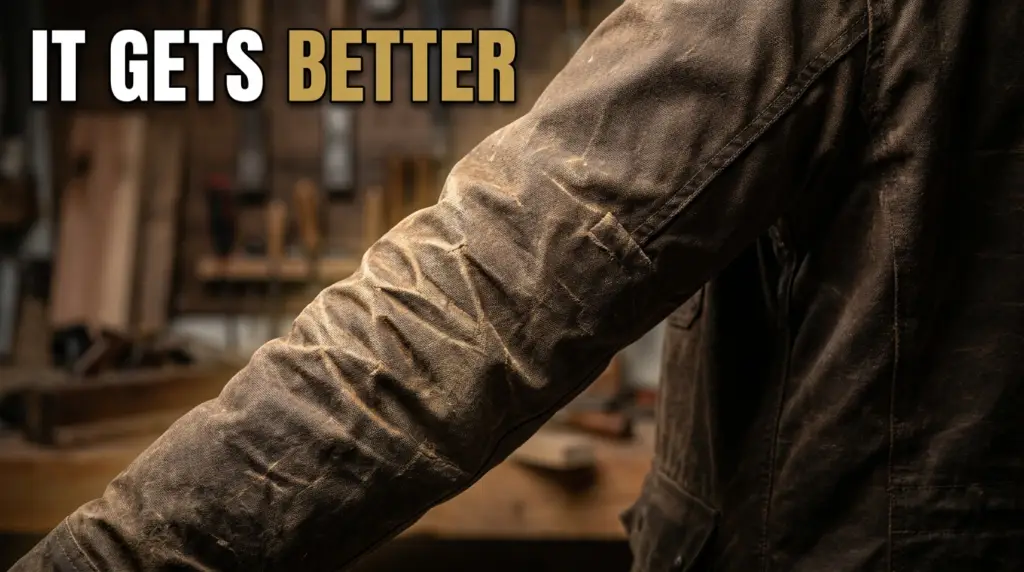
See that deep, honeycomb-style creasing? Notice how the color is so much lighter there? That’s from thousands of hours of leaning on desks, driving with an arm out the window, just living. The wax has been pushed around over and over, creating a pattern that’s totally unique to how you move. It’s softer there too — more flexible. A perfect mold of the arm.
The Pocket
See that faint, circular fade near the bottom of the pocket? During the first year with this jacket, a round Zippo lighter rode in that pocket everywhere. The hard edges rubbed against the inside, and over time, it left a perfect ghost impression in the fabric. The lighter’s gone now, but the jacket remembers it was there.
The Stains
Some people are terrified of staining a jacket like this. But honestly? You have to learn to embrace it. That dark spot on the cuff? That’s from a late-night coffee spill on a road trip through the mountains. It was annoying at first, but now it’s part of the jacket’s history. It’s a reminder of that trip every single time. A good stain just adds character — full stop.
The Front Placket
Look at where the buttons are. The fabric is more faded and worn here than almost anywhere else. That’s just from the simple, repetitive act of buttoning and unbuttoning thousands of times. It shows the jacket has been used. It shows this wasn’t sitting in a closet — it’s been out in the world, doing its job.
Every single one of these marks — the creases, the fades, the stains — is a chapter. My story, written right into the fabric.
Fit, Function, and Practicality
A jacket that tells a story is great, but it still has to work as a jacket. So let’s talk fit and function.
Breaking It In
The first thing you’ll notice with a new waxed canvas jacket is that stiffness. It can feel pretty awkward, honestly. The advice is simple: just wear it. A lot. Body warmth helps soften the wax, and the canvas will start to break in and mold to your shape after the first 10 to 15 wears.
Getting the Right Fit
For sizing, at 6’1″ and around 185 lbs, a Large fits well with room to spare. With this kind of workwear, you generally don’t want a super-slim, trendy fit. These jackets were born from utility. You want enough room in the shoulders and chest to throw a sweater or a hoodie underneath without feeling totally pinned down. A fit that’s too tight just loses that functional, workwear vibe that makes these jackets so cool.
Seasons and Weather
As far as practicality goes, this is a true three-season workhorse. It’s the perfect outer layer for fall and spring. The waxed canvas blocks wind well and shrugs off a light rain shower no problem. In winter, it isn’t insulated enough to be a standalone coat in freezing temperatures — but layer a good wool sweater or down vest underneath, and it can take you through some pretty cold days.
Washing and Care
One cardinal rule, though: never put it in a washing machine or dryer. You’ll melt the wax and destroy the jacket. If it gets muddy, let it dry and brush it off. For a serious mess, spot-clean with cold water. That’s it. According to sustainable fashion guidance from Harper’s Bazaar, caring for garments the right way is one of the most impactful things you can do for both longevity and sustainability.
The “After”: What the Jacket Looks Like Today
Here it is. This is the jacket now — after four years.
No longer stiff, the jacket feels soft and genuinely comfortable now. The once-flat color has become a mosaic of fades and marks. And rather than feeling like an impersonal product, it’s a piece of me. It has a rugged, vintage look that you just can’t buy off the shelf. And that’s what makes it look tougher — not because it’s new and perfect, but because it looks like it has survived. It’s faced the world and has the scars to prove it.
This aging process is what sets it apart from so many other clothes out there, which brands design for a season or two, tops. Fast fashion falls apart or goes out of style. A jacket like this does the opposite — it ages into character instead of aging out of relevance.
In a world that’s finally starting to take sustainability more seriously, there’s a quiet power in owning something you won’t have to replace for years, maybe even decades. This isn’t just a jacket. It’s an investment in a story that you get to write yourself.
So, Is a Womens Canvas Jacket Worth It?
If you’re looking for another disposable garment to toss out next year, then honestly — no. This isn’t for you.
But if you value craftsmanship, appreciate things that tell a story, and want a jacket that will literally change with you? Then absolutely, yes. It’s a stand against throwaway culture. It’s a commitment to things built to last.
It’s that rare piece of clothing that looks its best not on a model in a catalog — but on you, after years of adventure. It becomes a part of your life. A trusty companion that just gets better with every trip you take. You don’t just wear a jacket like this. You build a relationship with it. And that is a rare and beautiful thing.
FAQ Section
Q1: What is a womens canvas jacket made of? A womens canvas jacket is typically made from heavy-duty cotton duck canvas, which is a tightly woven, dense fabric known for its durability and resistance to tears. Many styles also feature a wax treatment on the outside, which adds water resistance and develops a unique patina over time.
Q2: How do you care for a womens canvas jacket? Never put a waxed canvas jacket in a washing machine or dryer — the heat will melt the wax coating and ruin the fabric. For mud or dirt, let it dry completely first and then brush it off. For tougher spots, spot-clean with cold water only. Re-waxing occasionally will restore water resistance over time.
Q3: Does a womens canvas jacket run true to size? Most waxed canvas jackets tend to run slightly fitted, so sizing up by one size is often recommended. This gives you enough room to layer a hoodie or sweater underneath without feeling restricted, which is very much part of the workwear-inspired design intent.
Q4: Can a womens canvas jacket be worn in the rain? Yes — a waxed canvas jacket handles light to moderate rain very well. The wax treatment makes water bead up and roll off the surface. It is not fully waterproof in heavy downpours, but it performs far better than most other casual jacket fabrics in wet weather.
Q5: How long does a womens canvas jacket last? With proper care, a quality waxed canvas jacket can last many years — sometimes decades. Unlike fast fashion jackets that degrade quickly, canvas jackets actually improve in appearance with wear, making them one of the most long-lasting outerwear investments you can make.