The Surprising History of Khaki and Jeans That Still Shapes What You Wear Today
Every morning, a quiet war is fought in your closet. You think you’re just choosing a pair of pants — but you’re actually picking a side in a conflict that has been going on for over 150 years.
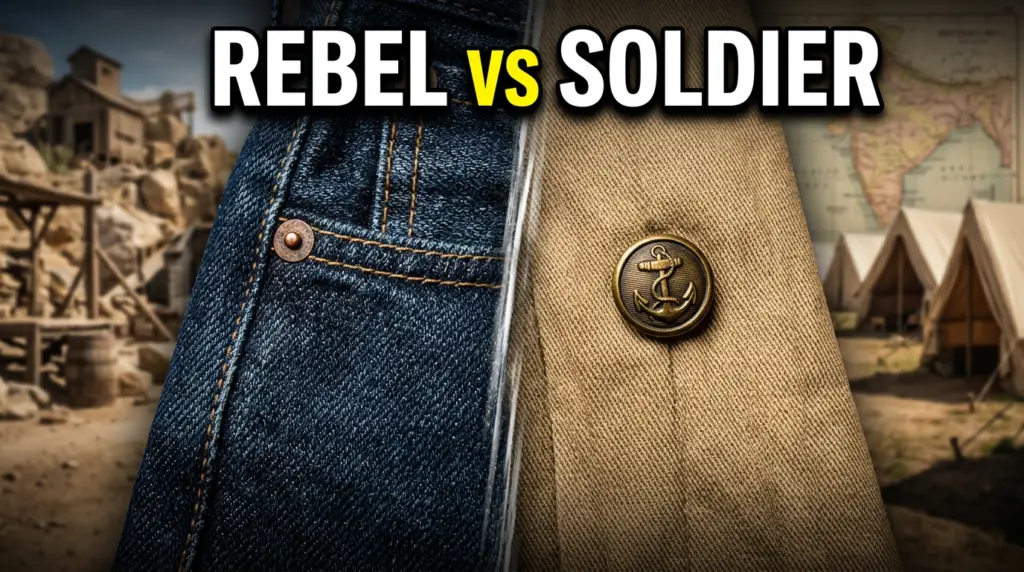
On one side, you have a symbol of rebellion born in the American West. On the other, a uniform of order forged in the British Empire. The story of khaki and jeans isn’t just about what looks good. It’s about how a battle between miners and soldiers ended up dictating what you’re wearing right now. The answer is buried in military history, material science, and the very fabric of our culture.
The Rebel: The Origin Story of Jeans
The story of jeans starts not in a high-fashion studio, but in the dirt and dust of 19th-century America. Before jeans were a statement, they were basically armor.
Where Denim Actually Came From
The fabric itself — denim — actually has European roots. Specifically, the name is a mash-up of “serge de Nîmes,” a tough cotton twill from Nîmes, France. But it was in the American West that this rugged material would find its true calling.
During the California Gold Rush, miners and farmers needed clothes that could survive punishing work. Their pants kept ripping at the seams and pockets. So a tailor in Nevada named Jacob Davis came up with a clever fix: reinforce the stress points — the pockets, the base of the fly — with the same little copper rivets he used on horse blankets. Simple. Brilliant. However, Davis had the idea but not the money to patent it.
So he wrote a letter to his fabric supplier, a man named Levi Strauss in San Francisco. Together, in 1873, they secured a patent for an “Improvement in Fastening Pocket-Openings.” And just like that, the modern blue jean was born.
From Work Gear to Cultural Symbol
At first, workers called them “waist overalls.” They weren’t a fashion choice — they were a piece of equipment. Made from heavy-duty denim and dyed with indigo, they were tough, affordable, and only got better with age. For decades, jeans served as the unofficial uniform of the American working man: the cowboy, the lumberjack, the railroad worker. They stood as a symbol of hard labor and rugged individualism.
For the first half of the 20th century, that’s pretty much where jeans stayed. But after World War II, something began to shift. American GIs stationed overseas wore their jeans off-duty, which helped introduce denim to the world as a distinctly American piece of clothing. Back home, meanwhile, a new cultural force was rising: the teenager. And they were looking for a uniform of their own.
Hollywood gave it to them. Marlon Brando in The Wild One and James Dean in Rebel Without a Cause completely transformed the image of jeans. Paired with a plain white t-shirt and a leather jacket, the blue jean was no longer about work. Instead, it became about defiance — a direct rejection of the clean-cut, conformist vibe of the 1950s. Jeans grew so linked with youth rebellion that some schools actually banned them, which, of course, only made them cooler.
Jeans as a Symbol of Revolution
Through the ’60s and ’70s, that rebellious spirit ran even deeper. Civil rights activists wore jeans while marching for equality — a powerful symbol of solidarity with the working class. Rock stars wore them. Protestors wore them. Furthermore, each group used the fabric as a canvas for its own message. The humble work pant had, therefore, become a global symbol of revolution.
The Soldier: The Origin Story of Khakis
To find the origin of khakis, we need to travel halfway around the world — to the heat and dust of British India in the mid-19th century.
Why the British Army Changed Their Trousers
British soldiers stationed in places like the Punjab region wore their traditional formal uniforms: heavy, bright red wool coats and white trousers. These “red coats” projected the power of the British Empire. But on the dusty plains of India, they were hot, impractical, and they turned soldiers into dangerously visible targets.
A British officer, Sir Harry Lumsden, took charge of raising the new Corps of Guides in 1846 and quickly realized his men needed to blend in. His solution was tactical and brilliantly simple. Soldiers started dyeing their white cotton trousers with local materials — mud, or pigments from plants like the mazari palm — to camouflage themselves against the terrain. The result was a drab, soil-colored beige.
They called it “khaki,” borrowing a word from Hindustani that means “dust” or “soil.”
How Khaki Spread Across the World’s Armies
This wasn’t a fashion statement — it was survival. Khaki became one of the world’s first widespread uses of military camouflage, a uniform specifically designed not to be seen. The lightweight cotton twill was also far more breathable in the heat, which made it practical beyond just camouflage. The idea caught on fast. Other regiments in India quickly adopted khaki, and it became the official service dress after the Afghan War of 1878–80. Then, the U.S. Army officially adopted a khaki uniform in 1898 for the Spanish-American War, and by the early 1900s, it had become standard across multiple militaries.
As Harper’s Bazaar notes in its fashion history coverage, military dress has long shaped civilian style — and khakis are perhaps the clearest example of that influence.
For the next 50 years, khaki and olive-drab uniforms remained standard issue through both World Wars. And just like jeans, it was the end of World War II that finally brought these military trousers into everyday civilian life.
From the Barracks to the Campus
Returning GIs brought their khakis home with them. But instead of landing with rebels, khakis found a home in a completely different world: college campuses.
In the post-war boom of the 1950s, university students — especially in the Ivy League — enthusiastically embraced khakis. Paired with a button-down shirt and a navy blazer, khakis quickly became the foundation of the “preppy” look. If jeans were about rejecting the establishment, khakis were clearly about looking ready to join it. They were more formal than jeans but more comfortable than a suit — clean, respectable, and orderly.
While James Dean made jeans look dangerous, figures like John F. Kennedy wore khakis and projected an image of effortless, all-American competence. The battle lines for your closet had, by this point, been firmly drawn.
Khaki and Jeans in the Modern Wardrobe
By the late 20th century, the rivalry went fully public. It played out in offices, on campuses, and at family dinners. Your choice of pants said something about you.
The Rise of Business Casual in the 1990s
Jeans carried the image of youth, creativity, and a casual attitude. Khakis, on the other hand, represented something more conservative, put-together, and professional. One was for Saturday. The other was for Monday.
The 1990s became a key battleground with the rise of “business casual.” As tech companies in Silicon Valley started rejecting the stuffy suits of Wall Street, khaki pants quickly became the default for the new relaxed office. Jeans were often still a step too far for most workplaces. Khakis, therefore, served as the perfect compromise — comfortable, but still signaling a level of professionalism. They were neutral, adaptable, and orderly, which were the same qualities that made them such a great military uniform a century before.
How the Rules Changed
Today, however, the old dividing line has all but dissolved. Remote work and a broader shift toward personal style have blurred the old rules significantly. The choice is no longer just about fabric — it’s about fit, silhouette, and context. A pair of baggy, pleated khakis can look like a relic from a ’90s office park. But a modern, well-tailored straight-leg pair looks sharp and incredibly versatile. Meanwhile, dark well-fitting jeans dressed up with a blazer can actually look more polished than a sloppy pair of khakis.
What’s the Real Difference Between Khaki and Jeans?
Here’s a useful way to think about it: the materials themselves still shape their strengths.
It All Comes Down to Fabric
Denim is a heavier, more rugged twill. That texture naturally reads as casual — it carries a kind of attitude with it no matter what you do. Khaki’s lighter cotton twill, however, is a smoother, cleaner canvas. Because of this key difference, khaki works like a chameleon. It tends to take on the style of whatever you pair it with. Jeans, on the other hand, always bring a little bit of their rebellious DNA to the party.
Ultimately, here’s how each one reads in the real world:
- Jeans project texture, attitude, and rugged authenticity.
- Khakis project flexibility, polish, and approachability — a true bridge between casual and formal.
So, you wear jeans when you want to lean into a relaxed, confident energy. You wear khakis when you need to stay adaptable, ready for a wider range of situations without looking out of place.
Which One Should You Actually Wear?
The war between khaki and jeans was never really about which pant is “better.” It’s always been about understanding the message you want to send.
That pair of jeans is the descendant of a worker’s armor — transformed, over time, into a symbol of rebellion woven through more than a century of culture. That pair of khakis, similarly, is the legacy of a soldier’s camouflage — transformed into a uniform of quiet order and adaptability.
One was built to stand out and survive hard work. The other was designed to blend in and get a job done. Over time, those practical origins gave both pants their lasting cultural power.
What you’re really choosing is your uniform for the day. Are you the rebel, or are you the soldier? In the modern world, most of us need to be a little bit of both. And that’s precisely why, after 150 years of conflict, the most likely outcome is a long and lasting truce — right inside your closet.
FAQ Section
Q: What is the difference between khaki and jeans?
A: Jeans consist of denim — a heavy, rugged cotton twill — and carry a naturally casual, textured vibe. Khakis, by contrast, use a lighter cotton twill that is smoother and more adaptable. Jeans tend to signal casual confidence and attitude, while khakis signal polish and flexibility.
Q: Can you wear khaki and jeans together?
A: Khaki and jeans typically refer to two separate trouser styles, not pieces worn together. However, styling a khaki jacket or khaki shirt with jeans is a popular combination that works really well for a relaxed smart-casual look.
Q: Are khakis more formal than jeans?
A: Generally, yes. Khakis sit closer to the smart-casual end of the spectrum and work better in professional or semi-formal settings. Dark, well-fitted jeans can bridge the gap, but khakis still hold a slight edge in most dress-code contexts.
Q: Where did the word “khaki” come from?
A: “Khaki” comes from a Hindustani word meaning “dust” or “soil.” British soldiers in India first used it in the mid-1800s when they started dyeing their white uniforms to camouflage against the dusty terrain.
Q: Why were jeans originally invented?
A: Jacob Davis and Levi Strauss invented jeans in 1873 as durable workwear for miners and laborers during the California Gold Rush. The key innovation was using copper rivets to reinforce pocket seams that kept tearing under hard use.
Q: Are khakis in style in 2026?
A: Yes — modern, well-tailored khakis are very much in style. Slim straight-leg cuts and pleated wide-leg styles have both made strong comebacks, especially in elevated casual and smart-casual outfits.