The Best Top Quality Lasting Nail File, Proven by Science
You do everything right. You use cuticle oil, you’re gentle with your hands, and you even take biotin. And yet, your nails still split, peel, and snag on your favourite sweater. For years, you’ve been told the secret to preventing breakage is simply learning the right filing technique. But what if that’s only half the story? What if finding the best top quality lasting nail file is actually the missing piece?
Because the tool itself might be a bigger part of the problem than you’ve ever realised.
The culprit for your damaged nails could be sitting in your manicure kit right now. So, instead of relying on opinions and brand loyalty, here’s the science-backed answer — including what actually happens to your nail under a high-powered microscope when you use different types of files.
The Problem With Most Nail Files
The frustration of weak, damaged nails is incredibly common. While major causes of nail fragility include things like ageing, frequent hand washing, harsh chemicals, and nutritional gaps, the microscopic damage from improper filing can absolutely make things worse.
Every time you file, you’re reshaping the nail’s free edge, which is made of compressed layers of a protein called keratin. When those layers are damaged, they begin to separate — and that separation leads to peeling and splitting. The goal of a truly good file, therefore, is to shape the nail while leaving that edge smooth and sealed. A bad file, on the other hand, can create real chaos at a microscopic level.
The Three Contenders: Which Nail File Type Is Actually Worth It?
There are three main types of nail files on the market, and each one tells a very different story under a microscope.
First, there’s the classic emery board — the undisputed champion of convenience store checkout aisles. It’s cheap, it’s everywhere, and it’s probably what most people grew up using.
Next is its tougher cousin: the metal file. Durable and long-lasting, it feels like a no-nonsense, professional-grade tool.
And finally, there’s the one that often gets dismissed as a luxury item: the glass, or crystal, nail file. Elegant and modern, but is it actually better?
To understand what each one truly does, it helps to know what a healthy nail edge is supposed to look like. Under the microscope, a cleanly cut or naturally unbroken nail edge is relatively smooth. You can see the compressed keratin layers fused together, forming a solid, unified structure. That’s the ideal state — and that’s the benchmark each file is being measured against.
Under the Microscope: What These Files Really Do to Your Nails
The Emery Board: Cheap but Damaging
First up is the most common nail file on the planet. Emery boards are typically made of cardboard with abrasive particles glued onto the surface. They’re often designed to be disposable, and, frankly, there’s a good reason for that.
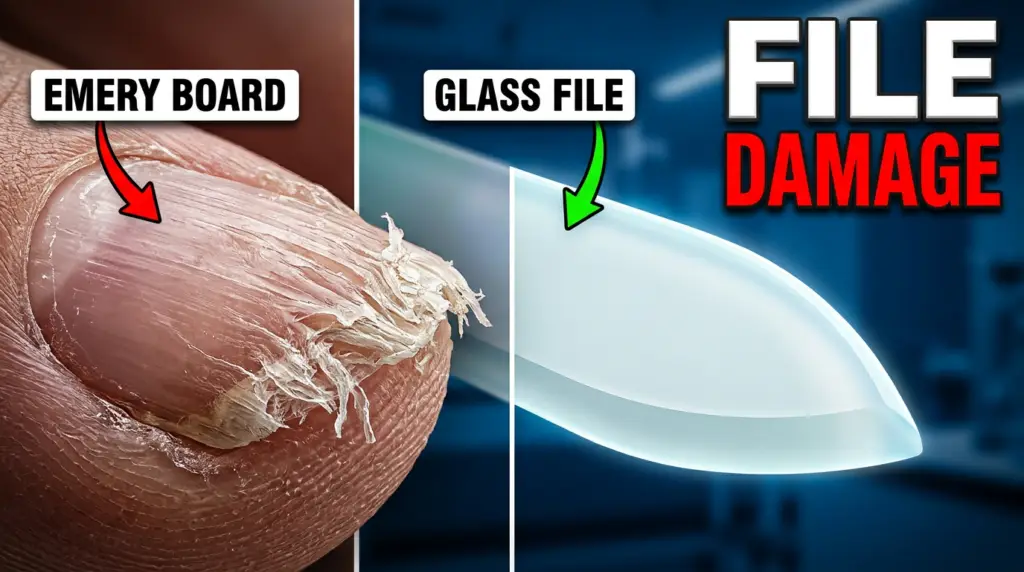
After filing a healthy nail with a standard, coarse-grit emery board and examining it closely, the result is pretty shocking. The edge of the nail looks frayed and shredded — almost like a torn piece of rope. There are tiny, jagged canyons and deep grooves where individual keratin layers have been lifted, creating countless micro-tears that will eventually catch on fabric and lead to bigger breaks.
The reason for this comes down to construction. The abrasive particles on many cheap emery boards are irregular and aggressive, creating a surface that rips at the nail rather than sanding it smoothly. It’s effective at removing length, but it comes at a real cost to the nail’s structural integrity. Using a coarse emery board is essentially like taking rough, low-grit sandpaper to delicate wood — you’ll change the shape, but you risk destroying the finish entirely.
As noted by nail care experts at Byrdie, the grit and construction quality of a nail file directly affect how much trauma the nail edge sustains during shaping. This is precisely why so many people find their nails weaken over time despite doing everything else correctly.
The Metal File: Durable, but Still Problematic for Natural Nails
Metal files are often found in old-school manicure sets and are well known for their durability. On one hand, they last a long time and can be sanitised, which is a genuine plus. But how do they actually treat the nail itself?
After filing a fresh nail with a typical metal file and examining the edge closely, the view is a little better — but still concerning. While there’s less of the fluffy, frayed texture seen with the emery board, the metal file creates its own distinct pattern of damage. The edge is marked by sharp, deep striations, almost as though a saw has been at work on it.
These grooves create weak points in the nail structure. While a metal file is efficient at grinding down nail material — which can be genuinely useful for thick or artificial nails — an aggressive one is simply too harsh for the delicate layered structure of a natural nail. It scrapes rather than files, and that scraping action is a common cause of splitting over time.
The Glass File: What Makes It Stand Apart
The glass file is where things get genuinely interesting. Popularised in the Czech Republic in the late 1990s, true glass files are made from hardened glass where the abrasive surface is chemically etched directly into the material itself. This isn’t a coating that wears off — the texture is part of the file. And that seemingly small manufacturing difference turns out to be everything.
After filing a nail with a quality glass file and examining the edge under the microscope, the difference is immediately obvious. The edge is significantly smoother and cleaner. There are far fewer tears and no deep grooves. Instead, the edge appears much more uniform — and it actually looks sealed.
The science behind this is straightforward. The etched surface of a quality glass file has a very fine, uniform grit that glides across the nail. Rather than ripping the keratin layers apart, it gently grinds them down, reducing roughness at the edge. The result is a smooth tip that is far less likely to peel, split, or snag on anything. It creates a more finished edge — not more weak points.
The Science of Grit: Why It Matters More Than Technique
The microscopic evidence is compelling, but to fully understand why the glass file performed so well, it helps to talk about grit. The “grit” of a nail file refers to its coarseness, measured by a number. A lower number means a coarser, more aggressive file. A higher number means a finer, smoother surface.
For shaping tough acrylic nails, a coarse grit around 100 might be necessary. However, for natural nails, using a grit that is too low is a recipe for the kind of damage described above. Most nail experts recommend a grit of 180 to 240 for shaping natural nails, because anything lower creates micro-tears even with careful technique.
This is exactly where many popular files fall short. A cheap emery board often has a very coarse, low-grit surface that’s simply too aggressive for daily natural nail care. Some metal files are equally abrasive. A quality glass file, on the other hand, naturally has a fine and uniform grit — which is exactly why it’s so much gentler on the nail structure. It may work a little more slowly, but that gives you more control and helps prevent accidental over-filing.
The One-Direction Filing Myth
This also clears up a common nail care myth: that you absolutely must only file in one direction. That advice exists entirely because of the damage caused by coarser files. Sawing back and forth with a rough emery board rapidly increases micro-tears, essentially shredding the nail tip with every pass. However, because a fine-grit glass file smooths the nail edge as it files, many people find they can safely file in both directions without causing the same degree of damage. That said, a gentle, one-direction approach is always the safest habit to maintain.
Best Top Quality Lasting Nail File: The Hygiene Factor
Beyond performance, hygiene is another major reason to reconsider your current file.
Porous emery boards are notoriously difficult to clean, making them a potential breeding ground for bacteria over time. For personal use, they’re generally fine until they wear out — but they should never, under any circumstances, be shared. Metal files can be cleaned and sanitised more effectively. Glass files, however, are the clear winner here too. Being non-porous, a glass file can simply be washed with soap and water or wiped down with alcohol, and it is completely ready to use again. With proper care, a good glass file lasts for years — making it a far better long-term investment than an endless cycle of disposable emery boards.
According to the nail and beauty editors at Glamour, glass files consistently rank as the most hygienic and long-lasting option for home nail care, especially for people with sensitive or brittle nails.
How to Choose the Best Top Quality Lasting Nail File
After looking at the science and the microscopic evidence, the conclusion is clear. For the health and strength of most natural nails, a high-quality glass nail file is the top contender. It creates a smoother, more uniform edge that helps prevent splitting and peeling, it’s hygienic, and it lasts for years — making it a much smarter investment than a lifetime of disposable boards.
But this doesn’t mean every other type of file is completely useless. The key is simply matching the right tool to the right job.
- For thick nails or acrylics and gels — a high-quality, lower-grit file is often the right tool for heavy-duty shaping. Just be extra gentle if you’re using it on natural nails alongside.
- For emery boards — their best role is probably as a backup in your travel bag for an emergency snag, rather than as the main tool in your everyday manicure routine.
- For glass files — look specifically for ones labelled as “etched” and made from Czech or Bohemian glass. This is consistently a mark of quality you can trust.
Cheaper versions that have grit simply sprayed or glued onto glass can wear off over time and may perform no better than a standard emery board. A true etched glass file will feel almost smooth to the touch and, as long as you don’t drop it, will genuinely last for years.
The Practical Takeaway
The idea that a tiny, inexpensive tool could be quietly undermining your entire nail care routine is frustrating. But it’s also genuinely empowering. It proves that small, informed choices — backed by a little science — can make a real difference.
By switching from a file that tears and shreds the nail edge to one that smooths and protects it, you are fundamentally changing your nail care for the better. The journey to stronger, healthier nails doesn’t have to start with an expensive treatment or a magic supplement. It can start with simply choosing a better tool.
The best top quality lasting nail file is not about price tags or brand names — it’s about understanding what the tool actually does to your nail at a structural level. And now, you have the science to make that choice with confidence.
FAQ Section
Q1: What is the best top quality lasting nail file for natural nails?
A: For natural nails, a chemically etched glass nail file is widely considered the best top quality lasting nail file available. Its fine, uniform grit smooths the nail edge rather than tearing it, which helps prevent splitting, peeling, and breakage over time. Look for files specifically labelled as “etched” and made from Czech or Bohemian glass for the best results.
Q2: How long does a glass nail file actually last?
A: A genuine etched glass nail file can last for several years with basic care. Since the abrasive texture is etched into the glass itself rather than applied as a coating, it does not wear down the same way emery boards or coated files do. The main risk is dropping it, as glass files can crack or chip if they fall on a hard surface.
Q3: Why do emery boards damage nails?
A: Many cheap emery boards use irregular, coarse abrasive particles glued onto cardboard. This construction creates an aggressive surface that rips at the keratin layers of the nail rather than sanding them smoothly. The result, when examined under a microscope, is a frayed, micro-torn nail edge that is far more prone to peeling, splitting, and snagging.
Q4: Is it really bad to file nails back and forth?
A: Filing back and forth with a coarse emery board does significantly increase micro-tears and can shred the nail tip. However, with a fine-grit glass file, the risk is much lower because the file smooths as it works. A gentle one-direction stroke is still the safest habit, but the material of the file matters far more than the direction when it comes to real nail damage.