Long Sleeve Wedding Dress: Why This Bridal Icon Never Goes Out of Style
Fashion is fickle. Trends rise, peak, and vanish — bell bottoms, shoulder pads, ultra-low-rise jeans. Each had its moment. Each faded. Yet the long sleeve wedding dress has done something almost no other bridal style has managed: it has endured, evolved, and come back stronger with every generation. From queens to movie stars to modern-day brides, this one style has never really left. Here’s the story of why — and what makes it so powerful, even now.
The Royal Blueprint: How Queen Victoria Changed Everything
Before 1840, brides wore dresses of all colors. There was no “bridal white.” Then a young queen changed everything with a single, deliberate choice.
When Queen Victoria married Prince Albert in 1840, she wore white — not because tradition demanded it, but because she wanted to show off the finest British lace. Her heavy silk satin gown featured a wide flounce of handmade Honiton lace, crafted by local artisans at a time when the British lace industry was struggling. White was simply the best backdrop for their work.
Why the Sleeves Mattered
The gown also had long sleeves — standard for formal dress in the 19th century. But paired with that white fabric, the sleeves took on new meaning. They signaled modesty, respectability, and aristocratic grace. Together, the white color and the covered silhouette created a new bridal ideal.
Newspapers and early illustrated magazines spread images of the royal wedding across Britain and beyond. Suddenly, brides everywhere wanted to replicate that look. Victoria had created a blueprint, and for the next hundred years, Western bridal fashion followed her lead.
Grace Kelly and the Fairytale Standard
The long sleeve remained a bridal staple through the early 20th century. However, in 1956, it transformed from a symbol of respectable tradition into something far more powerful: a fairytale icon.
When actress Grace Kelly married Prince Rainier of Monaco, an estimated 30 million people watched. The dress she wore became arguably the most influential wedding gown in modern history. MGM’s head costume designer, Helen Rose, created it as a gift from the studio. A team of 35 people spent six weeks on its construction.
A Dress Built to Last
The gown featured a high neck, a fitted bodice made from 125-year-old antique Brussels lace, and thousands of hand-sewn pearls. Most importantly, it had those iconic, delicate long sleeves. The result was extraordinary — conservative and breathtakingly beautiful at the same time.
The “Grace Kelly” silhouette — fitted lace bodice, long sleeves, full dramatic skirt — became the definitive bridal fantasy. Designers have referenced it ever since. It proved that long sleeves weren’t just for queens of a bygone era. They could be glamorous, cinematic, and deeply modern all at once.
The Latter 20th Century: A Style for Every Generation
After Grace Kelly, the long sleeve proved just how versatile it could be. Each decade found a new way to interpret it.
The 1970s brought a bohemian energy. Princess Caroline of Monaco’s 1978 gown featured translucent lace bell sleeves — soft, whimsical, and free-spirited. These were nothing like the structured sleeves of Victorian formality. They floated, they moved, they felt alive.
The Diana Effect
Then came the 1980s. No gown captured that maximalist decade more dramatically than Princess Diana’s wedding dress, with its enormous puffed long sleeves. To modern eyes, the volume looks theatrical. At the time, it was an instant icon. Furthermore, it proved the sleeve could absorb any era’s energy — whether romantic, dramatic, or over-the-top.
Each generation made the long sleeve its own. That adaptability is exactly why the trend never died. It never belonged to just one aesthetic or one era. It belonged to whoever needed it.
According to fashion historians at Vogue, the long-sleeved silhouette has appeared in every major royal wedding since Victoria, making it one of the most continuously referenced styles in bridal history.
The Kate Middleton Effect: A Modern Renaissance
By the early 2000s, strapless gowns dominated mainstream bridal fashion. Long sleeves felt dated. Old-fashioned. Then came April 29, 2011.
Kate Middleton’s arrival at Westminster Abbey sparked an immediate global shift. Sarah Burton for Alexander McQueen designed the gown. The V-neckline and flowing skirt felt contemporary, but the long sleeves — hand-cut lace incorporating roses for England, thistles for Scotland, daffodils for Wales, and shamrocks for Northern Ireland — were a direct nod to bridal history.
The Long Sleeve Comeback
The “Kate Effect” was instant and measurable. Search engines and retailers reported a significant spike in demand for long-sleeved lace gowns almost overnight. Designers rushed to create collections inspired by her silhouette. Kate Middleton reminded an entire generation that sleeves weren’t about modesty alone — they were about elegance, intention, and making a timeless statement.
In many ways, her gown was the 21st-century answer to Grace Kelly’s dress. Classic, but with a youthful edge that made it feel entirely of its time.
Why the Long Sleeve Wedding Dress Has Such a Powerful Hold
So why does this particular style command such loyalty? The answer lies in something deeper than fashion. It’s psychological.
A long sleeve wedding dress changes what the eye notices. Rather than focusing on bare skin, attention travels to the silhouette, the fabric texture, and the bride’s overall posture. This creates a sense of refinement and deliberate intention. Moreover, it gives many brides a feeling of groundedness on a day filled with overwhelming emotion.
The Paradox That Makes It Work
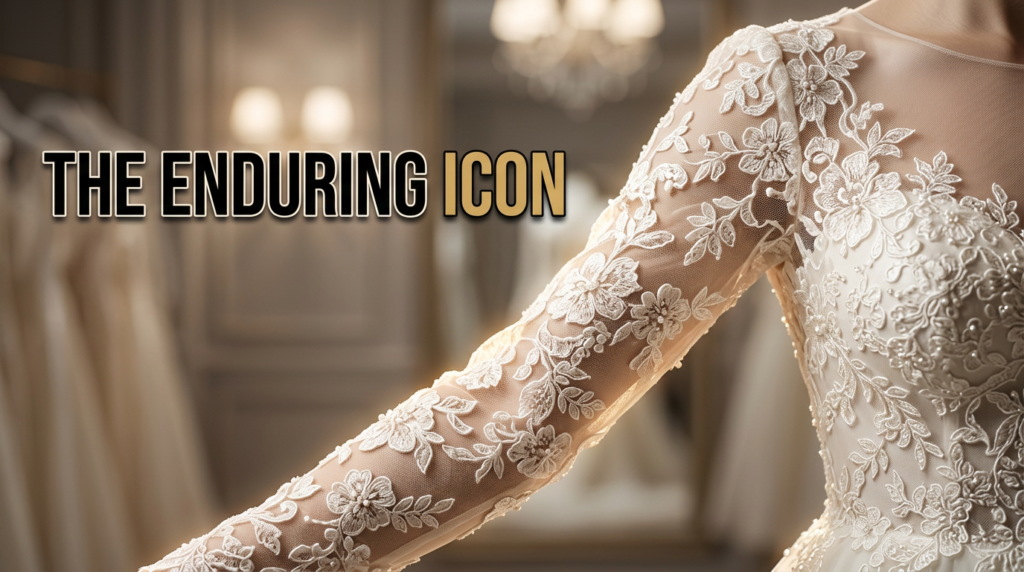
There’s also a compelling paradox at the heart of the long-sleeved gown. It can be both modest and deeply sensual at the same time. A sheer illusion sleeve with delicate lace covers the arm — yet it also reveals and hints. A sleek, unadorned crepe sleeve feels architectural and powerful. A soft bishop sleeve feels gentle and romantic.
Ultimately, the long sleeve endures because it masters contradiction. It offers tradition and modernity. Modesty and sensuality. Regal formality and personal expression. As Harper’s Bazaar notes in its guide to bridal fashion psychology, the choice of sleeves is one of the most emotionally charged decisions a bride makes — because it shapes the entire emotional register of the gown.
What’s Next: The Rise of the Detachable Sleeve
The latest evolution of the long sleeve isn’t just about aesthetics — it’s about functionality. Recent bridal collections point clearly to one emerging direction: modularity.
Today’s brides often want two looks in a single day. Something formal and dramatic for the ceremony. Something more practical and party-ready for the reception. The detachable sleeve answers that need perfectly.
Tradition Meets Versatility
Designers now create gowns with removable sleeves, capes, and overlays that let a bride completely transform her appearance between ceremony and reception. She can wear classic, long-sleeved elegance for her walk down the aisle, then remove the sleeves to reveal a strapless or thin-strapped silhouette for the party.
This isn’t just practical — it reflects a modern desire for both tradition and versatility. The long sleeve is no longer simply a permanent feature. It has become a dynamic, intentional accessory in its own right.
The Enduring Appeal of Long Sleeve Wedding Dresses
From Queen Victoria’s lace to Grace Kelly’s fairytale glamour, from Princess Diana’s dramatic puffs to Kate Middleton’s modern elegance — the long sleeve wedding dress has done far more than survive. It has thrived.
It has woven itself through nearly two centuries of bridal history, constantly reinventing itself for each new era while holding onto that timeless sense of grace. The reason this trend refuses to die is simple: it has never belonged to just one moment in time. Instead, it belongs to every bride who wants her wedding day to feel beautiful, intentional, and unforgettable.
FAQ — Long Sleeve Wedding Dress
Q1: What makes a long sleeve wedding dress a timeless choice?
A: A long sleeve wedding dress has appeared in major royal weddings and iconic bridal moments for nearly 200 years. Its ability to be styled as modern, vintage, romantic, or architectural makes it adaptable to any era. It’s one of the few bridal silhouettes that genuinely transcends trend cycles.
Q2: Are long sleeve wedding dresses still popular in the mid-2020s?
A: Yes — bridal trend reports for the mid-2020s point strongly to sleeves as a central focal point. Specifically, fitted illusion lace sleeves, elegant sheer overlays, and detachable sleeve options are among the most requested styles from contemporary brides and designers.
Q3: What is an illusion sleeve on a wedding dress?
A: An illusion sleeve uses sheer, see-through fabric — typically tulle or lace — to create the appearance of a covered arm while revealing the skin beneath. The effect feels both modest and romantic, making it one of the most popular sleeve styles in modern bridal fashion.
Q4: Can a long sleeve wedding dress work in warm weather?
A: Absolutely. Many brides choose lightweight fabrics like chiffon, organza, or sheer lace for warm-weather ceremonies. Detachable sleeves are also a practical solution — brides wear them for the ceremony and remove them for the outdoor reception.
Q5: What body types suit a long sleeve wedding dress best?
A: Long sleeves work beautifully across all body types. For brides who feel self-conscious about their arms, full lace or fitted sleeves offer coverage with elegance. For brides who want drama, bishop or bell sleeves create a striking silhouette. The versatility of the style means there’s a version for everyone.
Q6: What is the difference between a bishop sleeve and a fitted sleeve on a bridal gown?
A: A bishop sleeve is full and billowing from the shoulder, gathered tightly at the wrist — associated with romantic, vintage, and bohemian aesthetics. A fitted sleeve hugs the arm from shoulder to wrist and reads as sleek, modern, and architectural. Both styles appear regularly in contemporary bridal collections.
Q7: Which royal brides wore long sleeve wedding dresses?
A: Queen Victoria (1840), Princess Caroline of Monaco (1978), Princess Diana (1981), and Catherine, Princess of Wales (2011) are among the most iconic examples. Each adapted the sleeve to reflect the aesthetic of her era, contributing to the style’s remarkable longevity.
Q8: Is a long sleeve wedding dress appropriate for a church wedding?
A: Long-sleeved gowns are often considered ideal for religious ceremonies, where covered shoulders and arms may be required or preferred. Beyond dress code compliance, the silhouette also carries a sense of formality and tradition that suits a church or cathedral setting beautifully.