GlossiWEAR and the Real Reason Glossier Became a Billion-Dollar Brand
What if a beauty brand’s most valuable product wasn’t makeup at all — but belonging? That’s the question Glossier answered in 2019 when it launched GlossiWEAR, a line of hoodies, slide sandals, and tote bags. On the surface, it looked like simple merchandise. Underneath, it was a declaration. It announced that Glossier had stopped being a cosmetics company and started being something far more powerful — a cultural identity people could wear. To understand why that mattered so much, you have to understand what the brand was really building from the very beginning.
What the Old Beauty Industry Got Wrong
To appreciate why Glossier felt so different, you need to remember what the beauty industry often looked like before it arrived. For a long time, the dominant model relied on a top-down monologue. Legacy corporations spent enormous budgets on glossy magazine spreads and dramatic TV commercials featuring impossibly flawless supermodels and A-list celebrities.
The unspoken message often felt like: you aren’t enough, but this product can fix you. Beauty standards came from experts locked away in labs in Paris or New York. They decided what colors you should wear and what problems you needed to solve.
Distance Was the Strategy — Until It Wasn’t
The old model built its entire authority on distance. Brands felt untouchable. Their advice read like commands, not conversations. For decades, that model worked beautifully. But a new generation growing up online started craving something the old guard wasn’t built to deliver: authenticity and genuine connection.
Customers no longer wanted to be told what to buy. They wanted to be part of the conversation. The frustration was quiet but it was real. The stage was set for disruption — someone just needed to flip the script entirely.
How Emily Weiss Built a Community Before She Built a Company
That disruption didn’t begin with a product. It began with a blog. In 2010, a young fashion assistant named Emily Weiss launched a website called “Into the Gloss.” While working at magazines like Vogue, she noticed the most interesting beauty conversations weren’t happening in boardrooms. They were happening in bathrooms and behind the scenes.
“Into the Gloss” became famous for its “Top Shelf” series. Weiss visited the homes of influential women and talked about the products they actually used and loved, in their own words. It was personal, specific, and revolutionary — because it felt real.
Listening as a Business Strategy
The blog exploded precisely because it did one simple thing: it listened. Weiss wasn’t gathering data through formal market research. Instead, she collected a continuous stream of candid feedback from passionate readers who wrote detailed comments about what they wanted, what they hated, and what the market was missing entirely.
After four years of this, she did the logical next thing. In 2014, Weiss launched Glossier with just four products — each one designed to address the exact needs her community had been voicing for years. The readers of “Into the Gloss” became Glossier’s first customers, its first advocates, and its first marketing team. The brand didn’t find its community; it grew from one. That DNA defined everything that followed.
As Harvard Business Review has documented in its coverage of community-led brand building and direct-to-consumer strategy, brands that treat community as a core asset rather than a marketing tactic tend to generate deeper loyalty and higher long-term customer value than traditional advertising-led competitors.
The Three Principles Behind Glossier’s Marketing Playbook
From day one, Glossier’s marketing didn’t feel like marketing. It felt like a movement. The company followed three core principles that rewrote how a beauty brand could operate.
Turning Customers Into Advocates
First, Glossier turned its customers into its most powerful marketing channel. While influencer marketing was already growing, Glossier refined a true peer-to-peer model. The brand encouraged customers to share photos using hashtags like #GlossierPink. Suddenly, the brand’s Instagram feed wasn’t filled with paid models. It became a mosaic of real people from everywhere, showing honest product use in real life.
The pink bubble-wrap pouches that the products arrived in were deliberately designed to be photogenic. As a result, they quickly became a status symbol in their own right. Moreover, the packaging encouraged customers to share their purchases online, further amplifying the brand’s visibility. In fact, at one point, the company reported that an impressive 70% of its online sales came from peer-to-peer referrals—a figure that clearly highlights the power of community-driven growth.
Building an Instantly Recognizable World
Second, Glossier created a brand identity so specific it felt like a place. The “no-makeup makeup” look directly challenged the heavy, contoured aesthetic popular at the time. The packaging was minimalist. The typography was clean. The signature pastel pink became so recognizable it’s now simply called “Glossier pink.”
Owning a Glossier product stopped being about having a new lip gloss. It became about adopting a particular taste level that signaled you were in the know. The brand didn’t sell individual products; it sold membership to a curated world.
Making the Community the Product
Third, and most importantly, Glossier made the community itself feel like the offering. The brand’s social media tone was conversational and human — more like a friend giving recommendations than a corporation broadcasting messages. Physical stores became experiential playgrounds. Staff in pink jumpsuits helped customers discover products rather than pushing sales.
Everything reinforced the same feeling: access, intimacy, and belonging. You weren’t just buying makeup. You were buying into a shared identity.
GlossiWEAR: The Moment the Real Product Was Revealed
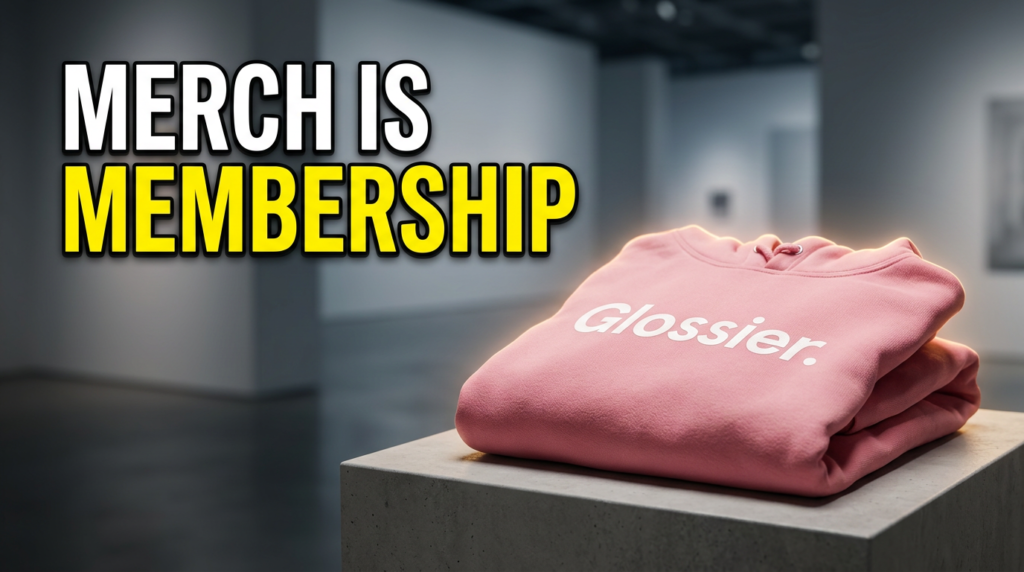
This entire strategy of building a world — not just a product line — hit its clearest expression in July 2019 with the launch of GlossiWEAR. The collection included a signature pink hoodie, slide sandals, and duffel bags. Fans had already been asking to purchase the gray sweatshirts and pink jumpsuits worn by store employees, so in one sense, GlossiWEAR simply met an existing demand.
But it signaled something far larger than that. The launch of a clothing line was the moment Glossier openly acknowledged what its true product had always been. Not the Milky Jelly Cleanser. Not the Boy Brow. The real product was the brand itself — the feeling of belonging, the aesthetic, the community — and now you could literally put it on.
Why People Paid for a Makeup Brand’s Hoodie
That’s why people eagerly paid for a hoodie with a cosmetics logo on it. It wasn’t just clothing—it was a badge of identity. More than a fashion choice, it signaled belonging. In effect, it announced: ‘I’m part of this world. GlossiWEAR functioned as a physical token of the digital community its customers already belonged to.
The launch proved a principle that applies far beyond beauty: if a brand builds a powerful emotional connection with its community, it gains the ability to sell almost anything. Glossier had crossed the line from beauty company to lifestyle brand. The merch was just the most visible proof.
As Entrepreneur has explored in its analysis of how modern DTC brands convert community into commerce, the brands that achieve the deepest commercial loyalty are those that make consumers feel like genuine participants in a shared story rather than passive buyers at the end of a supply chain.
The Double-Edged Sword: When Community Becomes a Challenge
Glossier’s success sent ripples across the consumer world. It helped write a new playbook that prioritized community, authenticity, and direct consumer relationships. It proved that modern shoppers — especially Millennials and Gen Z — don’t just want to be sold to. They want to be invited in.
However, the very thing that made Glossier powerful also became its greatest challenge. As the company grew from a beloved startup into a billion-dollar corporation, maintaining authentic connection got significantly harder. What feels special at small scale can feel manufactured at mass scale.
Cracks in the Curated Image
Cracks began to show. In 2020, an anonymous Instagram account called @outtathegloss, run by former retail employees, alleged a toxic work culture and instances of racism in stores. The allegations directly shattered the brand’s carefully curated inclusive image.
Customers also started criticizing limited shade ranges in certain products, arguing that the “skin first” philosophy often left out those with imperfect skin or darker skin tones. The brand built on listening faced accusations of not listening enough. A sub-brand called “Glossier Play,” meant to explore bolder makeup, flopped widely and was discontinued after roughly a year — a rare but instructive misstep.
This is the core paradox of building a brand on a feeling: that feeling carries enormous power, but it’s also fragile. Feelings can change. And when they do, no amount of good packaging makes up the difference.
The Bigger Lesson: Modern Brands Compete on World-Building
The ultimate lesson from Glossier’s story extends well beyond beauty. The most successful modern brands don’t compete solely on product or price. They compete on world-building. They build entire ecosystems of content, community, and commerce that people actively want to live inside.
This pattern appears everywhere. That minimalist coffee brand with the obsessively curated Instagram feed. The outdoor gear company funding environmental causes. The cookware brand teaching you how to host a perfect dinner party. Each one, in its own way, sells a feeling — a better, more interesting, more connected version of yourself.
Glossier’s playbook — start with content, build a community, launch a product, then sell the lifestyle — has become a foundational strategy for a new generation of consumer brands. They understand that in a saturated market, attention is currency, but attachment is the ultimate goal.
The question GlossiWEAR raised — and that every world-building brand raises — is worth sitting with: when a brand gets this good at building a universe and selling you a place in it, where exactly is the line between community and consumerism?
FAQ
Q1: What exactly was GlossiWEAR, and when did Glossier launch it? Launched in 2019, GlossiWEAR was Glossier’s clothing and accessories line, created in response to customer demand. More than simple merchandise, it marked the brand’s evolution from a beauty company into a broader lifestyle brand.
Q2: Why did GlossiWEAR succeed where most beauty brand merch fails? Most beauty brands launch merchandise without first building a genuine identity customers want to belong to. Glossier spent years creating a world — a specific aesthetic, a community, a shared set of values — before selling a hoodie. By the time GlossiWEAR launched, customers already felt part of something. The clothing just made that membership visible.
Q3: Who founded Glossier, and what was the brand’s origin story? Emily Weiss founded Glossier in 2014, building it directly on the community she had grown through her beauty blog “Into the Gloss,” which she launched in 2010. The blog’s “Top Shelf” series — intimate conversations with influential women about their real product routines — created the loyal audience that became Glossier’s first customer base.
Q4: What products made Glossier famous before GlossiWEAR? Glossier built its reputation on a small, focused product line centered on the “skin first, makeup second” philosophy. Standout products included Boy Brow, the Cloud Paint blush, and the Milky Jelly Cleanser. The brand’s minimalist packaging and iconic pink bubble-wrap shipping pouches became status symbols in their own right.
Q5: What controversies has Glossier faced as it grew? In 2020, an anonymous Instagram account run by former retail employees alleged a toxic work culture and racism within Glossier stores. The brand also faced criticism for limited shade ranges that some customers felt excluded those with darker skin tones or more complex skin. These challenges highlighted the difficulty of sustaining an authentic, inclusive brand identity at scale.