
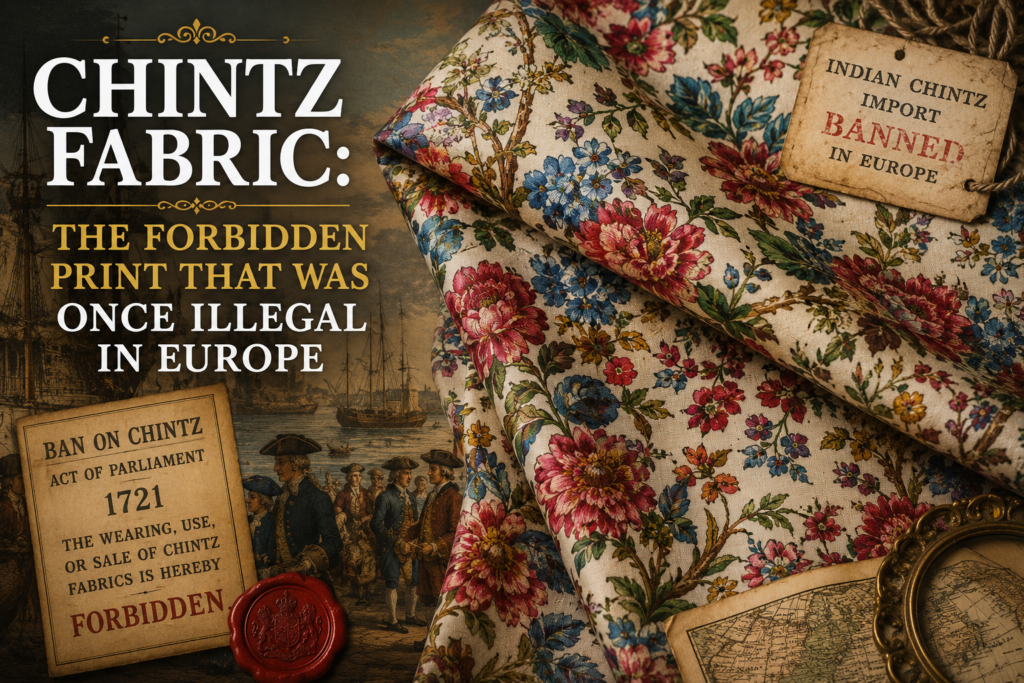
Chintz Fabric: The Print So Beautiful It Got Banned in Europe
What if a piece of fabric was so beautiful, so intoxicating, that it threatened to collapse entire economies? In the 17th and 18th centuries, a floral fever for a textile from India called chintz fabric gripped Europe. The obsession grew so wild that governments did the unthinkable: they banned it. People were fined, imprisoned, and in France, smugglers even risked being sentenced to forced labor on galley ships, all for a piece of printed cotton. This is the story of the forbidden fabric that people were willing to break the law for, and how it quietly conquered the world and your home.
The Marvel From the East
Before it was a criminal offense, chintz was a work of art. For centuries, artisans in India had perfected a craft that left the rest of the world in awe. The name itself comes from the Hindi word “chint,” meaning “spotted” or “variegated.” It refers to cotton cloth that was meticulously hand-painted or block-printed with vivid, intricate designs.
Now, imagine a world before synthetic dyes, where colors were fugitive things, bleeding and fading with every wash. While wealthy Europeans had colorful silks and velvets, most textiles were heavy wools and linens. Then, along the trade routes, came chintz. It was lightweight, breathable, and exploded with colors that seemed almost supernatural, bright reds, deep indigos, and sunny yellows, all locked into the cotton fibers.
The secret was a masterful understanding of chemistry that Europeans couldn’t replicate for centuries. Indian artisans used natural mordants, metallic salts that bind dye to fabric, and resist-dyeing techniques, like using wax, to create complex, multi-colored patterns that were miraculously colorfast. Wash after wash, the colors stayed brilliant. These weren’t just patterns; they were often stories told on cloth, frequently featuring a “Tree of Life” motif, sprawling with exotic flowers and birds that captured European fantasies of the East.
When the first pieces started arriving in Europe in the 16th century with Portuguese traders, and in greater numbers in the 17th century, they were astoundingly expensive and rare, luxuries reserved for the absolute wealthiest. They were used for grand bed coverings and wall hangings, transforming dark, drab European interiors. But that was just the beginning. Soon, this fabric would move from the walls of the wealthy to the backs of the masses, igniting a frenzy no one saw coming.
The Floral Frenzy
The obsession with chintz didn’t happen overnight. At first, it was a status symbol. But as these expensive furnishings wore out, they were often passed down to servants. In a stroke of genius, maids and working women began repurposing the old chintz into clothing, skirts, jackets, and petticoats. Suddenly, the fabric wasn’t just for decoration; it was fashion.
And the elite took notice. The lightweight cotton was a revelation compared to the stiff, heavy silks of the era. It was comfortable, feminine, and shockingly vibrant. What started as a discreet lining soon became the main event. Gowns, hats, and even men’s waistcoats were soon covered in dazzling Indian florals. At the Palace of Versailles, the heart of European fashion, the chintz craze reached a fever pitch, with courtiers parading in flowing floral gowns, a moment fashion historians still point to as one of the first true cross-class trend explosions in Europe.
Demand exploded. By the late 17th century, England, France, and the Netherlands were importing vast quantities of chintz annually. The East India Companies capitalized on the trend, even sending European pattern books to Indian artisans to create customized designs. Chintz became a major global fashion craze, worn by everyone from duchesses to dairy maids. It was a social equalizer; for the first time, people of all classes could wear the same vibrant patterns.
This floral fever was more than a trend; it was a revolution. Indian textiles, including chintz, were so valuable they were used as a currency to trade for spices in Southeast Asia. A simple piece of printed cotton was now shaping global commerce. But back in Europe, this beautiful fabric was about to make some powerful enemies.
The Backlash and the Ban
Not everyone was thrilled with the chintz craze. For the powerful wool and silk industries in France and England, it was a catastrophe. Weavers and mill owners watched in horror as consumers abandoned their fabrics for the cheaper, more fashionable Indian cottons. Their businesses were collapsing, and they were furious.
They began lobbying their governments, demanding protection. Pamphlets decried the fabric and the women who wore it, worrying that the widespread availability of “indiennes,” the French term for all Indian-style printed cottons, was blurring class lines. The economic and social anxieties boiled over, and governments decided to act.
France struck first. In 1686, Louis XIV declared a ban on the import, production, and wearing of most printed cotton textiles. The penalties were severe: fines, imprisonment, and for smugglers, the terrifying sentence of forced labor on naval galley ships.
England followed with its own series of laws, the Calico Acts, culminating in a strict 1721 ban on using most printed cottons for clothing and furniture. Other nations passed their own restrictions. An entire continent had effectively declared war on a piece of fabric. But as with any prohibition, making it illegal only made it more desirable.
Imitation and Industrialization
The bans, of course, didn’t work. A thriving black market kept Europe’s fashion-conscious supplied with forbidden prints. In France, the law was widely flouted, even by nobles at the royal court who defiantly continued to wear their favorite patterns. The demand was simply too strong. If Europeans couldn’t import it, they decided they would have to make it themselves.
This set off a frantic race of industrial espionage. For decades, European manufacturers had no idea how Indian artisans achieved such brilliant, colorfast dyes. French officials and missionaries in India became industrial spies, sending back detailed reports and fabric samples that broke down the complex, multi-step process.
Armed with this stolen knowledge, European mills began to produce their own versions. At first, they were poor imitations. These mass-produced copies often used inferior dyes and simpler patterns. It’s from these cheaper, gaudier versions that we get the modern word “chintzy,” a far cry from the fabric’s luxurious origins.
But this drive to imitate spurred incredible innovation. The quest to replicate Indian prints fueled the development of new technologies like copperplate and roller printing. By the time France lifted its ban in 1759 and England relaxed its own rules in the 1770s, their mills were ready. While it’s an overstatement to say it kickstarted the Industrial Revolution, the desire to copy Indian cotton was a powerful engine for mechanization in the textile industry.
This triumph of European industry had a devastating effect on the original creators. Over the next century, British policies actively dismantled India’s textile dominance, transforming it into a supplier of raw cotton for British factories and a market for their machine-made goods. The very artisans whose genius had captivated the world found their livelihoods destroyed.
The Legacy of a Forbidden Fabric
Though the chintz craze of the 18th century faded, the fabric never truly went away. Its DNA is woven into our modern world. The floral patterns that once caused riots are now a timeless staple of interior design and fashion.
In design, “chintz” came to describe the specific style of glazed, floral-printed cotton. Its quintessential English country house aesthetic was revived by brands like Laura Ashley in the 20th century. Today, it’s at the heart of the “Grandmillennial” style, a joyful rebellion against minimalist beige that embraces color and tradition on everything from armchairs to wallpaper, a resurgence that design and fashion editors have tracked closely as maximalism has made its comeback. High-fashion houses still use bold, chintz-inspired patterns in their collections, proving its enduring appeal.
The story of chintz fabric is a thread that connects us to a complex history of art, trade, and power. It’s a story of cultural exchange and appropriation, of incredible craftsmanship and ruthless industrialization. It began as a treasured Indian art form, became a global sensation, was outlawed as a threat to Western economies, and was ultimately reborn as a household name.
So the next time you see a floral pattern on a sofa, a dress, or wallpaper, take a closer look. You might be seeing the echo of a forgotten frenzy, a reminder that beauty can be powerful, revolutionary, and at one point in history, even illegal.
FAQ Section
What exactly is chintz fabric?
Chintz fabric is a glazed, floral-printed cotton textile that originated in India, traditionally made using hand-painting or block-printing with natural dyes that stayed vibrant wash after wash.
Why was chintz fabric banned in Europe?
Chintz fabric was banned in France in 1686 and later restricted in England through the Calico Acts because it threatened the domestic wool and silk industries, which couldn’t compete with its lower cost and vivid colors.
Where does the word “chintzy” come from?
The word “chintzy” comes from the cheaper European imitations of chintz fabric, which used inferior dyes and simpler patterns compared to the original Indian textiles.
Is chintz fabric still used today?
Yes, chintz fabric remains popular in interior design and fashion, especially within the “Grandmillennial” style, and continues to appear in high-fashion collections and home decor.
What makes chintz fabric different from other printed cottons?
What set chintz fabric apart historically was its use of natural mordants and resist-dyeing techniques, which created colorfast, multi-colored patterns that European manufacturers couldn’t replicate for centuries.