
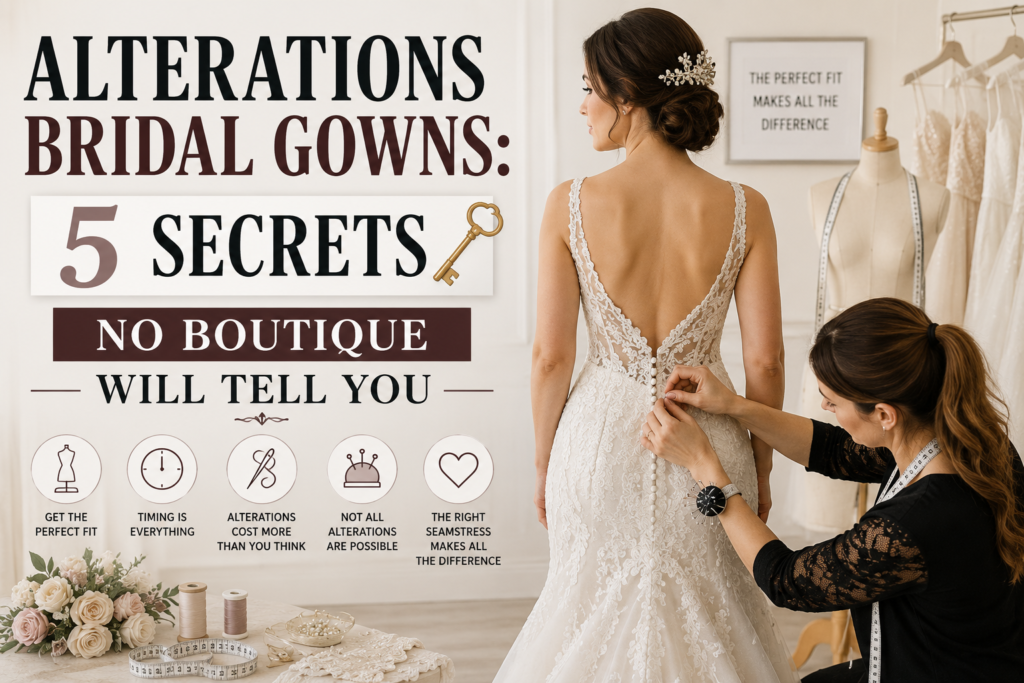
Alterations Bridal Gowns: What No One Tells You Before Your First Fitting
You said “yes” to the dress! You popped the champagne and took the pictures, but the boutique probably didn’t mention that the most critical part of your bridal look is only just beginning. It feels like there’s a conspiracy of silence around alterations bridal gowns, and it leaves way too many brides stressed, confused, and completely over budget. Boutiques are masters at selling the fantasy, but they often leave out the practical, sometimes painful, reality of making that fantasy fit perfectly.
This is your look behind the curtain at the hidden costs, surprising timelines, and crucial secrets most boutiques won’t tell you, so your dream dress doesn’t become a nightmare. The goal is walking down that aisle feeling confident, comfortable, and absolutely in control.
Secret #1: The True Cost Is Higher Than You Think
Let’s get right to it: money. When you bought your dress, did anyone hand you a detailed price list for alterations? Or was it more of a vague, “Oh, it’s usually a few hundred dollars”? This is where so many bridal budgets go to die.
The truth is, in many areas, standard alterations can land somewhere between $300 and $700. But that’s just the starting line. If your gown has delicate lace, heavy beading, or layers upon layers of fabric, it’s realistic to see that cost climb into the $700 to $1,500 range, or even higher.
Here’s why. Every single adjustment is its own charge. Hemming the length isn’t a flat fee. A simple satin hem is one price, but a scalloped lace hem that has to be removed, shortened, and perfectly stitched back on by hand? That’s a whole different level of labor and cost. Taking in the sides of a simple crepe dress is one thing, but taking in a corseted bodice with boning means a seamstress has to deconstruct and then rebuild a huge portion of the dress. That’s not a quick snip; it’s hours of skilled work.
Then come the hidden costs. A bustle often costs more if it needs extra points, so a cathedral train can be much pricier than a simple one. Final pressing and steaming may also add up to $100. The boutique price is only the starting point, much like the broader trend explained in how wedding industry pricing has evolved beyond the initial gown cost. As a rule of thumb, budget an extra 15% to 20% of your gown’s price for alterations, though the final cost depends on the dress and the work it needs.
Secret #2: The Shocking Timeline You Can’t Ignore
Alright, let’s talk about the one thing you can’t buy more of: time. You can’t just drop your dress off a month before the wedding and expect a miracle. The gold standard for a proper alterations bridal gowns timeline is between 8 and 12 weeks. That’s two to three full months before your wedding day, which shocks a lot of brides who think it’s a quick, two-week job. Here’s why that assumption is so dangerous.
Your alterations will happen over two or three separate fittings, each spaced weeks apart. At the first fitting, the big work gets pinned, taking in the bodice, adjusting straps, and marking the hem. Your seamstress then needs several weeks for that foundational work. At your second fitting, you’ll check her work and fine-tune the fit. This is also when the bustle usually gets designed. Then, she needs another few weeks for those adjustments. Your final fitting is typically one or two weeks before your wedding for tiny tweaks and the final check.
This schedule is your safety net. What if the fit is still off? What if the beading is more complicated than expected? That 8-to-12-week window builds in a buffer. If you wait until six weeks before your wedding, you’re entering the danger zone. You’ll likely be hit with a “rush fee,” which can hike your bill by 20% to 50%. Even worse, a good seamstress might not be able to fit you in at all, especially during peak season.
And this master timeline starts way earlier. To safely hit that three-month alterations window for a made-to-order gown, you need to have bought it 9 to 12 months before your wedding, since it can take 4 to 6 months just for the dress to arrive from the designer. Of course, if you buy off-the-rack, your timeline is much faster, but you still need to secure that 8-12 week spot with a seamstress.
Secret #3: Your Dress Size Is Just a Number
This next secret is one worth shouting from the rooftops for every bride to hear. Your bridal gown size is just a starting point. It is not a reflection of your body. It’s an industry reality that the vast majority of wedding dresses require alterations to get that perfect “made-for-you” fit. It doesn’t matter if you’re a size 2 or a size 22; off-the-rack gowns are made for a standard model, not for your unique proportions. It is incredibly rare for anyone’s bust, waist, and hips to perfectly match a designer’s chart.
So when your dress arrives and it’s too long, or it gapes at the bust, or feels too snug in the hips, please, hear this: do not let that little voice in your head tell you something is wrong with your body. Nothing is wrong with you. The standardized sizing system is what’s imperfect. Alterations exist to customize that standard pattern to your exact figure.
Think about it: designers make wedding dresses extra long to fit the tallest brides in heels, so nearly everyone needs a hem. They also leave the straps long because shortening them is much easier than lengthening them. This is all by design. The dress isn’t supposed to be perfect yet. Alterations aren’t a “fix” for a problem; they are the final, essential step in creating your gown. Your seamstress is a sculptor. She’ll take in the waist, add cups for support, and adjust the straps until the gown looks like it was made just for you.So, release the pressure. Your size is just a number on a tag; the fit is what truly matters.
Secret #4: What You Must Bring to Every Single Fitting
Your boutique will tell you to bring your shoes and undergarments to your fittings. But they might not communicate how serious this is. This isn’t a suggestion; it’s a non-negotiable rule. Here’s why: every single millimeter matters. You have to bring the exact shoes and the exact undergarments you’re wearing on your wedding day to every single fitting, starting with the very first one.
Let’s talk shoes. The hem is pinned to a super precise length based on your heel height. If you bring 3-inch heels to the first fitting but later decide to wear 2.5-inch heels, your dress will be too long and you’ll be tripping on it all night. If you switch to a higher heel, it’ll be too short. Changing shoes mid-stream could mean redoing the entire hem, costing you time and money.
Undergarments are even more critical. Your shapewear or bra literally changes the map of your body. A push-up bra versus a stick-on cup creates a completely different shape for the bodice. Shapewear can smooth your hips and waist by an inch or more. The seamstress is fitting the dress to the body you have in that moment. If you show up to your second fitting in different undergarments, all her work on the bodice might be for nothing. The dress could suddenly be too loose or way too tight.
For your final fitting, bring your accessories: your veil, your belt, your jewelry. This is your final dress rehearsal. Does your bracelet snag the fabric? Does your necklace clasp interfere with the back of the dress? Seeing the complete look is your last quality-control check. Don’t just bring parts of the vision; bring the whole thing.
Secret #5: The Bustle Is a Bigger Deal Than You Think
In the boutique, everyone fawns over that dramatic, gorgeous train. But no one really tells you what to do with it during a five-hour reception filled with dancing and mingling. And that brings us to the last secret: the bustle is a feat of engineering, and getting it wrong can absolutely ruin your night. A bustle is simply the system of hooks, buttons, or ribbons used to lift your train off the floor, a construction detail rooted in historical dress design that carries directly into modern bridal wear. Of course, you can skip this step entirely if your dress is short or doesn’t have a train.
But if your dress has a train, remember that not all bustles are created equal. The right style depends on your dress’s fabric, weight, and train length. A simple one-point bustle might be fine for a light chiffon train. But a heavy satin cathedral train? That might need a complex, multi-point under-bustle to distribute the weight evenly. If the bustle is too weak for the dress, hooks will pop, buttons will break, and you’ll spend your own party dragging a dirty, torn train or carrying a wad of fabric in your arms.
You need to have a direct conversation about this. Ask your seamstress, “Is this bustle strong enough to hold up while I’m dancing?” And at your final fitting, bring your maid of honor or whoever will be helping you. Make them practice bustling the dress several times. Have them take a video on their phone so they remember how the puzzle works. A panicked bridesmaid fumbling with invisible loops in a dimly lit hall is a recipe for stress. Don’t do that to her. Once it’s bustled, test it. Walk, sit, do a little dance. Make sure it feels secure. The bustle isn’t just an afterthought; it’s your ticket to freedom on the dance floor.
Bringing It All Together
So, let’s run through these secrets one more time. First, your alterations cost is a real, separate budget item. Second, that 2-to-3-month alterations timeline is your best friend. Third, dress size is just a starting point, so don’t let it mess with your head. Fourth, bringing your exact shoes and undergarments to every fitting isn’t optional. And finally, your bustle needs to be strong enough to survive the party.
The world of alterations bridal gowns can feel like a mystery, but it doesn’t have to be stressful. Going in with your eyes wide open means you can ask the right questions, create a realistic budget, and manage your timeline like a pro. This whole process is about transforming a beautiful dress into your perfect dress.
FAQ Section
How much do alterations bridal gowns typically cost?
Standard alterations bridal gowns usually cost between $300 and $700, though gowns with lace, beading, or heavy fabric can push that range to $700–$1,500 or more.
How far in advance should you book bridal gown alterations?
The ideal window for alterations bridal gowns is 8 to 12 weeks before the wedding, spread across two to three separate fittings.
Why does my wedding dress size feel different from my regular size?
Bridal sizing differs from everyday clothing, and most gowns need alterations regardless of size because designers cut them for a standard form rather than an individual body.
What should I bring to a bridal gown fitting?
Bring the exact shoes and undergarments planned for the wedding day to every fitting, and bring accessories like a veil or jewelry to the final fitting.
How does a bustle work on a wedding dress?
A bustle uses hooks, buttons, or ribbons to lift the train off the floor after the ceremony, and the right style depends on the dress’s fabric, weight, and train length.