All the Ear Piercing Names You Need to Know Before Your Next Appointment
So you want a new ear piercing. You go online for inspiration, and suddenly you’re drowning in words you’ve never heard of. What on earth is a rook? Where does a snug even go? Is a daith different from a tragus? It can be seriously overwhelming, which is exactly why sorting out all the ear piercing names in one place makes the whole process so much easier.
This guide walks you through every ear piercing out there, explained simply. By the end, you’ll be able to walk into any piercing studio with total confidence and know exactly what to ask for.
Understanding the Two Main Types of Ear Piercings
The world of ear piercings really breaks down into two main categories: piercings on the soft, fleshy lobe, and piercings in the harder cartilage that shapes the rest of your ear.
Lobe piercings are famous for being less painful and healing more quickly. Cartilage piercings, on the other hand, take a bit more commitment but open up a world of creative styling. Below, we’ll work our way around the entire ear, covering placement, pain, healing, and the best jewelry for each spot.
The Foundation: Lobe Piercings
Let’s start with the most classic placement of all: the lobe. This is the soft, fleshy part at the bottom of your ear, and it’s pretty much the perfect starting point for anyone’s piercing journey.
Standard Lobe Piercing
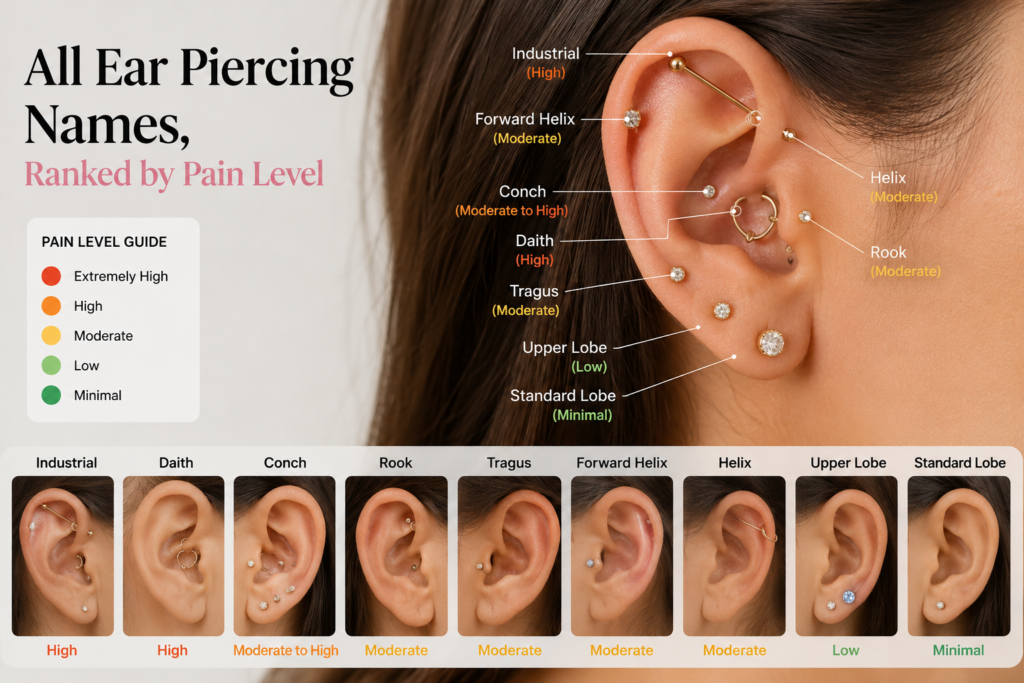
This is the one most people get first, placed right in the thickest part of the earlobe. In terms of pain, it’s about as low as it gets — more of a quick, sharp pinch than anything else. Healing is also the fastest of any ear piercing. It can feel healed in about 6 to 8 weeks, but the inside can take several months to fully strengthen before you should be changing jewelry all the time. For styling, the sky’s the limit. Studs, hoops, and dangly earrings all look great here, making it the perfect anchor for any ear design.
Upper Lobe Piercing
Move a little higher up the lobe, but still in that soft tissue, and you’ve got the upper lobe piercing. Since you’re getting closer to where cartilage starts, the pain might feel a slight step up from the standard lobe. Healing is also a bit longer, often taking 3 to 5 months. Upper lobe piercings are perfect for creating a “stacked” or “constellation” look. A popular style is to place two or three piercings in a row, often with jewelry that gets smaller as it goes up the ear.
Stacked Lobe Piercing
This isn’t one specific placement but a style where you intentionally cluster two or more piercings on the lobe. Often, a second piercing is placed directly above an existing one to create a vertical “stack.” It’s a modern way to add detail to your lobe without moving into cartilage. Pain is similar to an upper lobe piercing, but healing can sometimes take longer — up to 4 months or more — if the piercings sit very close together, since there might be more swelling.
Transverse Lobe Piercing
Here’s a more unique one. Instead of piercing from front to back, the transverse lobe piercing goes horizontally through the lobe tissue using a barbell. Because of the longer channel through the tissue, healing can be trickier and take longer than a standard lobe piercing, often 2 to 10 months. Pain is usually low, similar to other lobe piercings, but it requires a very skilled piercer to get the angle just right.
The Outer Edge: Cartilage Piercings
Now we’re moving up into the cartilage, the firm tissue that gives your ear its shape. The single most important thing to remember with all cartilage piercings is that they take a lot longer to heal, since cartilage doesn’t have as much blood flow. We’re talking 6 to 12 months, and sometimes even longer, so patience is key.
Helix Piercing
The helix is one of the most popular cartilage piercings and refers to any piercing on the curled outer rim of your ear. When it comes to pain, most people find it manageable — a sharp pinch that fades quickly. For initial healing, piercers almost always recommend a flat-back stud, since hoops can cause irritation and bumps on a fresh piercing. Once fully healed, in about 6 to 9 months, a hoop looks amazing. You can also get double or triple helix piercings for a beautiful ladder effect.
Forward Helix Piercing
Follow the rim of your ear forward toward your face, and you’ll find the forward helix, the bit of cartilage right above your tragus. The space is smaller, so the pain can feel a little sharper for a second. Healing again falls in that 6-to-9-month window. Because of the tiny space, this spot is perfect for delicate studs, and a double or triple forward helix creates a really striking cluster.
Auricle Piercing
Sometimes called a mid-helix, the auricle sits on the outer rim of the ear, but lower down than a standard helix — about halfway between your lobe and the top of your ear. The pain and healing are very similar to a helix piercing, with a healing period of 6 to 9 months. It’s a great placement to bridge the gap between your lobe piercings and your upper helix.
Tragus Piercing
The tragus is that little flap of cartilage right in front of your ear canal, and it’s a hugely popular spot. According to Byrdie, the cartilage here is thick enough that pain is often described as a quick, intense pressure rather than a sharp sting. Healing can take anywhere from 6 to 12 months. A tiny stud is the best choice while it heals, and you can switch to a snug hoop later on. Just remember to avoid earbuds in that ear while it’s healing, to prevent irritation.
Snug Piercing
The snug is one of the most unique and bold piercings out there. It’s a horizontal piercing through the inner ridge of cartilage that sits between the outer rim and the inner ear. Because it goes through a thick, sensitive area, it’s known for being one of the more painful piercings. It’s also notoriously tricky to heal, often taking a year or more, and your ear needs a prominent enough ridge to even get this piercing in the first place.
The Inner Ear: More Cartilage Options
Let’s venture deeper into the inner folds of the ear. These piercings are often show-stoppers and create amazing focal points.
Conch Piercing
Named after a conch shell, this piercing sits in the large, cup-shaped area in the center of your ear. You can get an inner conch, in the middle of the “bowl,” or an outer conch, closer to the rim. Pain is usually moderate for a cartilage piercing, and healing takes 6 to 12 months. The inner conch is perfect for a statement stud, while a healed outer conch is where you can wear a large hoop that wraps spectacularly around the outside of your ear.
Rook Piercing
The rook is a vertical piercing that goes through the ridge of cartilage in your upper inner ear, right above the daith. It’s a very cool, striking placement. Because it goes through a thick fold of cartilage, the pain is often rated on the higher side. Healing takes a solid 6 to 12 months, and sometimes longer. The classic jewelry is a curved barbell, which lets the decorative ends peek out from the top and bottom of that cartilage fold.
Daith Piercing
A daith piercing sits on the innermost fold of cartilage just above the opening to the ear canal. When done right, the entry and exit holes are hidden, making it look like the ring is emerging directly from your ear. Pain is often described as a unique, dull pressure, and like other inner cartilage piercings, it can take 6 to 12 months to fully heal. It looks beautiful with snug hoops and decorative clicker rings, and just like the tragus, you’ll have to skip the earbuds during healing.
Flat Piercing
Just like the name suggests, this piercing goes through the flat, wide area of cartilage in the upper ear. Pain is relatively moderate for cartilage, and healing time is typically 6 to 9 months. This spot is the perfect canvas for showing off more elaborate decorative studs, like clusters, gems, or floral designs, since there are no folds to get in the way.
Anti-Tragus Piercing
Directly opposite the tragus is a small fold of cartilage above the lobe, and that’s where the anti-tragus goes. It’s a less common but very cool placement that beautifully mirrors a tragus piercing. Pain is often on the higher side, and you can expect a healing time of 6 to 12 months. Small studs or tiny curved barbells usually work best here.
Specialty Piercings That Combine Two Points
Finally, there are a couple of piercings that are in a league of their own, connecting two separate holes with a single piece of jewelry.
Industrial Piercing
The industrial is one of the most dramatic ear piercings out there. It’s made of two separate piercings through the upper cartilage — often a helix and a forward-facing helix — connected by a single long barbell. Because it’s two cartilage piercings trying to heal at once, the pain can be intense, and the healing is long and complicated, often taking 9 months to a year or more. Your ear anatomy is critical here, since the bar needs to sit perfectly without pressing on the flat of your ear, so always get this done by a highly skilled piercer.
Orbital Piercing
An orbital is similar to an industrial, since it also involves two piercings, but they’re connected by a hoop instead of a bar. This can be done almost anywhere, from the lobe to the helix. For example, two helix piercings could be connected by one ring. The pain and healing depend entirely on the location — a lobe orbital heals much faster than a cartilage orbital, which can take up to a year.
Anatomy and Aftercare Tips to Remember
Not every piercing will work for every ear. For piercings like a rook or a snug, you need a prominent enough fold of cartilage. For an industrial, the curves of your ear must align perfectly. A great professional piercer will always look at your anatomy first and tell you honestly what will and won’t work, so it’s worth listening closely to that advice.
The healing times mentioned throughout this guide are estimates. Cartilage can take a very long time to heal on the inside, even when it looks fine on the outside. As Refinery29 notes in its piercing coverage, gentle, minimal aftercare tends to work best. Be patient, clean your piercing with a sterile saline solution, and try not to sleep on it. Don’t over-clean it, don’t use harsh chemicals, and don’t twist the jewelry — that’s outdated advice.
And there you have it: a complete tour of the ear, from the simplest lobe to the most complex industrial. With over 15 different piercings covered, you should now feel ready to choose your next piece of ear art with total confidence.
FAQ Section
What are all the ear piercing names in order from least to most painful?
Generally, lobe piercings hurt the least, followed by helix, forward helix, tragus, and conch. Rook, snug, daith, and industrial piercings tend to rank as the most painful, since they go through thicker cartilage.
How long does it take to learn all the ear piercing names and placements?
Most people pick up the basics quickly once they see a diagram, since the names correspond to specific anatomical spots on the ear like the lobe, helix, tragus, and conch.
Which ear piercing heals the fastest?
The standard lobe piercing heals fastest, often in 6 to 8 weeks, since it’s soft tissue with good blood flow.
Can I get multiple cartilage piercings at once?
It’s possible, but many piercers recommend spacing them out since healing multiple cartilage piercings at the same time can increase swelling and complications.
What jewelry is best for a first cartilage piercing?
A flat-back stud is usually recommended for new cartilage piercings, since hoops and rings can snag and irritate the area while it heals.