The Women’s Car Coat: The Most Versatile Coat You’ll Ever Own
This might look like just another stylish coat. But its most important design feature — its length — was never actually a fashion choice. It was a practical solution to a dirty, dangerous problem that no longer exists.
The women’s car coat is one of the most versatile pieces you can own. It handles that awkward in-between weather perfectly. It looks sharp in the office, yet relaxed enough for the weekend.
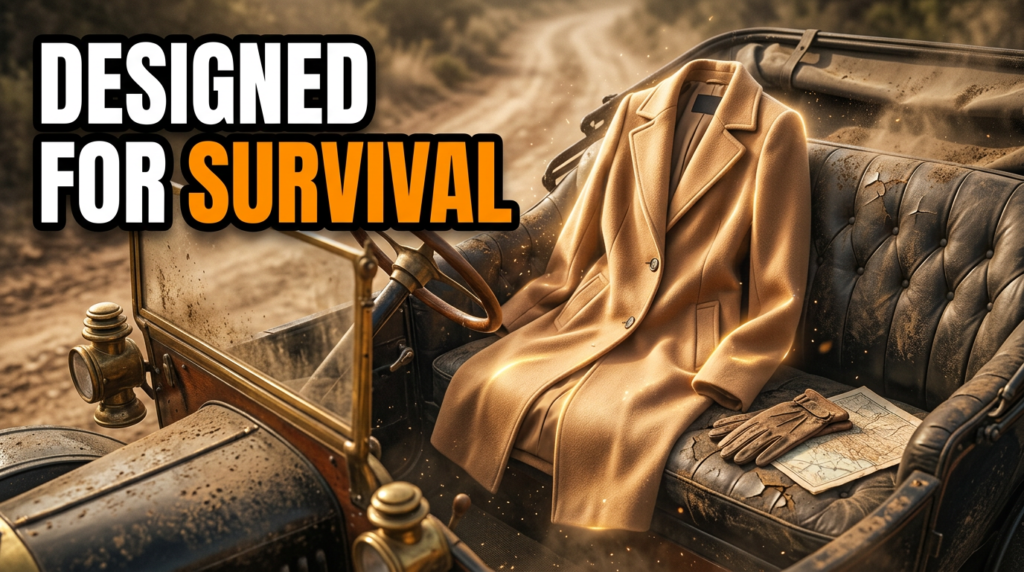
But here is the thing. Its famous length — that neat mid-thigh cut — was not designed for style. It was engineered for survival. To understand why this coat works so well today, we need to go back in time. Back to open roads, open-top cars, and a whole lot of dust.
The Original Problem That Created the Women’s Car Coat
Picture the world at the turn of the 20th century. The horse-and-buggy era was ending. A new mechanical beast was taking over: the automobile.
Between 1900 and 1920, the number of cars in America exploded. It went from just a few thousand to over eight million. However, these were not the comfortable, sealed vehicles we drive today.
Driving Was an Outdoor Sport
The first cars were loud, temperamental, and wide open to the elements. Think less of a cosy cabin and more of a powered carriage. Most had no roof, no doors, and absolutely no heating. Driving was not a commute — it was an outdoor adventure for the rich and daring.
The roads were just as rough. In fact, the vast majority were unpaved dirt and gravel. Every trip kicked up enormous clouds of dust, mud, and grit. On top of that, early cars leaked oil and mechanical fluids constantly. You were not just driving — you were sitting in the middle of a filthy, chaotic whirlwind.
The First Solution: Cover Everything
Protecting expensive clothing was not about style. It was an absolute necessity. So, the first solution was logical: cover everything.
In winter, drivers wore monstrously heavy coats made of thick fur — raccoon, sheepskin, or heavy fur-lined wool. In summer, they switched to long, lightweight “duster” coats made of linen or canvas. These were designed simply to keep road grime off their clothes.
The uniform of the early motorist was goggles, gloves, and a coat that was basically a wearable blanket. It was practical, but also incredibly cumbersome. There had to be a better way.
The Accidental Genius Behind the Mid-Thigh Length
As the 1920s roared on, cars began to change. Enclosed and semi-enclosed bodies appeared, offering more protection from the weather. However, this created a brand new problem.
Those long, floor-length dusters and fur coats became a serious nuisance. Getting in and out of a car with actual doors was difficult. Moreover, the long hems bunched around the driver’s legs and tangled with the pedals. They were a genuine hazard.
The Perfect Compromise
The world needed a new kind of coat. It had to be long enough to protect you while seated. But it also needed to be short enough to give you full freedom of movement. So, out of pure function, the modern car coat was born.
Its defining feature was its length — a perfect compromise forged by circumstance. The coat was cut to end at the mid-thigh. This was the stroke of accidental genius.
When you stood up, it was a handsome three-quarter length coat. But when you sat down in the driver’s seat, the hem fell right to your knees — covering your lap and protecting your clothes from dirt and drafts. Crucially, it was short enough that it never bunched up or got tangled in the pedals.
Design Details Refined for Driving
The length was just the beginning. In fact, the whole design was refined for the act of driving. Many early car coats featured a subtle A-line shape — slightly wider at the hem — to allow more movement.
Wide raglan sleeves, which connect at the collar rather than the shoulder, gave drivers an unrestricted range of motion for steering. Collars were tall and designed to flip up against the wind. Pockets were large and deep, perfect for holding maps or gloves.
As enclosed cars with heaters became the norm, heavy wools gave way to lighter materials. By the 1930s, suede and softer fabrics had taken over. The coat had become shorter, lighter, and more tailored. And in solving a purely practical problem, it accidentally created a silhouette that was balanced, flattering, and incredibly versatile.
“The function had created a form that would long outlive the function itself.”
How the Car Coat Became a Fashion Icon
For its first few decades, the car coat was tied directly to the automobile. Owning one was a status symbol. It meant you probably owned a car, which placed you at the very front of modernity and wealth.
But as car ownership spread, the coat took on a life of its own. It stepped off the road and into everyday culture.
As Harper’s Bazaar notes in its guide to classic outerwear, the car coat’s journey from functional garment to cultural icon is one of fashion’s most fascinating stories. Few pieces have managed to cross that boundary so cleanly.
Why the Women’s Car Coat Still Works in 2026
So why, after more than a hundred years, is this coat still so relevant? Why do designers from Burberry to The Row continue to produce it season after season?
The answer goes back to that original, accidental length. The mid-thigh cut — perfected for sitting in an early car — also happens to be the most versatile length for a modern coat.
The Perfect In-Between Length
It is long enough to wear over a suit jacket or blazer without the tail peeking out awkwardly. So, it works perfectly for the commute and the office. But it is also short enough that it does not feel as formal as a full-length overcoat. As a result, it looks just as good with jeans and a jumper on the weekend.
It strikes the ideal balance between a jacket and a coat. It offers more protection than a short jacket. Moreover, it gives more freedom and a more relaxed feel than a long overcoat. This makes it the perfect transitional piece for unpredictable spring and autumn weather.
Clean Lines, Timeless Confidence
The beauty of the women’s car coat lies in its clean, minimal lines. It is typically single-breasted with a simple button front, a straight collar, and unfussy pockets. The garment is defined by its structure, not by excessive detailing.
That restraint is exactly what gives it such a timeless, confident feel. When you put on a well-fitting car coat, it instantly frames your body. It makes any outfit look more intentional and put-together — without trying too hard.
The Quiet Luxury Coat of the Moment
Today, the women’s car coat sits at the heart of “investment dressing” and the quiet luxury movement. Its unfussy design means it never really goes out of style. A well-made version in wool, cashmere, or durable cotton blend is something you can wear for years — even decades.
As Elle’s edit of the best women’s coats consistently shows, the car coat remains one of the top recommended styles for everyday wear. It adapts to trends without being defined by them.
A Coat Designed by Accident, Perfected by Time
The story of the women’s car coat is a perfect example of accidental genius. It started as a purely functional object, born to solve a very specific problem: staying clean and comfortable while driving a primitive, open-air machine.
Its defining length was not a matter of aesthetics. It was a matter of inches, dictated by the relationship between a seated person and a new technology. And yet, in solving that one problem, it created a silhouette so well-balanced and adaptable that it has remained a wardrobe staple for over a hundred years.
Our cars are now sealed, climate-controlled bubbles. The original problem is long gone. But the solution remains — because it accidentally answered a much more timeless question: what do you wear when you want to look sharp, feel comfortable, and be ready for anything?
The car coat is not just an outerwear choice. It is a piece of design history. It carries the story of the automobile’s birth, the rise of suburban life, and the enduring power of smart, practical design.
Women’s Car Coat — Your Questions Answered
What is a women’s car coat?
A women’s car coat is a structured mid-thigh length coat, originally designed for motorists in the early 20th century. Its hem sits just above the knee when you sit down. As a result, it protects your outfit while keeping your legs completely free. Today, it is one of the most versatile styles of outerwear available.
What is the difference between a car coat and a regular coat?
The key difference is length. A car coat ends at the mid-thigh, which places it between a short jacket and a full-length overcoat. This makes it more flexible than either option. Moreover, it typically features a clean, minimal design with raglan or set-in sleeves and a straight collar.
How do you style a women’s car coat?
A women’s car coat works with almost everything. Wear it over a blazer and trousers for the office. Layer it over jeans and a knit for casual weekends. It also pairs beautifully with midi dresses and ankle boots for a more elevated look. Because of its clean lines, it makes every outfit look more polished.
What is the best fabric for a women’s car coat?
Wool and cashmere blends are the most popular choices for a classic, warm car coat. Cotton gabardine works well for lighter, transitional weather. However, if you want a more casual option, a cotton-nylon blend offers easy care and water resistance.
What colours work best for a women’s car coat?
Camel is the most iconic and versatile choice. Navy, black, and off-white also work extremely well because they pair with almost every colour in your wardrobe. For a bolder option, deep burgundy and forest green have become popular in recent seasons.
Is a women’s car coat worth investing in?
Yes. A well-made women’s car coat in a classic colour and quality fabric is one of the best outerwear investments you can make. Because its design is timeless, it does not go out of style. Moreover, its versatile length works across casual, smart-casual, and professional outfits equally well.
Is a women’s car coat good for petite figures?
Yes, the mid-thigh length is actually very flattering on petite frames. Unlike a full-length coat, it does not overwhelm a shorter figure. In fact, it creates the illusion of longer legs. A single-breasted, straight-cut version works especially well for petite body types.